
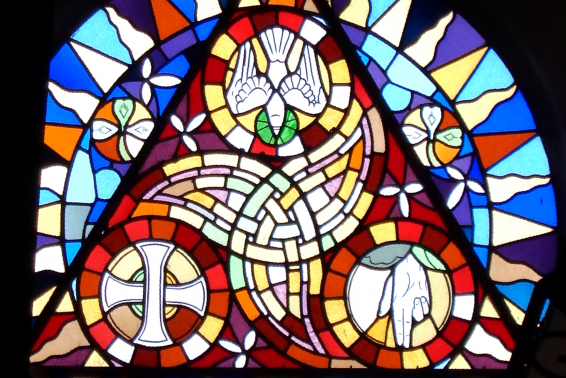
In the last blog, I talked about how we as Christians are united. I also mentioned there is a line, a doctrinal line, between orthodox Christianity and cults. One of the essential doctrines that set apart Christianity from cults is the Trinity, so I thought I’d look at there here.
Definition
The trinity doctrine is described like this: In the nature of the one true God there are three divine Persons, God the Father, God the Son, and God the Holy Spirit. The three Persons are the one true God. But, where do we find this in Scripture? Here are some passages:
The Father is God: Gal. 1:1
The Son is God: Heb 1:8
The Holy Spirit is God: Acts 5:3-4
Yet there is only one God: Isa. 44:6; Acts 2:24.
Three persons are called God, yet there is only one God. Therefore the three Persons are the one God. It’s defined as simply as that.
Within the trinity, the Son and Holy Spirit are submissive to the Father. They are not inferior in any way except positionally. Their submission is voluntary. We’ll look at that more when we look at the deity of Christ in a future post.
Some History
Throughout church history there have been disagreements on this doctrine. Mostly the arguments centered around the deity of Christ. For now, just understand the orthodox (standard) belief was that Jesus is God, equal to the Father.
The trinity has always been understood within Christianity. Look at how early the trinity appears in Christian writings. Polycarp, the Bishop of Smyrna, a disciple and coworker with the Apostle John for years, wrote this: ” I have collected these things, when they had almost faded away through the lapse of time, that the Lord Jesus Christ may also gather me along with His elect into His heavenly kingdom, to whom, with the Father and the Holy Spirit, be glory for ever and ever. Amen.
So, not only does the trinity appear in Scripture but also in the writings of the early church.
There have been several misunderstandings concerning the trinity and how it works however.
Modalism: This idea was championed by a guy named Sabellius who died around 215 a.d. The belief didn’t die with him, though. It continued for several centuries and still appears in sects like the United Pentecostal Church. This is the belief that God is just one Person who wears three hats. There are two major forms of this. The first is dynamic modalism where one believes God acted as the Father in the Old Testament times, as the Son when Jesus walked the earth, and as the Holy Spirit today. Static modalism, the second major form, says God acts as the Father in His creation, as the Son in redemption, and as the Holy Spirit in our sanctification. This doctrine was attractive to early believers since it solved the problem of three Persons but one God.
Tritheism: This is the belief that the trinity is actually three separate gods. It was briefly the teaching of Dionysius the bishop of Alexandria (d. 264 a.d.) trying to disprove the Sabellian heresy. The church pointed out his error. He then admitted his error and returned to orthodoxy. Mormons believe a form of Tritheism.
Arianism: This doctrine is named after Arius of Alexandria (c. 250-336 a.d.). Arianism is the teaching which brought about the Nicene Council (325 a.d.) which issued the Nicene Creed.
Arianism is the belief that only the Father is God. The Son is His first and greatest creation through which He created the universe. Normally, very little attention is paid to the Holy Spirit, but some Arians believe He is just God’s force. Many in the early Eastern church believed God could not be involved with matter. This solved that problem by teaching it was not God but His creation (Jesus) which created matter. Jehovah’s Witnesses are modern day Arians.
The church’s orthodox stand on the trinity was not officially and fully settled until the Council of Nicaea in 325 a.d. though, as I said above, it was believed much earlier. Brave men stood strongly and boldly against the misinterpretations of this doctrine. Athanasius (300-373) Bishop of Alexandria, spent most of his life combating Arianism. Arianism was a huge threat to orthodox theology for several centuries. Even at age 25, Athanasius was a major player at the Council of Nicaea but suffered exile five times throughout his life for defending the Nicene Creed and the trinity doctrine it presented.
So, while the trinity may be a little hard to understand, it is clear from Scripture that God exists in three divine Persons, Father, Son, and Holy Spirit yet is one holy and everlasting God.
Why is this important?
Knowing God better is always important, and understanding Who and What He is adds to that. Also, God is triune and chooses to exist that way. He is a God Who is communal. Maybe that’s why He made us. I’m sure that’s why He encourages us to gather in families, friends, and churches. The more we understand God, the easier it will be to relate to Him.
 Believers Armed and Dangerous
You write:
Please define “cult,” and would you call Judaism a cult because it doesn’t affirm a Trinity?
You also write:
Not so fast. Logical contradictions cannot be true under any circumstance, and that includes biblical teaching. If your doctrine entails contradictions, then it follows that the Bible does not, indeed cannot, teach the Trinity.
Your definition is contradictory on its face, for if each “person” is God and if each person is different from the other persons, then you have three gods, not one. If by “God” you mean a composite unity, then by definition each person is but fractionally God and not fully God which of course contradicts your assertion that they are God. Finally, if each person has the “nature” of divinity akin to you and I having a human nature, then you’ve asserted tritheism. Two persons having the human nature are two humans. Ergo, two persons having the God nature are two gods.
Now, I’m perfectly willing to defend my statements both logically and respectfully, but I’ve found that most trinitarians will delete my posts or block them when they find that they’re unable to rationally defend the Trinity. If you would like to discuss the matter, I ask that you commit to not blocking or deleting my posts so long as I remain respectful.
<>
Hi,
Sorry I’ve taken so long to reply. I just needed to spend some time with my wife. Family first, of course.
Of course, I agree with your statement that logical contradictions cannot be true under any condition (the First Law of Logic is the Law of Non-Contradiction: “A cannot be Non-A at any time, way, and under the same conditions”), so I’m with you on that. I don’t believe the trinity doctrine contains logical contradictions, though. I’ll take your claims one at a time:
First, your claim; “Your definition is contradictory on its face, for if each ‘person’ is God and if each person is different from the other persons, then you have three gods.”
I don’t agree with your premise my claim is contradictory. We have examples in nature of one being being three persons without being three beings. People with multiple personalities, for instance, are multiple persons without being multiple beings. True that is a mental disorder, but it may not be for God. Also, your comment involves an alleged logical contradiction not whether it was an illness. So, following the logic, it is perfectly logical to assume one being can be three persons of different personalities. A true premise should include things as they are, not as we wish them to be. My belief, therefore, is not contradictory on its face. It may seem contrary, but it’s not.
Your next comment went like this: “If by ‘God’ you mean a composite unity, then by definition each person is but fractionally God and not fully God which of course contradicts your assertion that they are God.”
The Trinity doctrine does not claim a composite unity but a triunity. An example of this would be the dimensions of a cube. While you have three different dimensions, height, width, and depth, all three share the same nature even though they are different in function. The composite unity like an egg for example, three parts (shell, white, and yoke) making up a single entity. While removing one facet of the egg would still leave the other two. Like the trinity doctrine, removing one dimension of a cube would eliminate the other two. They are different in some ways, share the same nature, and would not exist as God were one to cease to exist. Composite unity is not the trinitarian claim.
Your third comment said, “Finally, if each person has the ‘nature’ of divinity akin to you and I having a human nature, then you’ve asserted tritheism. Two persons having the human nature are two humans. Ergo, two persons having the God nature are two gods.”
I wouldn’t agree that God’s nature can be compared, “akin”, to human nature. The very idea of God being what philosophers define as, “That of which there can be nothing greater,” would seem to exclude the comparison or equation. They are not the same. If God is as the Bible and human philosophy present Him (omnipotent, for instance), then He is perfectly capable of existing in any form He wishes.
I’m not quite sure why you included your final paragraph, so I’ll leave that for other readers to decide..
Thank you for your input.
LikeLike
Hi,
Sorry I’ve taken so long to reply. I just needed to spend some time with my wife. Family first, of course.
I agree with your statement that logical contradictions cannot be true under any condition (the First Law of Logic is the Law of Non-Contradiction: “A cannot be Non-A at any time under the same conditions”), so I’m with you on that. I don’t believe the trinity doctrine contains logical contradictions. That seems to be the theme of your comment, so I’ll take your claims one at a time:
First, your claim; “Your definition is contradictory on its face, for if each “person” is God and if each person is different from the other persons, then you have three gods.”
I don’t agree with your premise my claim is contradictory. We have examples in nature of one being being three persons without being three beings. People with multiple personalities, for instance are multiple persons without being multiple beings. True that is a mental disorder, but it may not be for God. Also, your comment involves an alleged logical contradiction not whether it was an illness. So, following the logic, it is perfectly logical to assume one being can be three persons of different personalities. I think your premise is faulty there. A true premise should include things as they are, not as we wish them to be. My belief, therefore, is not contradictory on its face. It may seem contrary, but it’s not.
Your next comment went like this: “If by ‘God’ you mean a composite unity, then by definition each person is but fractionally God and not fully God which of course contradicts your assertion that they are God.”
The Trinity doctrine does not claim a composite unity but a triunity. An example of this would be the dimensions of a cube. While you have three different dimensions, height, width, and depth, all three share the same nature even though they are different in function. The composite unity you claim is what an egg might be, three parts (shell, white, and yoke) making up a single entity. While removing one facet of the egg would still leave the other two, like the trinity doctrine, removing one dimension of a cube would eliminate the other two. They are different in some ways, share the same nature, and would not exist as God were one to cease to exist. Composite unity is not the trinitarian claim.
Your third comment said, “Finally, if each person has the ‘nature’ of divinity akin to you and I having a human nature, then you’ve asserted tritheism. Two persons having the human nature are two humans. Ergo, two persons having the God nature are two gods.”
I wouldn’t agree that God’s nature can be compared, “akin”, to human nature. The very idea of God being what philosophers define as, “That of which there can be nothing greater,” would seem to exclude the comparison or equation. They are not the same. If God is as the Bible and human philosophy present Him (omnipotent, for instance), then He is perfectly capable of existing in any form He wishes.
I’m not quite sure why you included your final paragraph.
Thank you for your input.
LikeLike
Hello again! Thanks for your reply. Last thing first, I’ve had numerous WordPress discussions along this line, but many trinitarians are simply unprepared or unwilling to have their views challenged, so they’ve resorted to either blocking my posts or deleting them. Since I don’t cut-and-paste, it takes time to write out an argument, and I don’t want to waste time doing so if the site administrator is going to delete what I say. I’m not blocked for being rude or trollish; it’s solely because they can’t rebut my arguments. That’s why I asked for a commitment to not block or delete my posts so long as I remain respectful.
Now, with respect to split personalities, I do not allege the impossibility of three or more somethings united in some way. The contradiction is in identifying the three somethings, individually, as the whole and not the part. A split personality is the original mind masquerading as one or more persons in defense against psychological trauma. It is thus one mind operating in distinct ways which is of course modalism. Moreover, either the personality has a real personal identity or it is the alter ego of the original mind. Of course, an alter ego is a person’s secondary personality, so it is really another dimension of the same person. If the former, then the “one mind” which is allegedly analogous to “one God” cannot be applied to the “real” person because the one mind is shared by two others. Thus, the personality isn’t God, only partly so. Given that, I think the analogy fails as a defense against contradiction. It is either indistinct from modalism or it fractionalizes the deity of each person.
Next you agree that God is not a strict composite unity, and I’m of course glad to hear that. Most of the “street” defenses of the Trinity appeal to composite unities, and I’ve encountered that online and personally far more than the official versions of the Trinity. However, your appeal to a cube doesn’t work for each dimension is a part of the whole. If “cube” in your analogy represents God, then one side of the cube is but “part” of God. So, though you abjure strict composition, a cube is composite unity. But if all you’re alleging is that there are different characteristics of one and the same person, then you’re also not affirming anything distinct from modalism. There’s nothing particularly trinitarian about that.
<>
Hi,
To your first point, I don’t block people unless they become abusive, vulgar, or the discussion becomes fruitless. Sometimes we have people who just want to argue and are not looking for persuasive arguments. They just want to show how smart they think they are and do so publicly. I don’t participate in that. So, if you’re open for discussion, I’m good with that so long as it heads to a point. If you have an opinion which has become a priori, the discussion is fruitless.
To continue the discussion now. It seems to me the acceptance of the possibility three or more somethings can unite in some way is yielding to my point that one Being can exist in three distinct Persons.
Arguing a point that God cannot do something other than something against His nature or is logically impossible if vacuous. An omnipotent Being can basically do whatever He wants including the form in which He chooses to exist.
My point on dimensions was not that God was the cube, only that three differing facets can share the same nature. I used the cube as an example.
Dimensions work no matter what the 3-D shape.
Of course modalism is the belief in God being one Person wearing three hats. That doesn’t fit the triunity I expressed in the dimension example. Dimensions are three distinct facets which coexist. The persons of modalism do not.
LikeLike
Hi,
The way we’ve been approaching this could drag on for eons, and I have a fairly busy schedule. So, I thought I’d just approach our discussion completely logically, deductively, through categorical syllogisms. As you know, if the premises of a categorical syllogism are true, the conclusion is necessarily true.
Syllogism #1
The God of philosophy is a Being of which there can be nothing greater
A Being of which there can be nothing greater must be omnipotent
———————————————————————————————–
Therefore, the God of philosophy must be an omnipotent being.
Syllogism #2
An omnipotent God has the power to choose the form in which He would like to exist
One of the options of existence is to exist as a triune Being
—————————————————————————-
Therefore, an omnipotent God can choose to exist as a triune Being
So, there is nothing illogical about an omnipotent God, the God of philosophy and the God of the Bible, existing in a triune state. In fact, according to the syllogisms above, God clearly has the power to exist as a triune Being if He wishes to.
Thank you for your input. In all fairness, I’ll allow you the last word. Just keep it respectful, my friend.
Hello again. You write:
I don’t know how it yields to your point since you deny composition. One bicycle can exist in many components (e.g. handlebar, frame, tires, etc.) but each part is a fraction of the whole. That’s acknowledged by all. But since you don’t define God in that manner, my acceptance is irrelevant to your point.
Modalism is more than “one Person wearing three hats.” It is one God revealing Himself in three very different modes of revelation. So if your definition is indistinct from modalism (as was your appeal to split personalities), then nothing trinitarian is being advanced.
<>
You continue:
I’m not certain what you’re driving at here. Since we both agree that God cannot do what is logically impossible, it should be understood that we both agree that He can do what is logically possible for Him to do. Yes, He can take whatever form He chooses.
And my counter is that either indistinct from modalism or it commits the contradiction I referred to earlier. A side of a cube is not the cube, and if you equate “person” with “side” and “cube” with “God” then it’s obvious that “person” is not “God” by definition. Besides, a cube is a composite entity which enables it to have sides. Since God is not composite, there can be no “side” to God. And again, if all you’re saying is that God can be perceived in multiple ways (love, mercy, judgment, wisdom, etc.) you’re affirming the same thing a Oneness theologian would affirm.
Moreover, “side” is ultimately an abstract, mind-dependent concept like concavity and convexity. The distinction exists in the mind as it is perceived, that is, an arc is concave or convex depending on how you’re viewing it. That’s like the distinction between the Morning Star (MS) and the Evening Star (ES) both are the planet Venus as we perceive them. True, we are view different aspects of her orbits, but it is one and the selfsame planet. Against, that’s modalism, not trinitarianism.
LikeLike
One other thing: You did not define cult and whether the Jewish denial of the Trinity entails Judaism being a cult.
LikeLike
Hi,
On the drive home, I realized I hadn’t given you a definition of a cult. My definition of a religious cult is a group of people holding a religious view and claiming to be a part of a specific religion but denying one or more of the central doctrines of that religion. Jehovah’s Witnesses would be a good example. They claim to be Christian but deny several central doctrines of Christianity, the deity of Christ for instance. Judaism is a world religion, not a cult. I expect there are cultic factions within Judaism who deny one of their central doctrines or more. World religions are not religious cults.
LikeLike
Thanks for the clarification, but I don’t think that it applies. Jehovah’s Witnesses do not claim to be “Christian” in the sense that you define it. They consider themselves the true Christian religion and the other denominations Christian in name only. Hence, they cannot be considered a breakoff of something they’ve never been a part of. They could just as easily call your brand of Christianity a “cult” because you deny what they consider the central doctrines of Christianity.
For me, I never use the word cult when referring to Jehovah’s Witnesses or Mormons because it’s seen as an epithet or name-calling which to me is wrong-footed. If a doctrine is false, I simply show why it is false and move forward.
LikeLike
Hello again! Since I don’t know your name, I’ll abbreviate an abbreviation of your handle (Armed and Dangerous) to A&D.
It appears that you were able to merge your comments into my profile, for your latest reply looks like I replied to myself. I’ve never seen that happen, but I got pinged that you replied, so I thank you nonetheless.
You write:
You and I are triune beings in the sense that we are body, soul and spirit (1 Thes. 5:23), so I wouldn’t argue against the possibility of any existent being triune. Everything that exists, other than God, is a composite unity of one sort or another, so there’s nothing illogical about that.
The contradiction occurs when we define our terms. We are body, soul and spirit, but we are one person. Our body, soul and spirit are but components of what we are and, individually, they do not equate our whole being. But when you tell me that each “component” is fully the one being of God (instead of a part), the logical contradiction is obvious: Each person is fully God and each person isn’t fully God. Since you agree that logical contradictions cannot be true under any circumstance, then it appears that you agree that a composite God cannot be true. How, then, can this conundrum be resolved? My position is that it cannot.
If you’re going to tell me that I’m in a cult because I do not affirm the Trinity, then I think it is incumbent upon you and everybody who agrees with you to tell me just what the Trinity is. And if your definition entails logical contradictions, then I think that it is unreasonable at best to find fault with those who cry foul.
The doctrine of the Trinity affirms the full divinity of three persons (Father, Son and Holy Spirit). Each person is different from the other in some way, and there is numerically only one God. But if each person is different in some way and if there is only one God, then composition cannot be avoided. And if composition cannot be avoided, then each person cannot be fully God. The solutions you’ve offered here are indistinct from what a Oneness theologian would argue, and if your solution does not distinguish you from modalism, then the allegation that we are cultish is curious at best.
It appears that you’re backing out due to your workload, so I thank you for your time, and I appreciate your allowing me to express my views here. All the best.
LikeLike