
But false prophets also arose among the people, just as there will be false teachers among you, who will secretly bring in destructive heresies, even denying the Master who bought them, bringing upon themselves swift destruction. 2 And many will follow their sensuality, and because of them the way of truth will be blasphemed. 3 And in their greed they will exploit you with false words. Their condemnation from long ago is not idle, and their destruction is not asleep. (2 Peter 2:1-3)
This is an interesting passage which mentions both false prophets and false teachers. The chapter itself as well as the book of Jude speaks mostly about false teachers, but it separates them as different entities.
False prophets have been a problem for the church throughout its history. The description of a false prophet can be found in Deut 18:22:
when a prophet speaks in the name of the Lord, if the word does not come to pass or come true, that is a word that the Lord has not spoken; the prophet has spoken it presumptuously. You need not be afraid of him.
False teachers, though, are a different breed. While the false prophets usually operate from outside the church, false teachers exist within the church or at least cloak themselves with the mantle of “Christian.” Paul warned the elders of Ephesus against these guys:
Pay careful attention to yourselves and to all the flock, in which the Holy Spirit has made you overseers, to care for the church of God, which he obtained with his own blood. 29 I know that after my departure fierce wolves will come in among you, not sparing the flock; 30 and from among your own selves will arise men speaking twisted things, to draw away the disciples after them. (Acts 20:28-30)
False teachers are a little difficult to discover. Their tactics are to teach mostly truth but slip in something unbiblical to draw people away from the truth. They pose as teachers of the Word but are emissaries of the enemy.
They might start simply like asking you to doubt God as the serpent did in the Garden to Eve. Maybe it would start with something like “You know the New Testament wasn’t really written until years after the apostles died.” That is simply not true, but if someone were to believe it, it might be enough to lead them to doubting God’s Word. Usually, it starts as simply as that or suggesting everyone is saved. “After all,” they might say, “doesn’t God love everyone? Then how could He condemn people to hell?” Of course, if this were true, then there was no reason for Christ to die on the cross.
I’m not saying everyone who believes this is a false teacher. This is just the initial steps some false teachers use to draw people in. After all, the draw is emotional, not scriptural. “If everyone is saved, then I don’t have to worry about my loved one who died without Christ.” That’s the sort of draw we might expect.
Some teachers are innocently teaching doctrinal error. They will be held responsible for that by God Himself. As we saw last week, it is the teacher’s responsibility to check and recheck what he is teaching to make sure it aligns with Scripture. God looks poorly upon lazy teachers.
Why is this important?
This is just as important to us as it was to the elders of Ephesus 2,000 years ago. We need to test all things we hear (1 Thess. 5:21) and even examine ourselves to make sure we haven’t been deceived into believing a lie (2 Cor. 13:5)
False teachers usually tell us salvation comes from Jesus plus something else. This is a lie. The Bible says we are saved by grace alone through faith alone in Christ alone.
Trust in the Bible as your standard. Test even your pastor against what you find in Scripture, and if you find something you think contradicts his teaching, take it to him. Any pastor worth his salt wants to make sure he is in line with God’s Word. You may also be wrong, and he can help you as well.
False teachers need to be confronted either by one of us or by church leadership. Don’t hold back if you suspect someone of being a false teacher. Go to them and lovingly ask about the point where you disagree. It is our job to protect the body but also to correct those in error and be corrected if necessary.
for there must be factions [heresies] among you in order that those who are genuine among you may be recognized. (1 Cor. 11:19)
Danger
The danger here is when we start to think anyone who disagrees with us is a false teacher. We should speak with others with whom we disagree. We could be wrong and need correction. That’s part of the purpose of the church, to keep our faith pure.
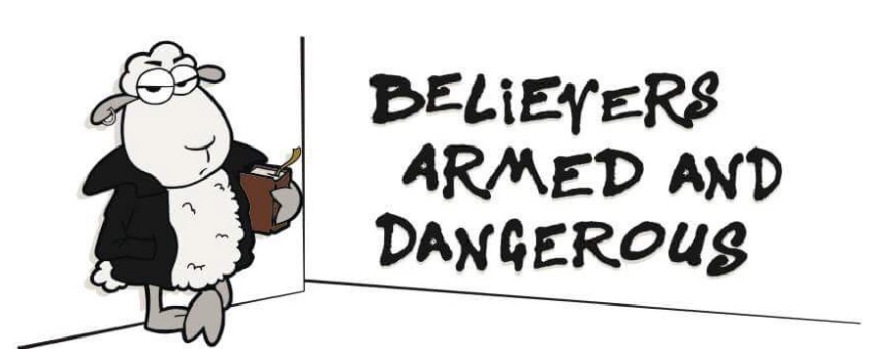
 Believers Armed and Dangerous