I’m always interested when a non-Christian source speaks of the truth of the Bible. As I mentioned last week, John’s ministry didn’t really last very long; probably less than a year. Yet, his life made such an impact that not just the Pharisees were interested in John, but he had become important enough and famous enough that a secular historian made note of his death. Flavius Josephus, a Jewish historian and contemporary of the apostle John, was writing about Herod’s loss to his former father in-law in a battle started because of Herod’s casting aside his first wife to marry his brother’s wife, Herodias:
“Now some of the Jews thought that the destruction of Herod’s army came from God, and that very justly, as a punishment of what he did against John, that was called the Baptist: for Herod slew him, who was a good man, and commanded the Jews to exercise virtue, both as to righteousness towards one another, and piety towards God, and so to come to baptism; for that the washing [with water] would be acceptable to him, if they made use of it, not in order to the putting away [or the remission] of some sins [only], but for the purification of the body; supposing still that the soul was thoroughly purified beforehand by righteousness. Now when [many] others came in crowds about him, for they were very greatly moved [or pleased] by hearing his words, Herod, who feared lest the great influence John had over the people might put it into his power and inclination to raise a rebellion, (for they seemed ready to do anything he should advise,) thought it best, by putting him to death, to prevent any mischief he might cause, and not bring himself into difficulties, by sparing a man who might make him repent of it when it would be too late. Accordingly he was sent a prisoner, out of Herod’s suspicious temper, to Macherus, the castle I before mentioned, and was there put to death. Now the Jews had an opinion that the destruction of this army was sent as a punishment upon Herod, and a mark of God’s displeasure to him.” (Flavius Josephus, Antiquities XVIII 2)
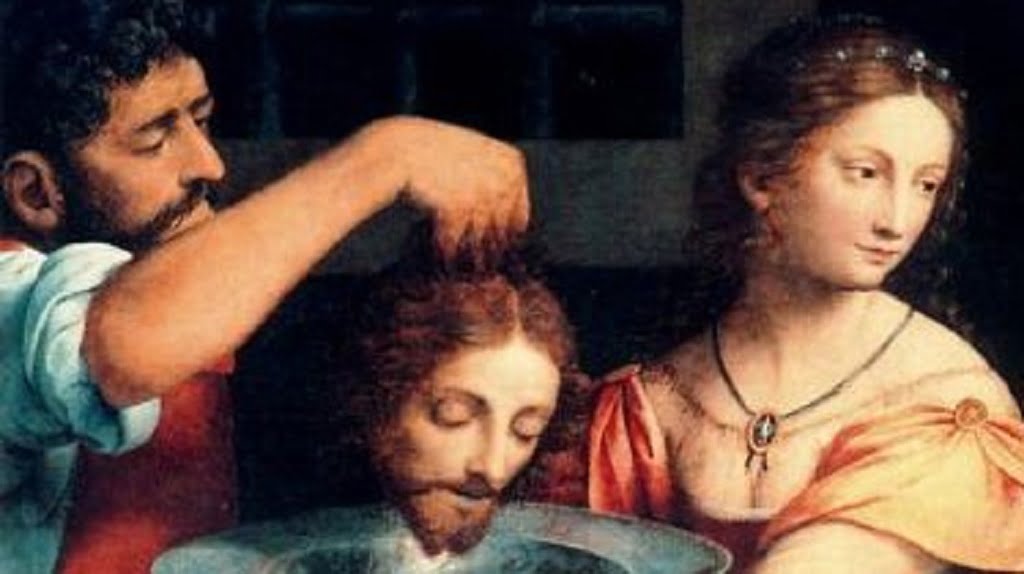
Matt. 14:3-11 (ESV) 3 For Herod had seized John and bound him and put him in prison for the sake of Herodias, his brother Philip’s wife, 4 because John had been saying to him, “It is not lawful for you to have her.” 5 And though he wanted to put him to death, he feared the people, because they held him to be a prophet. 6 But when Herod’s birthday came, the daughter of Herodias danced before the company and pleased Herod, 7 so that he promised with an oath to give her whatever she might ask. 8 Prompted by her mother, she said, “Give me the head of John the Baptist here on a platter.” 9 And the king was sorry, but because of his oaths and his guests he commanded it to be given. 10 He sent and had John beheaded in the prison, 11 and his head was brought on a platter and given to the girl, and she brought it to her mother.
Many have tried to disprove the Bible and the history it provides. Thus far none have succeeded. In fact, many were so moved by the evidence of the reliability of the Bible they became believers. Doctor Simon Greenleaf (1783-1853), an atheist law professor at Harvard and author of a three volume set on legal evidence, was challenged by some Christian students to apply the rules of evidence found in those volumes to disprove the resurrection of Christ. When he analyzed the evidence, he became a Christian.
More recently, Lee Strobel, an award winning investigative reporter for the Chicago Tribune set out to disprove this Christian faith his wife had accepted. In the process of researching with a skeptical eye, Lee became a Christian and wrote The Case for Christ.
Other names come to mind as well. Josh McDowell was an atheist turned Christian who tried to disprove the Christian narrative and published a book on his findings: Evidence that Demands a Verdict. Frank Morrison was another newspaperman who sought to disprove the bodily resurrection of Christ and became the author of Who Moved the Stone.
There are others who believe the Bible is not of God, but the evidence is so overwhelmingly against them they would be convinced if they would only look.
 Believers Armed and Dangerous