
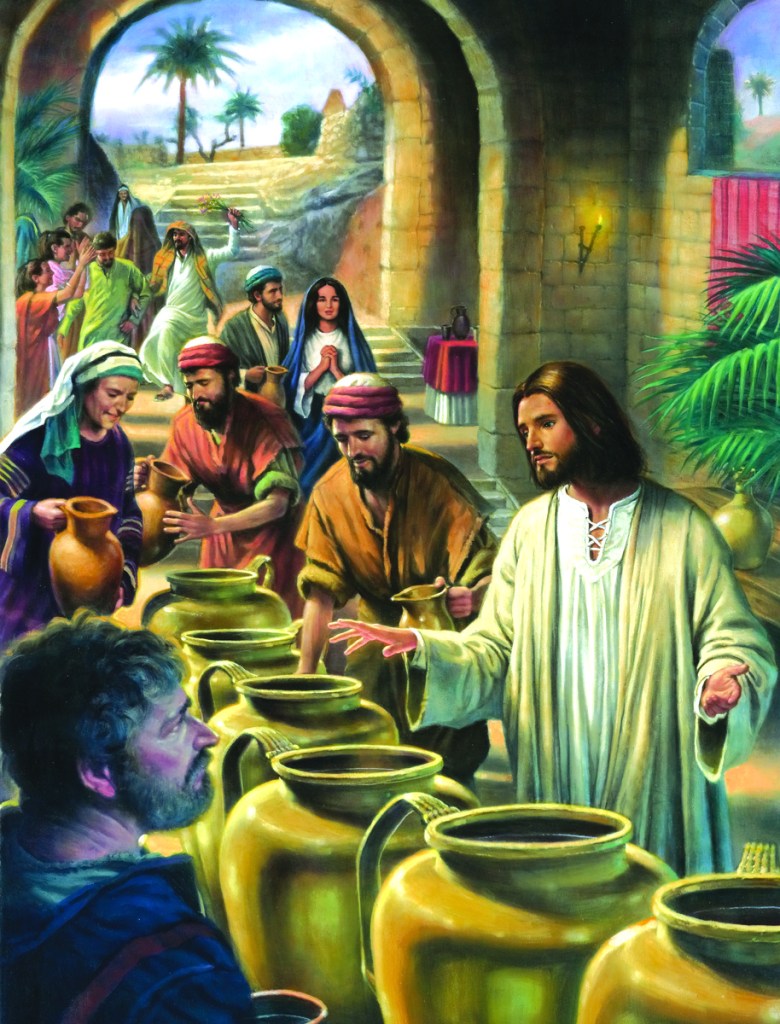
John 2:1-10 (ESV) On the third day there was a wedding at Cana in Galilee, and the mother of Jesus was there. 2 Jesus also was invited to the wedding with his disciples. 3 When the wine ran out, the mother of Jesus said to him, “They have no wine.” 4 And Jesus said to her, “Woman, what does this have to do with me? My hour has not yet come.” 5 His mother said to the servants, “Do whatever he tells you.”
6 Now there were six stone water jars there for the Jewish rites of purification, each holding twenty or thirty gallons. 7 Jesus said to the servants, “Fill the jars with water.” And they filled them up to the brim. 8 And he said to them, “Now draw some out and take it to the master of the feast.” So they took it. 9 When the master of the feast tasted the water now become wine, and did not know where it came from (though the servants who had drawn the water knew), the master of the feast called the bridegroom 10 and said to him, “Everyone serves the good wine first, and when people have drunk freely, then the poor wine. But you have kept the good wine until now.”
Notice Jesus as well as His disciples were invited to this wedding. There was also a “master of the feast” (vs. 9). This indicates this was very probably a large wedding. Masters of the feast were a common occurrence in Jerusalem but not in a village like Cana. So, it was a big wedding, maybe as many as a couple of hundred people.
Jewish wedding feasts of the time ran about a week. During that week, the bridegroom would appear as a surprise to all. The wedding could begin a day or two, or even longer, before the bridegroom appeared. The bridegroom is present here, so they did not run out of wine early in the wedding feast.
He and his family were responsible for the cost of the wedding and all that took place. If the wine were to run out, the error would follow the bridegroom all his life as the guy who couldn’t provide for his wedding guests bringing doubt whether he could provide for a wife and family. So, the bridegroom in this passage was in trouble. A guest could even sue the bridegroom’s family for running out of wine. It was as serious as that.
Mary comes to Jesus to point out the problem and He calls her “Woman. What does this have to do with me?” To American ears, this sounds rude or even insulting. In Greek, it isn’t. “Woman” is a term of respect like Sir or Ma’am. Jesus addressed Mary as “Woman” when on the cross:
John 19:26 (ESV) When Jesus saw his mother and the disciple whom he loved standing nearby, he said to his mother, “Woman, behold, your son!”
He used the term of Mary Magdalene in the garden:
John 20:15 (ESV) Jesus said to her, “Woman, why are you weeping? Whom are you seeking?” Supposing him to be the gardener, she said to him, “Sir, if you have carried him away, tell me where you have laid him, and I will take him away.”
In this context, it is an indication Jesus is no longer under the authority of His mother and is now an independent man making His own decisions. He is once again about His father’s business. His time for the announcing His ministry as Messiah had not yet come, so He performed the miracle in private, away from the party. Only the disciples present and the wedding servants were aware of it.
He asked the servants to fill the stone jars rather than His disciples, and they filled them to the brim with water as instructed. Then the wine was presented to the master of the feast. Why were the jars filled to the brim and why did He have the servants do this? The servants were neutral parties so no mistake could be made the disciples might have put something into the water if they had filled the jars. The jars were filled to the brim so if something were added, the jar would overflow.
Why was the wine taken to the master of the feast? The master was a professional wine expert. He verified the wine was excellent unaware of the miracle that produced it. Though the miracle was a private one, it left no room for misinterpretation.
It was beyond doubt a miracle and was done to bolster the disciples’ faith. Remember this was the first miracle they had seen. Their belief Jesus was the Messiah was now justified.
Taking the smaller estimate of 20 gallons each in the six stone jars, we arrive at 120 gallons of wine. At a 4 ounce serving and 200 guests, we have about 20 glasses of wine per attendee.
Drunkenness was frowned upon in the Old Testament (Isa 5:11). Drinking was not. A few glasses a day was acceptable. Surely, there would be some of this excellent wine left over. But this is just how God does things. He gives us more than we could ever ask for.
Why is this important?
The Bible records true miracles. These were not tricks but the altering of natural law for God’s purposes. In this case, the miracle was more for the disciples to understand Who Jesus was than anything. Most of Jesus’ miracles were fairly public: public healing, feeding of the 5,000, raising the dead, and such. Those were done as confirmation of Jesus’ message. Turning water into wine was done as confirmation of Jesus’ position and nature.
Look here for more information about Christians and alcohol
 Believers Armed and Dangerous