
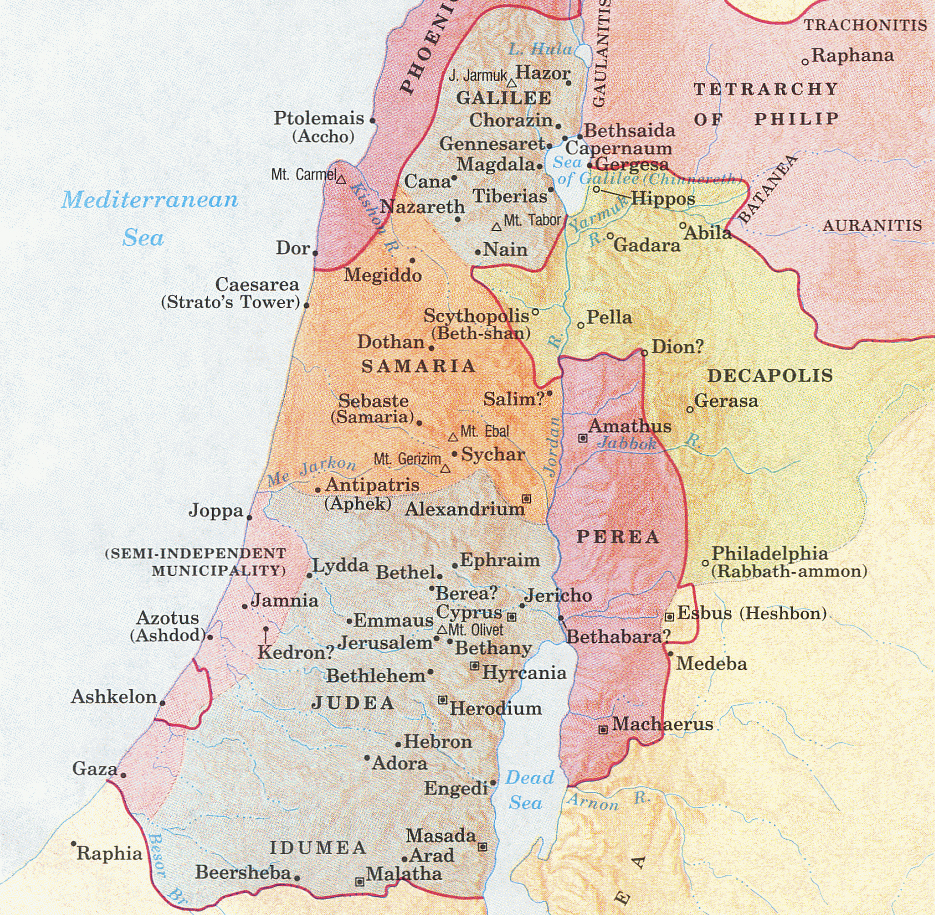
The Samaritans
John 4:9 (ESV) The Samaritan woman said to him, “How is it that you, a Jew, ask for a drink from me, a woman of Samaria?” (For Jews have no dealings with Samaritans.)
Samaritans. Why do you suppose the Jews has no dealings with Samaritans? I remember being told Samaritans were some sort of mixed race, part Jewish, and so were shunned by the Jews. I thought it would be good to look into these people and see why the Jews truly didn’t like them. Here’s what I found:
- The Jews’ issues with Samaritans began way back in 2 Kings chapter 17 where the Israelites of the Northern Kingdom of Israel jumped into idolatry with both feet. As a result, God allowed the Assyrians to conquer the Northern Kingdom of Israel. It was the practice of the Assyrians to relocate/scatter those they had conquered to other parts of their kingdom. This kept the captives from reuniting and forming a force to overthrow the Assyrians. Pretty smart!
So, the Jews were moved out of northern Israel. Then Assyrians and other captives were moved into an area of the Northern Kingdom known as Samaria. Now these guys started worshiping their pagan gods as they always had, but lions had multiplied in the area and started killing some of these folks off. Their pagan priests thought this was because they were ignoring the God of Israel (Many ancient people thought gods were local, only gods of a specific area), so they brought a Israelite priest back to Samaria to teach them about Yahweh.
The Samaritans then did not worship Yahweh alone but simply added Him to their pantheon of gods.
- The Samaritans later built a temple to Yahweh on Mount Gerizim and claimed it as the true temple of Yahweh rather than the Jerusalem Temple. The woman at the well in John 4:20 mentions this.
- After the Jews of the Southern Kingdom were held captive in Babylon (c. 587-539 b.c.), Cyrus, the King of Babylon, said they could return to Jerusalem to rebuild the temple and gave them resources to do so. The Samaritans offered to help in the construction, but the Israelites suspected they wanted some of the money given them by Cyrus and refused their help. This built animosity between the two peoples.
- Nehemiah 6:1-14 tells us the Samaritans made it extremely difficult to complete the rebuilding of the temple by Nehemiah and the Israelites. This made the Jews even more upset with the Samaritans.
- Samaria then became a refuge for the criminals of Judea. The Samaritans gladly welcomed them to their community. Criminals angry and running from the law of Judea added to the animosity of the Samaritans.
- The Samaritans only accepted the books of Moses and discounted the poetic books and the prophets.
- Lastly, during the Maccabean Revolt that ended about a century and a half before the scene of Jesus and the woman at the well, the Samaritans took the side of the enemy of the Jews.
Why is this important?
There were lots of reasons for the Jews to hate the Samaritans. We all have people we don’t like, people who have a history of hurting us or others. How should we deal with these folks? Look at how Jesus did this:
In John 4:4, we’re told Jesus “had” to pass through Samaria. There is a lot of significance to that word “had.” It means “necessary.” Jesus had another way to go from Judea to Galilee. Going through Samaria was not the only option. It was necessary for Jesus to go through Samaria because He needed to talk with this one woman and, because of their conversation, many in her town were brought into the kingdom.
We hold grudges, we have biases, we have people in our lives we just don’t like. Joyce Landorf called the annoying people in our lives “Irregular People.” Jesus showed us in John chapter 4 there is no excuse at all for the Christian to treat anyone, anyone at all, differently. For the Christian there is neither slave nor free, male nor female, Jew nor Greek. When we treat people poorly because of our prejudice or because they just annoy us, we are in sin and need to turn to God for forgiveness.
Jesus concern for the Woman at the Well was not about earthly prejudice. It was about eternal freedom.
 Believers Armed and Dangerous
One thought on “The Samaritans”