
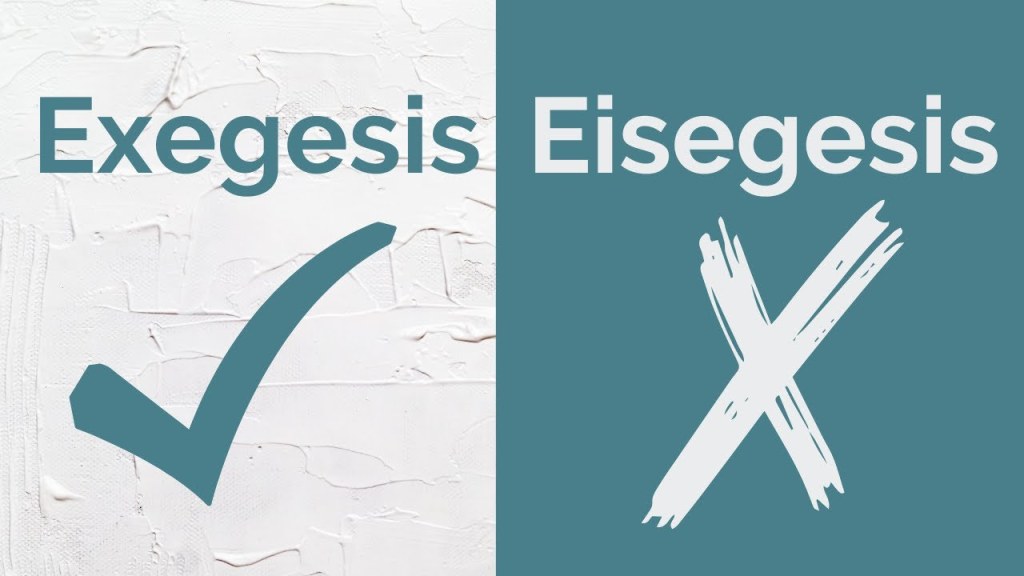
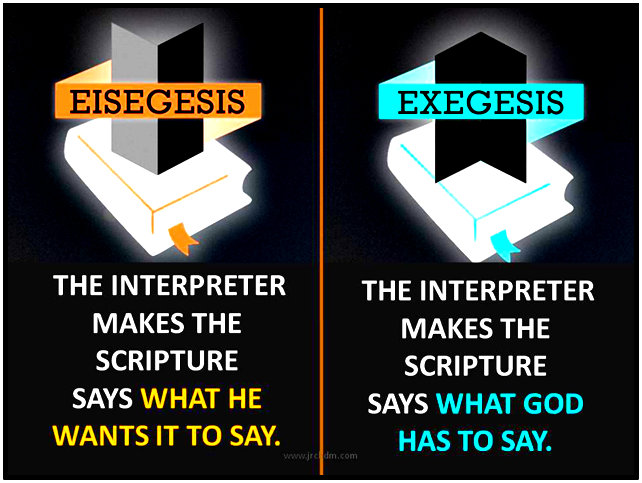
Exegesis and Eisegesis are a couple of interesting words, and as Christians we face them almost daily. Exegesis is to critically and analytically draw information from a text. For Christians this applies most readily to Scripture. Our goal should be to look at a passage as closely as possible from God’s point of view: what does He mean to say to the reader in this passage?
Eisegesis is reading into a text something that isn’t there. This can be pretty much any text, but for us, we’ll look at how this can mess up our understanding of Scripture. We do this all the time by carrying our preconceived notions with us when we want to interpret a passage of the Bible.
In our last blog we looked at some of the books that help keep us from making the “eisegesis” mistake. Let’s look at some easy methods of making sure we’re analyzing and not personalizing. The goal in Scripture study is to be objective, to see what the passage actually says, not to make it say what you want it to say.
How do we guard against reading our own view into a passage? There are some basic methods that will help us keep looking for God’s instruction rather than our own confirmation. As is true for every time we pick up our Bibles, we should pray. We have the Author available to us to tell us what Scripture says. We’d be fools not to take advantage of this.
When studying, you must also use a peer reviewed word-for-word translation of the Bible. The Living Bible or even the New Living Translation will not give you the words of the original text. The Living Bible, for instance, is a paraphrase. The author is just telling the story as best he can. The New Living Translation is a thought-for-thought translation. It is great for reading the story but for direct study of a passage, it has little value. Word-for-word translation such as the NASB, ESV, KJV, and NKJV are excellent for study.
Read the context of the passage and how it relates to the verses you’re trying to understand. Many of the biggest mistakes we can make come from ignoring the context and taking a verse out of context. Here is one of my favorite examples:
“Christ said, ‘Be still and know that I am God.’ Be still and know that you are God, and when you know that you are God, you will begin to live Godhood, and knowing Godhood, there is no reason to suffer.” (Meditations of Maharishi Mahesh Yogi, p. 178) This Bible quote is actually taken from Ps. 46:10 and is said by God Almighty Lord of Israel to assure His people and has nothing to do with our attaining godhood.
This is a pretty drastic example, but I wanted to show how someone can read something that isn’t there in order to support their own view. Now look at this one:
1 Cor. 15:50 (ESV) I tell you this, brothers: flesh and blood cannot inherit the kingdom of God, nor does the perishable inherit the imperishable.
This one is not so easy. Is Paul telling us we won’t have bodies in heaven? Well, no. 1 Cor. 15 is speaking almost exclusively about our bodies. If this is the context – our bodies – what can the Holy Spirit, speaking through Paul, mean? We need to see how or if the term “flesh and blood” is used elsewhere in Scripture. Does it always mean our physical bodies?
It turns out the term “flesh and blood” only appears four times in Scripture (Matt. 16:17; 1 Cor. 15:50; Eph. 6:12; and Heb. 2:14). The first verse in this list, Matthew 16:17, says, And Jesus answered him, “Blessed are you, Simon Bar-Jonah! For flesh and blood has not revealed this to you, but my Father who is in heaven.
Jesus wasn’t talking about physical flesh and blood but about sinful man here. If we apply this to 1 Cor. 15:50, it makes perfect sense: “Sinful man will never inherit the kingdom of God.” This is because we need to ask Jesus to take on that sin for us, so we can stand before God faultless (Jude 24).
So, by comparing the passage we don’t understand with the rest of Scripture, we have arrived at a logical conclusion.
Asking someone we trust about the passage should always be a last resort. It is up us to do the work ourselves with the requested guidance of the Holy Spirit. He is without error or the chance of error. Even the greatest human Bible expert would never claim they are.
Why is this important?
God tells us we are to be diligent workers of the Word of God, handling it accurately:
2 Tim. 2:15 (NASB) Be diligent to present yourself approved to God as a workman who does not need to be ashamed, handling accurately the word of truth.
God is anxious for us to study His Word and get it right. Never think Scripture is some big impenetrable code book. God has made it simple enough for a child to understand what is needed and complex enough to keep the greatest scholars busy probing it for thousands of years. He picks us up from where we are and uses His Word to take us where He wants us to be.
 Believers Armed and Dangerous