
Does Baptism Save Part II

This is the second of two blog posts on baptism and if it is necessary for salvation.

There are a number of passages which support the idea that salvation does not require baptism.  The thief on the cross, for instance, was not baptized, yet he was saved. 

When Peter preached to Cornelius and his family, they accepted the gospel and displayed the gifts of the Holy Spirit showing the Holy Spirit dwelt within them, they were saved.  After that they are baptized:

Acts 10:44-47 (ESV) 44  While Peter was still saying these things, the Holy Spirit fell on all who heard the word. 45  And the believers from among the circumcised who had come with Peter were amazed, because the gift of the Holy Spirit was poured out even on the Gentiles. 46  For they were hearing them speaking in tongues and extolling God. Then Peter declared, 47  “Can anyone withhold water for baptizing these people, who have received the Holy Spirit just as we have?”

So, salvation came to the gentiles followed by baptism.  Baptism was not required.  Cornelius was first saved, then baptized.

In 1 Corinthians 15:1-4, Paul lays the gospel out completely yet without mentioning baptism.   If baptism were that important, Paul would have included it.

Now I would remind you, brothers, of the gospel I preached to you, which you received, in which you stand, and by which you are being saved, if you hold fast to the word I preached to you—unless you believed in vain.

For I delivered to you as of first importance what I also received: that Christ died for our sins in accordance with the Scriptures, that he was buried, that he was raised on the third day in accordance with the Scriptures,

In fact, in the first chapter of that very book, Paul says this14 I thank God that I baptized none of you except Crispus and Gaius, 15 so that no one may say that you were baptized in my name. 16 (I did baptize also the household of Stephanas. Beyond that, I do not know whether I baptized anyone else.) 17 For Christ did not send me to baptize but to preach the gospel, and not with words of eloquent wisdom, lest the cross of Christ be emptied of its power.

Paul thanked God he didn’t baptize.  If baptism were necessary for salvation, would Paul have said this?

In Ephesians, Paul says there in one baptism.  Now there are two candidates for that one baptism, water baptism or baptism of the Holy Spirit which we receive upon acceptance of Christ.  Which do you suppose Paul is speaking of?

Ephesians 4:4-5 (ESV)   There is one body and one Spirit—just as you were called to the one hope that belongs to your call—  one Lord, one faith, one baptism,

Scripture is best explained by Scripture.  From what we’ve seen, baptism is in no way required for salvation.

Why is this important?

The answer to the primary question here is “No.  Baptism does not save you nor is it necessary in any way for salvation.  It is a command of our Lord, a part of the great commission.  Disciples are to be baptized:

Matt. 28:19  19 Go therefore and make disciples of all nations, baptizing them in the name of the Father and of the Son and of the Holy Spirit,

Though it is a command and therefore is a sin if not followed, our salvation does not rest upon it.  It is a public display and declaration that a Christian has dedicated his life to Christ.

Anytime someone tells you salvation comes through Jesus plus something else, they’re lying to you.  We are saved by grace alone through Christ alone and by nothing else.  To add something to this is to say Christ’s sacrifice was not enough.  We must do something else.

Does Baptism Save? Part I

Does Baptism Save? Part I

Does baptism save us?  I’ve had a number of conversations of late with people who think we must be baptized to be saved.  The fancy term for this is “baptismal regeneration” (BR).  They often list a number of verses they believe support their view and ignore those that don’t.  Let’s take a look at them all and see what the Bible teaches:

One of the primary verses used is Acts 2:38, “And Peter said to them, ‘Repent and be baptized every one of you in the name of Jesus Christ for the forgiveness of your sins, and you will receive the gift of the Holy Spirit.’”  This seems definitely to show baptism is needed for forgiveness, but let’s think about this.  The key word in understanding this verse is “for.”  “For” can mean “in order to” as in “this hoe is for removing weeds.”  That’s the meaning the BR folks apply to this verse.  But, there is another meaning of “for.”  It can also mean “because of” as in “wanted for murder.”  I would pose this is the meaning in Acts 2:38.  We are to be baptized because of the forgiveness of our sins as a sign of that forgiveness.  So, if it might mean either, this verse is not definitive, so examination of other passages is necessary. 

1 Peter 3:21 (ESV)  Baptism, which corresponds to this, now saves you, not as a removal of dirt from the body but as an appeal to God for a good conscience, through the resurrection of Jesus Christ,

This is another verse used by the BR proponents to support their view.  The passage itself says it’s not speaking of water baptism.  There are two baptisms for the Christian: water baptism and baptism of the Holy Spirit (Matt 3:11) which comes at the point of salvation when we are immersed in God’s Spirit.  The baptism in this verse is baptism of the Holy Spirit.

Mark 16:16 (ESV)  Whoever believes and is baptized will be saved, but whoever does not believe will be condemned.

This passage in Mark has some issues.  First, the end of Mark beginning in vs. 9 does not appear in the earliest manuscripts of the New Testament.  It may be an addition by an early copyist for his own use and then copied by others as though it were in the original.  The fact is doesn’t appear in early manuscripts is not the only issue, though.  The end of Mark seems to teach something contrary to the rest of Scripture.  Verse 12 says Jesus “appeared in another form” which is not true.  Jesus appeared to Mary in the same body that died on the cross.  If you have a modern translation or a study Bible, there should be a note recognizing the problems with the end of Mark.

But, even if this weren’t enough to discount the BR belief, note the baptism is not included in the second half of the verse.  So, not being baptized does not mean condemnation, only lack of belief.

Galatians 3:27 (ESV)   For as many of you as were baptized into Christ have put on Christ.

This is circular reasoning.  The BR people believe this means water baptism.  There is nothing in the passage that indicates that.  They are reading their conclusion into the verse to prove their conclusion.  Spiritual baptism is “baptism into Christ Jesus.”

Acts 22:16 (ESV)  And now why do you wait? Rise and be baptized and wash away your sins, calling on his name.’

This is Paul retelling his experience on the Road to Damascus (Acts 9).  The original recording of this event tells us a little more about it:

Acts 9:17-18 (ESV)   So Ananias departed and entered the house. And laying his hands on him he said, “Brother Saul, the Lord Jesus who appeared to you on the road by which you came has sent me so that you may regain your sight and be filled with the Holy Spirit.”   And immediately something like scales fell from his eyes, and he regained his sight. Then he rose and was baptized;

This added information tells us Ananias prayed over Paul.  Scales fell from his eyes as he received the Holy Spirit and then was baptized.  If one needs to be baptized to be saved, this would contradict that.  Paul was filled with the Holy Spirit before he was baptized.

John 3:5 (ESV)  Jesus answered, “Truly, truly, I say to you, unless one is born of water and the Spirit, he cannot enter the kingdom of God.

This is the conversation Jesus had with Nicodemus.  Remember the verse before this?

John 3:4 (ESV)  Nicodemus said to him, “How can a man be born when he is old? Can he enter a second time into his mother’s womb and be born?”

So, Nicodemus asked if “born again” meant he would have to go through natural child birth again.  Jesus said (paraphrased), no you are born once by woman (water breaks) and again by the Spirit of God.  It’s that simple.

That is what born-again means: Galatians 4:29 (ESV)   But just as at that time he who was born according to the flesh persecuted him who was born according to the Spirit, so also it is now.

Next week we’ll look at passages that show the Bible teaches we don’t need to be baptized to be saved.

Why is this important?

Belief that baptism is required for salvation lessens the sacrifice of Christ.  It says Jesus’ death wasn’t enough, that we need to do something in addition.

Jesus’ sacrifice was sufficient.  Baptism is a command, yes, but not a requirement for salvation.  Our sins are washed away by the blood of Christ and nothing else.

God and Oppression

I’ve done my best to keep politics out of my blog posts, and I will try to do so in this one.  I ask as you read this to remember it is read by people all over the world from China to Saudi Arabia, from Vietnam to Nepal, From the US to Norway, on all five continents and in 48 countries last year.  True the majority of readers is in America but the second largest group of readers, interestingly, is in Communist China. 

We’re told in Scripture that God gives us government leaders He wants, and we are to submit to their authority:

Romans 13:1-7 says: “Let every person be subject to the governing authorities. For there is no authority except from God, and those that exist have been instituted by God. Therefore whoever resists the authorities resists what God has appointed, and those who resist will incur judgment. For rulers are not a terror to good conduct, but to bad. Would you have no fear of the one who is in authority? Then do what is good, and you will receive his approval, for he is God’s servant for your good. But if you do wrong, be afraid, for he does not bear the sword in vain. For he is the servant of God, an avenger who carries out God’s wrath on the wrongdoer. Therefore one must be in subjection, not only to avoid God’s wrath but also for the sake of conscience. For because of this you also pay taxes, for the authorities are ministers of God, attending to this very thing. Pay to all what is owed to them: taxes to whom taxes are owed, revenue to whom revenue is owed, respect to whom respect is owed, honor to whom honor is owed.

This wasn’t talking about times of freedom and liberty.  When this was written, all of the Mediterranean was under harsh Roman rule.  Even so, the text tells us through Paul as he was led by the Holy Spirit that Christians were to follow Roman rule (so far as was biblical).

In Acts 5:28-29, the apostles tell us we are to obey God’s commands when they contradict man’s:

 “We strictly charged you not to teach in this name, yet here you have filled Jerusalem with your teaching, and you intend to bring this man’s blood upon us.” 29 But Peter and the apostles answered, “We must obey God rather than men.”

So, as I see it, our duty is to obey the laws of the land so long as they do not interfere with God’s commands.  If they do, God’s commands win out.

This is easy for an American to say, I know, but it stands as a biblical principle even if you must hide your obedience to God from the state.

Why is this important?

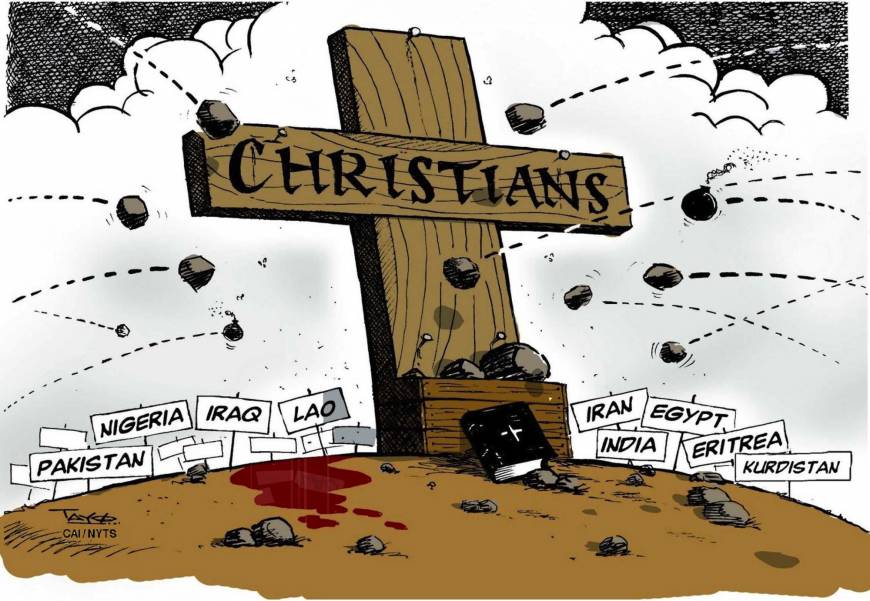
Many who read this blog are under oppression of various levels even now.  In China, pastors are captured, imprisoned, and sometimes tortured.  Even parishioners are often detained.  In Nepal and Afghanistan, you will suffer death for preaching the Christian gospel on the street, but people still do it.

Christians are so oppressed in some Muslim countries no missionaries are allowed in, and most refuse to sneak in.  It would mean certain death to be discovered.  Yet God is reaching these countries with the gospel through radio, TV, and even dreams.  The followers of Christ meet in secret.  Many are beheaded or worse.  In the Sudan, our brothers and sisters are captured and sold as slaves. Yet, the Christians follow the law so long as it does not contradict God’s law.

As I’ve said in earlier blogs, we were created most importantly to find Christ and to share Christ.  The thousands of Christians martyred in the first three centuries of the church have shown us how to submit to authority only after first submitting to God.

Christians in America think we’re persecuted because we see bumper stickers telling us we’re fools.  TV shows and movies portray us as simpletons and hypocrites.  Yet ours is not real persecution when women are being dragged from their homes and set aflame or beheaded in the town square simply because they have accepted Christ.

Church tradition tells us the apostle Andrew was nailed to an X-shaped cross (called St. Andrew’s Cross now) and took three days to die.  He was deprived of food and water, yet he did not cease to preach Jesus and Him crucified to those who would surround his cross.

In the United States we are about to have a changing of the guard.  Many think this will bring major changes, unchristian – anti-Christian changes, to our country.  If this is true, let’s keep in mind those in other nations who know what oppression truly is and face any oppressors with the love of Christ.  There is no prohibition to trying to bring a Christian worldview to our nations, of course. We need to remember, though, many would give all they have to live in America no matter who is in office.

Unity vs Uniformity

Phil 2:1-2  So if there is any encouragement in Christ, any comfort from love, any participation in the Spirit, any affection and sympathy, complete my joy by being of the same mind, having the same love, being in full accord and of one mind.

Many Christians believe we all need to think exactly alike.  We need to believe the same, act the same, and worship the same.  But, that’s not what Scripture says.  We are to be of one accord, one community, the church.  We can disagree on non-essentials.

As most of you know, I talk with JWs and ex-JWs fairly regularly.  They consider denominations as warring factions within the church.  Sadly, we the church, have given them that impression.  They ask why there need to be so many of what they call “divisions” in the church.

The answer, of course, is that people tend to join with others of like mind.  Denominations don’t disagree on basic doctrines like the Trinity, bodily resurrection of Christ, deity of Christ, or salvation by grace alone.  If they did, they wouldn’t be considered a part of the church.  Denominations disagree on peripheral issues like the mode of baptism, what day of the week to meet, and form of church government.

I had a friend tell me he would never street witness with a charismatic as though that area of his belief disqualified him as a Christian.  As hard as it is to believe, there are only two qualifications for being a Christian and they are found in Romans 10:9-10

because, if you confess with your mouth that Jesus is Lord and believe in your heart that God raised him from the dead, you will be saved. 10 For with the heart one believes and is justified, and with the mouth one confesses and is saved.

We’re not saved because we belong to the EV Free Church or the Church of the Nazarene.  We’re saved by grace through faith and that faith comes from acknowledging Jesus as Lord and that God raised Him from the dead.

Sure we have differences, but those differences are not the hills we necessarily want to die on.  A quote that has been attributed to everyone from Martin Luther to Billy Graham says, “In essentials, unity; in non-essentials liberty; but in all things charity.”  I think that’s a good maxim to live by.

The discussion of our differences is as old as the Church itself.  It’s the heart behind our discussions that is significant.  If we just want to argue to prove we’re right about a minor point of doctrine or belief, we’re approaching the discussion wrongly should end it.  If we think the other person would benefit from the discussion or that we might, we should continue on so long as it stays civil and loving. 

Public discussions are another issue.  I often listen to public debates between Christians and some representatives of a cult or other world religion.  There’s nothing wrong with those so long as the Christian, again, acts in a loving way.  But, if Christians angrily discuss some minor point of doctrine it makes the Christians look petty to the non-believers.  Debates of any sort which generate heat with very little light should be avoided.

Why is this important?

Heated discussions over minor issues damage the unity Paul spoke of in Phil. 2.  We get angry with a brother or sister over our disagreement which hurts Christ, our relationship with that brother or sister and erodes our own walks.

I’m not saying we should never stand up for the faith.  I’m not even saying we should shy away from discussions of minor issues.  But, if you find yourself or the person you’re speaking with getting upset, it’s time to end the discussion.

Dr. Walter Martin used to say “If two people think exactly alike, one of them isn’t thinking.”  I think he’s right.  If we all agree on everything it would be a world of boredom and a world without learning.  We learn best when challenged.

So, we should pick the hills we want to die on.  We should look out for the personal interest of the non-believer and even our brother as much as our own:  Phil. 2:4  Let each of you look not only to his own interests, but also to the interests of others.

Ours is a reasonable faith which can and should be examined and discussed in order for us to grow.  It is when we become intolerant of the minor differences we have with others that we border on legalism and pride.  Let’s join hands with our brothers and sisters in Christ to seek unity of the body.

Underestimating God

Psalm 145:3:  Great is the Lord, and greatly to be praised, and his greatness is unsearchable.

It seems no matter how much faith some of us have God still surprises us. 

Just how great is our Lord?  Pastor Chuck Smith used to say, “if you can get past the first verse of the Bible, the rest is easy,” and he was right.  The God who created all that exists through just a spoken word is greater than any of us will ever need.

Yet, we worry whether God can take care of some issue we’re facing whether great or small.    We worry about things from a desperately ill friend to whether we’ll be late for work.  Hopefully, some of what I say here will help with that.

First I’d like to address the fact God is infinite.  I’ve discussed infinity here before, so I’ll give the short definition.  Infinity is a number so large nothing can be added to it to make it larger.  We really can’t wrap our heads around that, but it’s true.  Think of the number of atoms in the universe.  Scientists estimate there are 3,000,000,000,000,000,000,000,000.  That’s a pretty big number, but it’s not infinity.  In fact, if the oceans were to represent an infinite number (and it can’t, of course, since it has limits) the number of atoms listed above would be smaller than a grain of sand.  That is a limited description, but we can get a sort of feel from it.

God is not just infinite in space – He is everywhere.  He’s infinite in every attribute He has.  He’s infinite in power, in knowledge, in presence.  Most of all, though, God is infinite in love.  In fact, everything He does is the result of His love for God is love (1 John 4:8).

So, as finite humans we constantly sell God short.  Being infinite in power means it was no more difficult for Him to create the entire universe than it would be to heal a friend of a cold.  God does have limits, though.  He is limited by those restrictions He has placed on Himself.  How God acts in our lives to some degree depends on our faith:

Matt. 13:58: 58 And he did not do many mighty works there, because of their unbelief.

He also limits His actions to allow for our freewill.  God wants all to be saved but all are not saved because they choose to refuse God’s gift:

1 Tim. 2:1-4  First of all, then, I urge that supplications, prayers, intercessions, and thanksgivings be made for all people, for kings and all who are in high positions, that we may lead a peaceful and quiet life, godly and dignified in every way. This is good, and it is pleasing in the sight of God our Savior, who desires all people to be saved and to come to the knowledge of the truth.

Other than the restrictions God has laid upon Himself and His nature – He can’t sin, for instance – there is nothing He cannot do.

Why is this important?

Some of us have friends and relatives who have been struck by this virus.  We see people around us dying and worry our loved one might die as well.  We plead to God to heal them, to deliver them from this affliction.  “Certainly God would want my friend to live and glorify Him.”

Certainly, God has the power to heal our friend, but God’s ways aren’t our ways.  He doesn’t act as we wish Him to. In Isa. 55:8-9, God says this:

For my thoughts are not your thoughts, neither are your ways my ways, declares the Lord. For as the heavens are higher than the earth, so are my ways higher than your ways and my thoughts than your thoughts.

As Christians, it is always a good practice to place our issues in God’s hands and yield to His will just as Shadrach, Meshack, and Abednego did with King Nebuchadnezzar.  They had refused to worship his golden image, so he threatened to throw them into the fiery furnace.  Notice their response:

Daniel 3:16-18:  16 Shadrach, Meshach, and Abednego answered and said to the king, “O Nebuchadnezzar, we have no need to answer you in this matter. 17 If this be so, our God whom we serve is able to deliver us from the burning fiery furnace, and he will deliver us out of your hand, O king. 18 But if not, be it known to you, O king, that we will not serve your gods or worship the golden image that you have set up.”

They had no doubt God could rescue them if it was His will. But, they recognized He might not. This should be our response in times of need as well.  Our God is greater than the trial.  He may not deliver us from the torment we’re facing in the way we want, but He will deliver us.  We mustn’t underestimate God.

The Godly Wife

Genesis 2:18  Then the Lord God said, “It is not good that the man should be alone; I will make him a helper fit for him.”

The word “helper” here is someone who works alongside of the man, someone who man needs because he could not perform the tasks on his own.  It speaks of help that is given, not required.  The Psalmist uses this word of God as “Helper” in Psalm 20:2; May he send you help from the sanctuary and give you support from Zion!

There are a lot of passages of Scripture that show the husband and wife are equal in all ways but rank in the home.  Rank has nothing to do with the equality of the nature of husband and wife.  In fact, Jesus was subject to Mary and Joseph.  As His earthly parents, they held a higher rank in the home:

Luke 2:51  And he went down with them and came to Nazareth and was submissive to them. And his mother treasured up all these things in her heart.

In fact, the Christian husband is told to treat his wife as an equal showing her honor.  :

Likewise, husbands, live with your wives in an understanding way, showing honor to the woman as the weaker vessel, since they are heirs with you of the grace of life, so that your prayers may not be hindered.

Peter treats the submission of the Christian wife as a sign to the non-believing husband: 

1 Peter 3:1  Likewise, wives, be subject to your own husbands, so that even if some do not obey the word, they may be won without a word by the conduct of their wives,

While again and again, the Christian husband is told to love his wife, the Christian wife would do well to show respect and appreciation for her husband

Ephesians 5:33  However, let each one of you love his wife as himself, and let the wife see that she respects her husband.

While wives need to know they are loved, husbands need even more to know their wife respects them.  We need to know our wives see us doing the job God has called us to do and respect us for doing it.  God hasn’t just given the man spiritual headship of the family, He has given man the drive to be that head and to do it well.  So, it is part of the Christian wife’s job to show her respect for the husband and the job he’s doing.

Why is this important?

There are Christian men and women in the church even today who do not understand the roles of husband and wife in the Christian family.  The Christian husband and wife must know how God’s design for the Christian marriage works and their places in that design.

The Christian marriage, as we’ve seen, is much like the church in how it is organized.  The church is the bride of Christ.  As His bride, we look to Him as the head.  That is our choice.  We volunteer to take the role of submission to Christ.  Refusing to submit to Christ damages our relationship with Him.

In the family, the woman voluntarily takes a submissive role to the husband, but as we saw last week, it is only in the final decisions on family matters after the husband and wife have discussed the issue at length.  Only when the two come to an impasse does the wife need to yield to the husband’s decision.

The Christian family design is not one of employer-employee but a partnership where one partner takes on the role as the tiebreaker.

There is so much more than I can include in a short blog post in being a godly wife.  I recommend you look into this further on your own.

Marriages break up most often because the spouses do not take marriage seriously or look into the roles each is to fulfill in their relationship.  Accepting those roles will help prevent many marriage issues.

The Christian Husband

I know I turn to Phil. 2:5-8 quite a bit, but it tells us so much about Jesus’ character and how we are to act as God’s children:

Have this mind among yourselves, which is yours in Christ Jesus, who, though he was in the form of God, did not count equality with God a thing to be grasped, but emptied himself, by taking the form of a servant, being born in the likeness of men. And being found in human form, he humbled himself by becoming obedient to the point of death, even death on a cross.

We see here the relationship of the Son and the Father as an example of how we are to be as Christians.  We are to humbly assume the roles God has placed us in.  While Jesus and the Father were still equal in nature, Jesus voluntarily took on a submissive role.  This is a wonderful picture of what we see in 1 Cor. 11:3 that the Head of Christ is God.  We also see both how our relationships as husbands should be to Him and to our wives:

But I want you to understand that the head of every man is Christ, the head of a wife is her husband, and the head of Christ is God.

We see from Phil. 2:8 that Jesus voluntarily humbled Himself, placing Himself under the Father’s authority.  We see this acted out in the garden.  Jesus spoke with the Father about how the payment for our sins was to be made.  Jesus yielded to the Father’s will.

I think that’s a good example of how the headship works in marriage.  The husband has the authority to make decisions regarding the family.  Our wives have voluntarily placed themselves under that authority because God says they should.  But, with authority comes responsibility.  Like the Father speaking to Jesus in the garden, the intelligent husband listens to his wife.  God doesn’t make decisions, so this isn’t a perfect analogy, but it does show how we are to act as Christian husbands.

I think this sheds some light on the “elephant in the room:”

Eph. 5:22-23 22 Wives, submit to your own husbands, as to the Lord. 23 For the husband is the head of the wife even as Christ is the head of the church, his body, and is himself its Savior.

Yes, the husband is the head of the wife but as Christ is the head over the husband.  Do we want to be under Jesus’ thumb, or do we want to work with Him as friends?  Jesus is love incarnate.  All His actions are made with love as should ours as husbands be.  The passage in Ephesians continues:

25 Husbands, love your wives, as Christ loved the church and gave himself up for her, 26 that he might sanctify her, having cleansed her by the washing of water with the word, 27 so that he might present the church to himself in splendor, without spot or wrinkle or any such thing, that she might be holy and without blemish.

Our job as husbands is to love our wives and do all we can to support them in their Christian walks.  A woman needs love.  They need to be told often we love them.  They are God’s treasure, and we are stewards of the purity and wealth of wisdom God has placed in them.  We fail them so often I often think women only marry men because there isn’t an alternative.

Why is this important?

I was standing in line at the grocery stores with a bouquet of flowers I had bought for my wife.  A little girl and her mother were ahead of me inline when the little girl pointed to me and said, “Look Mommy.  He did something bad.”  The mother chuckled.  I knelt down to the little girl and said, “Sweetheart, if you meet a man some day you want to marry and he doesn’t treat you like the gift from God that you are, look for someone else.”

That’s the responsibility of Christian husbands.  Our wives are gifts from God.  We must treat them as such and love them as such.  The world and the Lord are watching.

Prov 31:10 10   An excellent wife who can find? She is far more precious than jewels.

Modalism

Several years ago, after I spoke on the trinity at a church Bible study, one of the members of the class came up to me and said, “I believe God is just one Person wearing three hats, Father, Son, and Holy Spirit.”  I told him he was in error and explained briefly some of what you will read below.

The error this gentleman believed is called modalism, the belief God is just one divine Person who relates to us in three ways, as the Father, as the Son, and as the Holy Spirit.  The longer I’ve been a Christian, the more I’ve run into this belief, so I’m going to address it here.

In philosophy, there is a law called the Law of Identity, also known as the Law of Non-contradiction.  It says that “A” cannot be “non-A” at the same time, under the same circumstances, and in the same way.  To put it simply, each of us is similar to one another in many ways, but there are always differences.  Twins are not the same person although can they seem to be.

If two things are exactly alike in every way, they are equal to the same thing.  We see this in simple manufacturing.  I have two No. 2 pencils on my desk.  To all appearances, they are exactly alike.  But, on closer examination, they are not.  There are minor differences.  Even if there were no differences, they would not be logically called identical because they do not occupy the same space.  This is a little picky, but logic is picky in order to be successfully used.

So, with all that said, simply showing there is some difference between, say, the Father and the Son, we can show they are not the same Person.  In the rest of this post, I’ll present evidence they are not identical.

Isa. 44:6 identifies two Persons, one identifies Himself as YHWH and identifies the other as YHWH as well.  Though they are different Persons, they are both called YHWH (God)

Thus says the LORD, the King of Israel and his Redeemer, the LORD of hosts:   “I am the first and I am the last; besides me there is no god.

Whenever you see the word “LORD” in all caps as we see twice in this verse, it represents the divine name, YHWH.  Both “the King of Israel” and “His Redeemer, the LORD of hosts” are identified as God yet also as separate persons.

In Matt. 24:36, Jesus says the Father knows something He Himself does not know, the date of His return:

36 “But concerning that day and hour no one knows, not even the angels of heaven, nor the Son, but the Father only.

You can see the contradiction if someone knew something and also didn’t know it. It simply doesn’t make sense.

There are many more passages and other points Scripture makes showing Jesus and the Father are not the same Person.  They have different wills (Luke 22:42), they are in different locations at the same time (Matt. 5:44-45), And many other differences.

The biblical view of God is that He is one Being (Isa 43:10-11) but three distinct Persons, the Father (Gal. 1:1), the Son (Heb 1:8), and the Holy Spirit (Acts 5:3-4).  The one God exists in three Persons.

Why is this important?

If modalism were true, the Father died on the cross.  The most important issue, though, would be the modalist would have a view of Christ different than the Bible presents.  That may be different enough that salvation is not in the Christ they believe in.

The Father, The Spirit, & the Cup

Father, Spirit, Cup

Last week my blog was about the sacrifice Jesus went through to provide the offer of salvation for us.  But, He wasn’t the only one to suffer.

Surely he has borne our griefs and carried our sorrows yet we esteemed him stricken, smitten by God and afflicted.  But he was pierced for our transgressions; he was crushed for our iniquities; upon him was the chastisement that brought us peace, and with his wounds we are healed (Isa. 53:4-5)

God is triune.  The torture of Jesus I described last week did not go unfelt by the Father and the Holy Spirit.  The three Persons knew man could not be saved by the Law.  Man didn’t know it – and many still don’t – but we needed to be shown we couldn’t reach holiness on our own.  This was done by the legalistic structure of the Old Testament times.

It was only after we were shown this that God put into action His plan:

There is therefore now no condemnation for those who are in Christ Jesus. For the law of the Spirit of life has set you free in Christ Jesus from the law of sin and death. For God has done what the law, weakened by the flesh, could not do. By sending his own Son in the likeness of sinful flesh and for sin, he condemned sin in the flesh, in order that the righteous requirement of the law might be fulfilled in us, who walk not according to the flesh but according to the Spirit. (Rom. 8:1-4)

The old method, the Law was replaced on the cross by a new Law, the law of the Spirit of life in Christ Jesus.

This was all been prepared for us since before the foundation of the world (Matt. 25:34)

So, there was a plan upon which all three Persons of the Godhead agreed.  The First Person of the trinity was to take the lead while the Second Person was to submit to the Father’s will as a son does to his father:

For to which of the angels did God ever say, “You are my Son, today I have begotten you?”  Or again, “I will be to him a father, and he shall be to me a son”?  (Heb 1:5)

And being found in human form, he humbled himself by becoming obedient to the point of death, even death on a cross.  (Phil. 2:8)

The torture felt by the Father and Holy Spirit upon the death of Jesus was more infinitely horrific.   The God who is love personified sent His own Son to suffer a torturous lingering death and in doing so, to pay the price for our sins.

Those of us who are parents know the pain of punishing our children in order to acheive a greater purpose.  We often say “This will hurt me more than it hurts you,” and we’re right.  It does.

Now consider how much pain the Father and Holy Spirit felt to watch the Son carry the sins of the world on His shoulders, then turn away from Him in His greatest need, having then to exercise their wrath upon Him, then watch Him die.  We can never adequately describe the horror felt by the Father and the Spirit.

Why is this important?

In the last two verses of the book of Jude, there is a short doxology, a spontaneous expression of praise to God.  It goes like this:

24 Now to him who is able to keep you from stumbling and to present you blameless before the presence of his glory with great joy, 25 to the only God, our Savior, through Jesus Christ our Lord, be glory, majesty, dominion, and authority, before all time and now and forever. Amen.

This is why it was all done.  God, Father; Son; and Holy Spirit; wanted the result.  God wanted to present us before the presence of His glory, the very presence of God in heaven, and He will be ecstatic that we will be standing before Him.  For this all three Persons of the godhead suffered greatly.

That’s how much God loves you.

The Cup

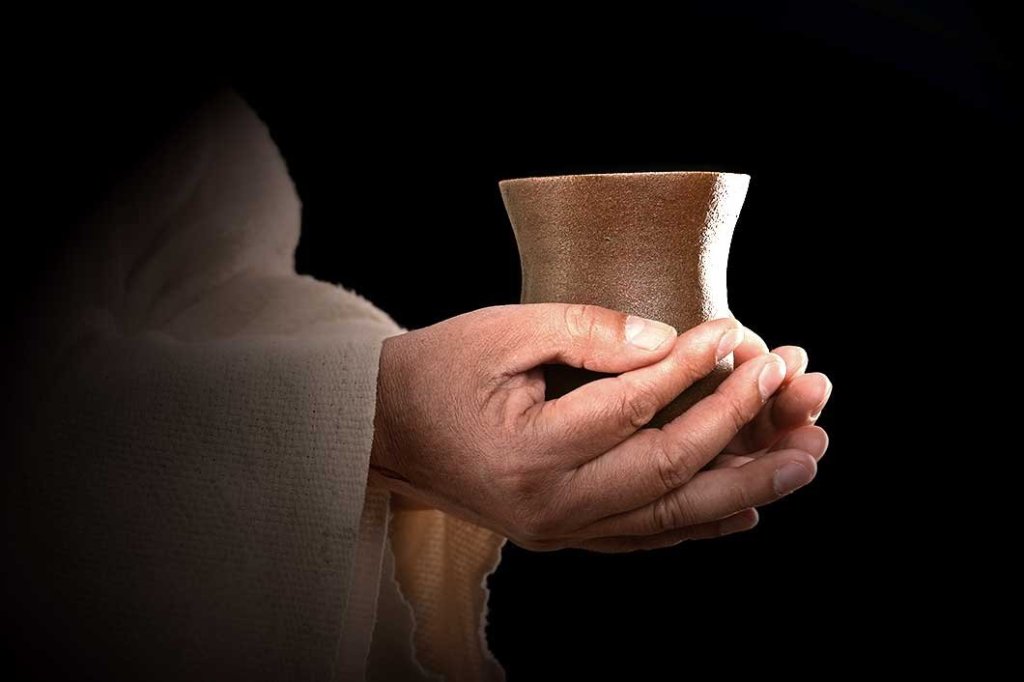
Usually, when Christians speak of “the cup” we’re talking about the communion cup.  I’d like to look at another cup, though, the cup Jesus spoke of in the Garden (Matt. 26:39):

And going a little farther he fell on his face and prayed, saying, “My Father, if it be possible, let this cup pass from me; nevertheless, not as I will, but as you will.”

I have always just believed He was speaking of the torturous death He was about to face, the scourging and crucifixion, but now I think there’s more to it. 

I’m not sure Jesus was terrified of crucifixion. The Bible seems to tell us He wasnt.  Look at Mark 10:32-34:

32 And they were on the road, going up to Jerusalem, and Jesus was walking ahead of them. And they were amazed, and those who followed were afraid. And taking the twelve again, he began to tell them what was to happen to him, 33 saying, “See, we are going up to Jerusalem, and the Son of Man will be delivered over to the chief priests and the scribes, and they will condemn him to death and deliver him over to the Gentiles. 34 And they will mock him and spit on him, and flog him and kill him. And after three days he will rise.”

Here, Jesus and His disciples are on their way to Jerusalem just before Passion Week.  According to the passage, Jesus was fully aware of what was in store for Him.  But, note in verse 32 Jesus is ahead of the disciples.  He’s not timidly heading for the crucifixion He will face.  He’s not hanging back.  He was going to Jerusalem ahead of everyone else to pay the price for you and me. 

In Hebrews 12:2, we’re told Jesus faced the cross because of the joy that was set before Him. That joy was the result of the sacrifice He offered for our salvation.  So, I don’t think a Roman scourging and crucifixion were all that Jesus was speaking of when He speaks of the cup in the garden.

During that same conversation in Mark chapter 10, Jesus tells the disciples they will share in the cup He will drink from:

39 And they said to him, “We are able.” And Jesus said to them, “The cup that I drink you will drink, and with the baptism with which I am baptized, you will be baptized,

I believe this cup and baptism speak of His execution, of a martyr’s death.  But, I believe there is something else in the cup that was only for Jesus Himself, the wrath of God.  In the Old Testament, God’s cup is often a cup of wrath (Isa 51:17)

The effect of God’s wrath can be widespread, even universal (Jer. 25:15 and 51:7).  So, that wrath is for all sin universally.

Why do I think God’s wrath is involved?  Hab. 1:13a, speaking of God, says, You who are of purer eyes than to see evil and cannot look at wrong. God cannot look upon evil.

So, in Mark 10, if Jesus is speaking of the cup He is about to drink – and it seems He is – then the portion of the cup the disciples would share is what He just described to them, a martyr’s death.  I believe Jesus had a deeper more dreadful portion He needed to face, the breaking of His relationship with the Father.

In the Garden, we’re told Jesus asked for the cup to be taken from Him if possible.  He then told the Father His will should be done.  It is then that Jesus sweats “great drops of blood”(Luke 22:44).  This is a rare condition called hematidrosis and is caused by incredible stress. 

On the cross, Jesus says “My God, My God, why have you forsaken me?” (Matt. 27:46).  When Jesus took on the sins of the world, past, present, and future, the Father had to turn away from Him and execute His wrath on Jesus.  He couldn’t look upon sin, and His response to sin is His wrath. Jesus had never felt separation from the Father before. It was excruciating.

Speaking about this, the Billy Graham organization says this:  “But in reality His words point to something far different. They point to the fact that when Jesus died on the cross, all our sins—without exception—were transferred to Him. He was without sin, for He was God in human flesh. But as He died all our sins were placed on Him, and He became the final and complete sacrifice for our sins. And in that moment He was banished from the presence of God, for sin cannot exist in God’s presence. His cry speaks of this truth; He endured the separation from God that you and I deserve.” (https://billygraham.org/story/did-god-abandon-jesus-on-the-cross-billy-graham-answers/)

In an earlier blog post I talked about the fact that God isn’t just loving, He is love personified.  God is love (1 John 4:8).  So, as with all God’s attributes, God’s love is infinite, Jesus’ love for the Father was and is infinite as well.

Think of the person who you love most.  Now think of how you would feel if that person not only turned from you, deserted you, but also brought their wrath fully upon you.  In an infinitely greater sense, that is what Jesus felt on the cross, the desertion and fury of God the Father upon Jesus Who carried the sins of us all.

I believe that is the cup Jesus wanted to be removed, desertion of the Father from their close relationship and facing the Father’s anger due to the sin Jesus assumed on our behalf.  This was the greater sacrifice.

Why is this important?

I’ve tried to convey how much God loves us by showing how much Jesus, God the Son, sacrificed for you and for me.  It wasn’t just taking on the form  of a man when He was previously in the form of God.  It isn’t even His physical sacrifice for our sins.  It is the fact the Father turned from the Son and brought His wrath to bear on the Sin Bearer.

While this wasn’t the purpose of Jesus’ sacrifice, it was the greater Personal consequence of taking our sins upon Himself, and He did it willingly.

That’s how much God loves you.