
Bible Study Questions?

What do we do if we have questions about a passage we’re studying?  Back when I started this blog nearly two and a half years ago, I gave several Bible study methods the Bible student can use to better understand God’s Word.  There were the word study, character study, ABCD study, and the topical study methods.  But, even with these methods we’ll run across portions of Scripture that puzzle us.  How do we check those passages to better understand them?  Here are some of the methods I use.

  • Pray: Always pray first and listen for the answer.  God will often open my eyes on the spot when I ask Him.  After all, we have access to the Author of the Book.  Why not use it?
  • Read the context:  First and foremost, we need to read the surrounding verses, the verses before and after the passage in question, to get the feel and better understand the topic being covered in the passage.
  • Who was the book written to, what was the purpose, etc?  Even if the salutations of Paul’s letters identify the recipient, we still need to know more about the occasion of the book, why it was written and if there are problems the book is addressing.  You can get this information from at least four sources.
    • Study Bibles.  A good study Bible normally contains an outline to each book as well as an introduction to that book.  A study Bible will also have notes that address particular passages, so if your passage is puzzling, sometimes the footnotes will clear up the confusion.
    • Bible dictionary.  Bible dictionaries are books that are written to explain topics and events in the Bible.  You’ll usually get book outlines for every book of the Bible.  You’ll get information on characters and geographic locations mentioned in the Bible.  So, if you need info on a specific book, a Bible dictionary is the place to start.
    • Bible encyclopedia.  Bible encyclopedias contain the same information Bible dictionaries offer plus more.  You can look up theological terms, heresies, and all sorts of things you won’t normally find in a Bible dictionary although Bible dictionaries are becoming broader in the scope.  Still, a good Bible encyclopedia goes more in depth on the subjects it contains than does a Bible dictionary.
    • Commentaries:  Commentaries will give you a considerable amount of information about a Bible book and particular passages within that book.  More on how I use commentaries later.
  • What type of book is it?  The Bible contains a number of book types.  In fact, the books are ordered by their type.  We have the five books of Moses, historical books, the writings (poetic writings), then prophetic books.  In the New Testament we have the biographies (gospels), historical book, writings (epistles), and prophetic (Revelation).  Each type of book has it’s own style of writing.  We need to understand the type of book before we judge a passage that confuses us.  A prophetic book will read very differently from a poetic book.

When I have a problem that these resources don’t handle, I turn to commentaries.  I don’t like using commentaries during my study because I believe Bible study is personal.  God wants to speak to the student as directly as possible, so I try to keep my study as pure as possible.  Commentaries are what someone else sees in the passage.  True, they are much better educated in the Bible than I am, but still I have God’s phone number, and He has mine.  He can talk with me.  Normally, I use commentaries at the end of my study to check what I’ve already decided the passage says.  A few times I’ve looked in a commentary and found something like, “some people think this means ‘X’, but that would be a major mistake because ‘Y’.”  I’ve found myself way out of line.  Good thing I checked before I wrote or taught what I had initially found.  We need to be careful with what we teach and accept as true.

I also use some language helps.  I don’t understand Greek or Hebrew, so I look to someone who does.  Because I don’t speak these languages, I can get into trouble here if I’m not extremely careful.  Greek and Hebrew are very different from each other and from English, so anything I think I understand should be checked if it doesn’t align with what I already know the Bible says.

If I still haven’t found help and am unsure of my conclusion about the passage, I’ll check with a more knowledgeable Christian friend.  I have a few pastors I can talk with comfortably about these questions, and I do.  Make friends with your pastor.  He wants to be a resource for your study and will almost always be glad you checked on a passage you’re unsure of.

If I still haven’t arrived at a satisfactory answer to the puzzling passage, and I think it’s extremely important, I’ll go to an expert.  I go to a seminary I trust, look up their faculty list, and I will usually find email addresses for the various professors.  If I have a theological question, I’ll send an email to a professor of theology.  If my question is a language question, then I send an email to the language department or a specific professor in that department.  If I can’t find email addresses, I’ll call the school and ask for the department I need information from.  They will usually direct me to someone who can help.

Lastly, once in a while there just is no answer this side of heaven.  We need to accept it and move on.

Speaking of questions, I’d like to initiate a new policy and open this blog up to your questions.  You might inspire a blog post, and that would be great!  No names will be mentioned.  You can comment here or email me at answersaz@gmail.com

Christians and Alcohol

You’re over at a friend’s home and they offer you some wine with dinner.  You’re a Christian.  What do you do?

Surprisingly, the Bible has quite a bit to say about this sort of situation.

First, let’s look at the issue of whether Christians can drink alcohol at all.  Eph. 5:18 calls drunkenness debauchery, so we can be sure we shouldn’t get drunk.  But, can we drink at all?  Of course, if you’re an alcoholic, the answer is a definite “NO!”  That’s just common sense, but what about the rest of us?

There are plenty of examples of saints drinking wine in Scripture, but some say drinking wine was necessary because the sanitary conditions were so bad they couldn’t drink the water.  “Today,” they say, “is different.  Sanitation is of a much higher quality, so we don’t need to drink wine and shouldn’t for fear of possible drunkenness.” 

I really don’t think that argument holds water.  Luke 7:33-34 says John the Baptist didn’t drink wine, but the same passage indicates almost certainly that Jesus did.  We can get two points from this short passage.  First, if John didn’t drink wine, wine wasn’t all there was to drink.  We also see that Jesus almost certainly drank wine.

Some deny the examples of New Testament Saints and Jesus Himself drinking wine.  They say it was really grape juice.  I don’t think Luke 1:15; 5:39 and several other passages could be interpreted as grape juice.   So, that argument is unsupported by Scripture.

At the wedding at Cana (John chapter 2), Jesus turned water into wine.  Was it real wine?  The master of the feast certainly thought so and so do most commentators.  So, we have to ask ourselves if drinking wine was sinful, why would Jesus provide it? The next question is should we?

Romans 14:21-23 (NLT2)
21  It is better not to eat meat or drink wine or do anything else if it might cause another believer to stumble. 22  You may believe there’s nothing wrong with what you are doing, but keep it between yourself and God. Blessed are those who don’t feel guilty for doing something they have decided is right.
23  But if you have doubts about whether or not you should eat something, you are sinning if you go ahead and do it. For you are not following your convictions. If you do anything you believe is not right, you are sinning.

A lot of Christians believe drinking alcohol is sinful behavior.  For them, then, according to this passage, drinking is truly wrong.  God would see it as sinful if they drank alcohol.

Based on some passages I’ve mentioned, though, many Christians believe God is fine with our having a glass of wine in the evening to relax or with dinner, a beer with friends or on a hot day.  The Bible allows for that.  However, the Bible doesn’t allow for stumbling a brother or sister who thinks drinking is wrong.  The Christian who is drinking is the one responsible for the decision and result not the brother or sister who is stumbled. Scripture doesn’t seem to make an allowance for the stumbled brother’s interpretation of biblical teaching.  I believe it also doesn’t allow us in principal to drink in front of an unbeliever who thinks Christians are hypocrites if they drink.  They might be standing in the way of that person’s decision to accept Christ.

 “So, am I supposed to be a closet drinker?” you might ask.  That’s up to you.  I have a beer on a hot day or once in a while in the evening.  I’ll have a glass of wine from time to time.  Personally, though, I almost never drink in public.  Though a beer might go well with a steak or wine with fish, it isn’t worth taking the chance someone who knows I’m a Christian might see me and stumble in their faith or on their path to Christ.  I had a Christian friend who believed drinking was allowed biblically but refused to drink. His reason? He thought he might hurt his witness to another believer.  After all, just how important is that drink?

To summarize, let me give my opinion on what we’ve looked at here.  The Bible allows for drinking in moderation.  Once you feel the intoxicating effects of alcohol, you’ve gone too far.  It also tells us not to drink in front of a brother who might be stumbled by it.

So, this is the gist of the arguments for and against Christians drinking.  Please decide for yourself.  Don’t play the “Holy Ghost Police” and criticize those with a different view. Do your own research and pray about it. 

Thinking of Leaving the Church?

Ephesians 4:11-12 (ESV)
11  And he gave the apostles, the prophets, the evangelists, the shepherds and teachers, 12  to equip the saints for the work of ministry, for building up the body of Christ,

People leave local churches all the time for lots of reasons.  Many have very little to do with their spiritual life.  Maybe the music is too loud or too soft.  Maybe it’s too modern or “those old hymns.”  Maybe the pastor said something, and an individual felt slighted or there was some personal conflict with others in the church.  People have even left churches because they didn’t like the color of the new carpet, the paint used in the sanctuary, even what the pastor and the worship team wears  Very seldom, though, do Christians leave a church because of something scandalous or doctrinal, and even then, I’m not sure there is a reason to leave.  The purpose of the church is to equip the saints for the work of the ministry.  If your church is doing that, there is most likely no reason to leave.

I was a member of a church where an associate pastor denied the trinity on two different occasions.  After the first denial, I talked with him after service to see if it was a mistake or if he really meant it.  He assured me it was a mistake.  When he did it a second time, I went to the board of elders asking them to correct him.  He ended up leaving.  My point isn’t that there are poor teachers in the pulpit but that we often need to stay where God has placed us and be part of the solution, not create more problems.  I’m sure people left over this “heresy” from the pulpit and didn’t give it a second thought, but leaving shouldn’t be our first response.   We are the body of Christ.  We are supposed to seek unity.

More important, I think, isn’t that people leave.  Christians will normally end up at another church where God can use them and where they will be fed.  What is more important is how they leave.

The new Christian might leave, and few notice.  This is especially and unfortunately true in larger churches where the loss of one-in-a-thousand or so new or infrequent attendees might go unnoticed.  This is actually a pretty major problem for the local church.  Keeping track of new attendees is difficult.

The mature Christian, however, is more problematic.  They are often looked up to and admired by many in the congregation.  When such a Christian leaves, there is a temporary hole left.  People want to know why she left or what she found distasteful or in error.  “Certainly a mature Christian wouldn’t leave over some of the reasons listed in the second paragraph of this blog!” you might say.  You would be surprised.  The old axiom, “The church isn’t a hotel for saints but a hospital for sinners” is true in so many ways.  The people in the church are not perfect and sometimes don’t act perfectly, even the experienced Christians.

Those of us who have been in churches for years have seen the letters that are sent out explaining some imagined doctrinal error.  We’ve heard the gossip of how poorly some Christian hero in the church was treated by leadership.  We’ve been in the Bible studies where a self-righteous prayer for the church’s obvious insensitivity has caused broken hearts.  Some of these are sincere.  Some are striking back at a church someone felt had let them down.  They are a source of division within the body of Christ.

Sure the more experienced Christian will shrug off the vicious ones and count them as attempts at division.  The church will often seek some sort of understanding and restoration of the unhappy congregant.  Some of these stories are so vitriolic, though, they are viewed with anger and disgust.  It’s the newer or weaker Christians who are often stumbled by this sort of gossip or parting statement.  That’s the saddest consequence.  The young Christians hear someone they looked up to left the church over some doctrinal difference when she was actually asked to leave because she was casting demons out of paintings in the church café (actual event), and the young Christians, too, leave the church or even the faith not having heard the whole story or having been misled by the offender.  The original Christian who left never understands the damage she left in her wake.

To summarize, if you’re planning to leave the church, ask yourself why.  I had a chief in the Navy who used to respond to every complaint with a pat answer: “Sounds like a personal problem to me.”  If the chief is speaking to you, maybe you should ask yourself a few questions:

  1.  Am I being ministered to at this church?
  2. Am I ministering to others?
  3. Is the Gospel being preached and the Bible taught?

I had wanted to leave a church years ago and mentioned it to a pastor friend of mine.  He was alarmed and asked me if I was called to another church or just wanted to leave this one.  I said I was just unhappy and wanted to leave.  I have held his response as one of the spiritual maxims of my life:  “You don’t leave a church unless you are clearly called elsewhere.”

I know the readers of this blog are mostly happy with the churches they attend.  Just sock this away in case you later become disillusioned with your church.  It might clear up a lot of confusion and help you decide the path to follow. Compare your reason for leaving with the purpose of the church.

What About Women?

The role of women in the church has been a heated discussion for years.  The arguments cover a broad spectrum of teachings.  So, I thought I’d throw my two cents into the pot, just to muddy the waters a bit more.

Some churches won’t let women do almost anything but teach the children.  Others have no limitations at all.  The rub comes when women feel slighted. They’re told men can do things they can’t.  They’re told to be submissive, subject to the rule of men.

The ill feelings come from different sources.  Many men lord this submission over the women. Some pastors beat it to death. Even biblical commentators and some study Bibles come down heavily on this.

But, what does the Bible actually say about the role of women?  For one thing, it says men and women are seen as equals and fellow laborers:

Philippians 4:3 (ESV) Yes, I ask you also, true companion, help these women, who have labored side by side with me in the gospel together with Clement and the rest of my fellow workers, whose names are in the book of life.

Galatians 3:28 (ESV) 28  There is neither Jew nor Greek, there is neither slave nor free, there is no male and female, for you are all one in Christ Jesus.

No inferiority here.  The dispute really comes with leadership positions.  Just where does a woman’s role fall in the leadership of the church?  Women can be ushers, greeters, women can serve communion, and baptize.  There is nothing in Scripture that teaches against this.

There is good biblical support that women can also be deacons.  In 1 Tim. 3, we are given the qualifications for deacons and elders.  Elders must be the husband of one wife.  That would exclude women as elders.  Pastors are teaching elders, so women would also be excluded from the pastorate. 

Under the qualifications for deacon, however, is the phrase ““Their wives likewise must be dignified, not slanderers, but sober-minded, faithful in all things.” (1 Tim. 3:11) 

You might think this would exclude women from being deacons as well, but the language here is interesting.  The New American Standard translates the passage this way: “Women must likewise be dignified, not malicious gossips, but temperate, faithful in all things.”  This is because the word often translated “wives” as in 1 Tim. 3:11, is more often translated “women” in the Bible than “wives” although it can be translated as either. 

In Romans 16:1, we read, “I commend to you our sister Phoebe, a servant of the church at Cenchreae,”

The word translated servant here in the ESV is, “diakonos,” the word from which we get our word, “deacon.”  The New Living Translation actually translates it as “deacon.”  So, many churches allow for women deacons including the conservative church I attend.  One more point on the role of women in the church is authority.  Paul says that women are not to teach or have authority over men: 

1 Timothy 2:12 (ESV) 12  I do not permit a woman to teach or to exercise authority over a man; rather, she is to remain quiet.

Deacons are seen in Scripture as servants rather than an authoritative role, by the way.

So, to summarize, women are equal to men in every way.  It is the leadership positions available to men and women which differ.  Many women cringe at the thought of being told to be submissive to men.  They believe that is God saying that women are inferior.  It isn’t. Submission is to be voluntary.

Luke tells us Jesus, the very Son of God, was submissive to Mary and Joseph:

Luke 2:51 (ESV) 51  And he went down with them and came to Nazareth and was submissive to them. And his mother treasured up all these things in her heart.

Paul tells us Jesus is submissive to God the Father

Philippians 2:8 (ESV) 8  And being found in human form, he humbled himself by becoming obedient to the point of death, even death on a cross.

So, even though Jesus was greater than Mary and Joseph, and He is equal to the Father, He voluntarily became submissive to them all.  The points being that “submissive” doesn’t equal “inferior,” and submission is not to be forced.

God has seen fit to put men in the leadership roles of the church and the home.  Society isn’t the standard of truth.  We aren’t the standard for truth.  God is, and we must leave it at that.

The next question, of course, is what is your role in the church?  Find where God has planted you and let Him use you there.

Standing on the Promises

Russell Kelso Carter, a pastor and later a medical doctor, wrote that old familiar hymn,  “Standing on the Promises of God.” It was first published in 1886.  Carter spoke in his hymn of the certainty of God’s promises.  So, humming the melody, I began to think about what promises are.

Promises, of course, are a sort of contract, a commitment.  Sometimes they’re unconditional.   God promised never to destroy the earth with a flood in Genesis 9:11.  Sometimes they are conditional.  In 2 Chronicles, God promises, “If my people who are called by my name will humble themselves, and pray, and seek my face, and turn from their wicked ways, then I will hear from Heaven and will forgive their sin, and will heal their land.”

There are warning promises (Ps. 9:17), saving promises (Rom. 10:13), motivating promises (2 Cor. 7:1), There are guiding promises (Ps. 32:8), Comforting promises (Ps. 55:22), uplifting promises (2 Cor. 12:9), and hopeful promises (Rom. 8:28).  All in all, there are well over 3500 promises in the Bible.  There are so many, people have filled books with just some of God’s promises.

“These are all great, but how do we claim all these promises,” you might ask?  We claim them through faith:  “But without faith, it is impossible to please him, for he who comes to God must believe that he is, and that he is a rewarder of those who diligently seek him” (Heb. 11:6).

And where does this faith come from?  “So then faith comes by hearing and hearing by the word of God” (Rom. 10:17).

The hardest thing about God’s promises is sometimes they take time to fulfill.  Patience is not a common trait among humans.  We don’t like waiting for our rewards.  When I was a kid, I’d order those toys off the back of cereal boxes and expect them to arrive in the next day’s mail.  The anticipation grew, but patience dwindled.  I was so excited when the toy actually arrived, though.

I don’t know if you’ve ever asked God for patience.  I have, and it was murder.  Nothing arrived on time, God was trying to teach me to be patient, but I didn’t learn much except to never again pray for patience.

God fulfills His promises.  I’ve waited sometimes for years to see people come to Christ, but they came.  I’ve seen people healed, money appear suddenly just in time for someone in desperate need, jobs found, couples married, children born.  I suppose then that “wait upon the Lord” is a good idea. (Ps. 27:14)

Some of my favorite promises are these:

Jer. 33:3 “Call to me and I will answer you and tell you great and mighty things which you do not know.”

John 1:12 “But to as many as received Him, to them He gave the right to become the children of God, to those who believe in His name.

My wife’s favorite is Matt 28:20b “….. and ‘lo I am with you always, even to the end of the age.”

The central verse of the entire Bible is a promise, John 3:16:

John 3:16 (NKJV)
16  For God so loved the world that He gave His only begotten Son, that whoever believes in Him should not perish but have everlasting life.

The Bible is filled with literally thousands of promises God has made to us.  What’s your favorite?

Church Government

A friend and I were discussing how our church is governed.  Like just about everything in the church, disagreement on this issue can range from friendly differences to people leaving the church or even to church splits.  The latter should never be.

So, why do some churches govern differently from others?  For some, it’s tradition.  With others, it’s just a matter of efficiency.  Some see a command in Scripture.  But, what does the Bible teach about church government?  We’ll look at that, but first let’s look at three major forms of church government today.  There are variations, but these are the three major general forms:

Congregational

First is the congregational form.  This is sometimes called the “Lynch Mob” form of church government, the congregation as a whole votes on just about everything that goes on in the church from the type of carpet to times of service.  I’ve been in congregational meetings where discussion of how many flowers should be on the alter dragged on and on. 

The pros and cons for this form are that: everyone is involved.  Since all decide, everyone has skin in the game.  Everyone, or at least the majority, wants the church programs to succeed and will work to make It so.  This can draw church members closer together and create more of a family atmosphere especially in smaller churches.  The drawback is also that everyone is involved, so it often takes a long period of time to get things done as well as major decisions like paying to repair a copier is often run by the congregation.  Even with all this, the pastor normally makes the everyday decisions.  The pastor is responsible to the congregation in this form.

Presbyterian

Secondly, we have the Presbyterian form.  “Presbyter” simply means “elder,” and these churches are run by a board of elders making pretty much all decisions regarding the church.  The pastor is regarded as a teaching elder and seldom has any more say on board decisions than any other board member. 

The congregation has little or nothing to say about how the church is run other than, perhaps, the election of these elders.  In some churches, the pastor appoints the elders.  The budget may be voted on by the congregation as well.  The pros of this are that major decisions do not require a congregational vote, smaller things are handled immediately, and ideally these decisions are made by spirit-filled and spiritually mature men.  The pastor has less pressure and is able to accomplish more.  Among the drawbacks are the fact the pastor has no direct “skin in the game” at various ministries within the church.  Since the entire board makes the decisions, the board responsibilities rest on the board and are often divided up among individual elders to oversee specific portions of the church ministries.  The senior pastor is responsible to the board of elders unless he is to be removed.  Then it normally goes to a congregational vote, but not always.

Episcopal

The third form is the pastor-run church, often called the “Moses” model.  In this form, all ministries are run past the senior pastor for his approval.  He makes the final decisions on pretty much all major issues facing the church.  While he may seek counsel in his decisions, the final responsibility falls on him.

The pros and cons are that the pastor has “skin in the game” for everything that goes on in the church.  He knows how every ministry is run and who is running it.  New ministries are promoted by the pastor since it is he who is responsible for the success or failure of that ministry.

The pastor, as you can see, carries a heavy load with this form of government.  Also, the pastor must be a fine man, mature in the faith and spirit led.  Otherwise the church can fall into error.  The pastor must be open and transparent to others in the congregation who can guard against error.

With all three forms, there is often a hierarchy above the local church that keeps tabs on it.  Many, like most Sothern Baptist churches, however are autonomous.  To protect themselves against error, they belong voluntarily to local associations of So. Baptist churches who keep an eye on each other.  That association has no real authority, but if a church is removed from the association, it doesn’t help that church’s reputation in the community.

I said I would give you scriptural evidence for the biblical model for church government.  Well, actually, all three I’ve mentioned appear in Scripture.  The church came together to vote for the office of elders in Acts 6:1-4 (Congregational).  The church at Jerusalem formed a council of elders and apostles to decide how to deal with Gentile believers in Acts 15:6 (Presbyterian).  In Titus 1:5, Paul directs Titus, the senior pastor at the church in Crete, to appoint elders.  This indicates Titus and Titus alone, was in authority over the church there (Episcopal).

So, all three forms of church government can be seen in Scripture.  These examples in Scripture are just that – examples.  A specific command is not given to form a particular type of government in Scripture.  It is left to the local congregation. 

So, don’t get yourself in a snit because you don’t like the form of government your church holds to.  So long as the pure Word is taught, people are ministered to, and error is addressed, you are in good hands.  After all, as a wise man once asked me, “Who’s church is it, Mike?”  The answer, of course, is Christ’s church.

Read and Study

The Bible is a wonderful Book.  Most Christians know how to read it.  But, reading isn’t all we’re commended to do with the Bible.  We’re commanded to read it, sure, but we’re also commanded to study and maybe even to memorize it.

2 Timothy 2:15 (ESV)
15  Do your best to present yourself to God as one approved, a worker who has no need to be ashamed, rightly handling the word of truth.

Psalm 119:11-12 (ESV)
11  I have stored up your word in my heart, that I might not sin against you.
12  Blessed are you, O LORD; teach me your statutes!

The act of memorizing the Bible is actually a very excellent form of Bible study.  The process of memorization requires you to think more deeply about that passage and what it means.  You become aware of every word and how it relates to others in that portion of Scripture.

So, how are we to do this?  Well, it’s pretty much up to you and how you learn best.  I do best just reading and repeating.  Some of us learn best by listening to someone else recite a passage and repeating it, some like flash cards.  There are other methods, too.  The Navigators are pretty good  and you might check Youtube.com for some more methods.  I do suggest you memorize by topic: salvation, for instance.  That helps you share with other if that is your purpose for memorizing Scripture.

How about studying rather than just reading?  “Just reading” is important.  God likes us to sit and read His Word to learn the stories, lessons, doctrines, etc. as we read.  It’s a good way to commune with God and have Him speak with us.

Studying involves a more deliberate approach.  One of the simplest way to dig a little deeper into Scripture is to paraphrase a verse or two, put that passage in your own words.  That way, it makes you look more closely at the passage and analyze it.  You are forced to understand the idea better in order to write it down in another form.

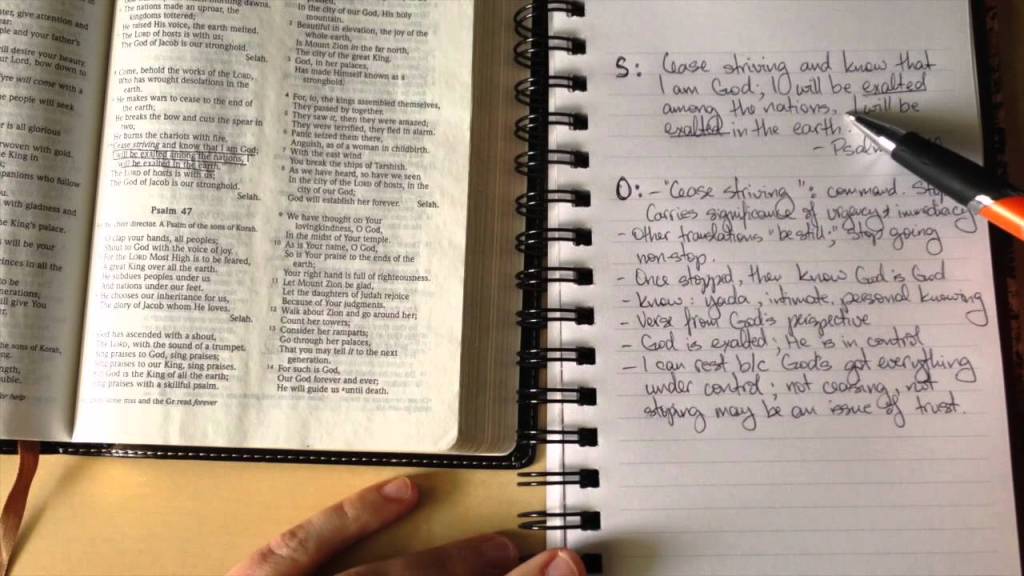
Another simple study method is called the ABC Method.  You can use this method for a paragraph or chapter, even a book of the Bible if you’re ambitious.  It goes like this:

You need to find A title for the passage.  That’s the “A”.

Then you need to decide on a Basic verse for the passage.  That’s the “B”

And, the “C” is for commitment.  What commitment has this passage made on your life?

Some students of the Bible add a “D” for “difficulty” to the study.  So, if there is something they don’t understand about the passage, they can research it a little later using more advanced study tools to better understand what is puzzling them.

Memorizing and Bible study go hand in hand.  The passages I’ve memorized keep coming to mind when I’m studying Scripture.  Maybe I’m reading a portion of Acts where the disciples are in trouble.  James chapter one comes to mind about trials, what they mean to us and how we are to respond to them.  Sometimes I even compare one passage I’ve memorized with another I’ve memorized or one I’ve heard on the radio program with one I’ve memorized and the Holy Spirit gives me insight through whose two passages being put side by side.

And, that’s it.  There’s nothing miraculous about better understanding the Bible.  It just takes some time and dedication.

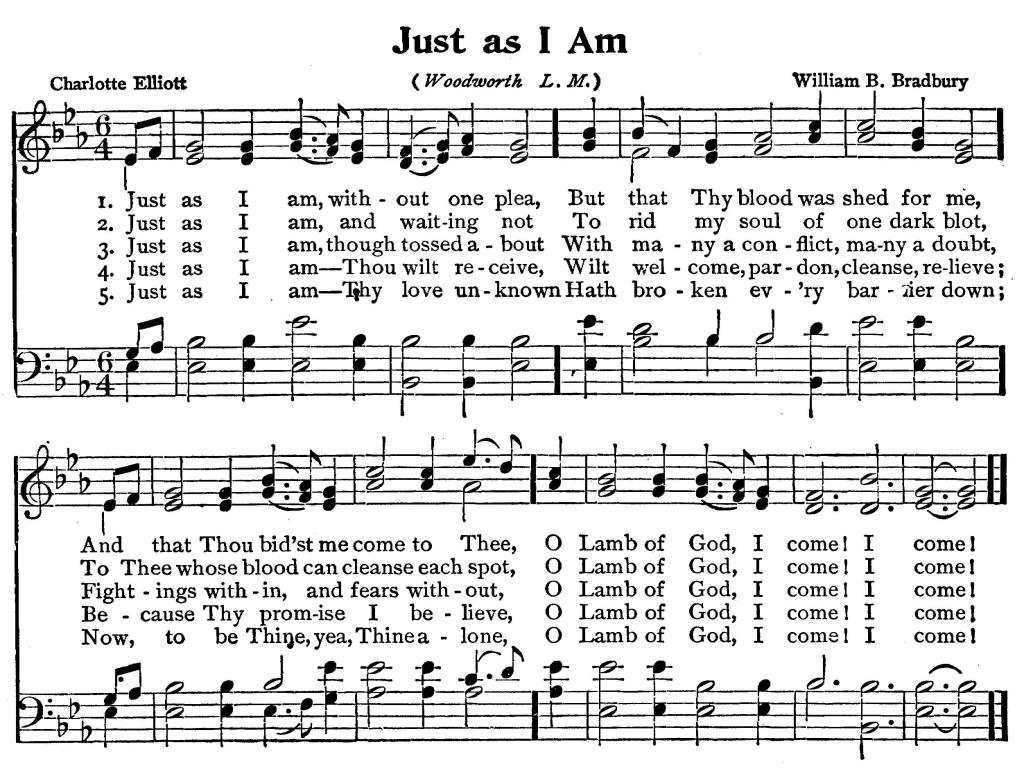
Just as We Are

The great old hymn Just As I Am has blessed millions over the years.  Billy Graham used it for decades to close his crusades.  There is a dramatic and inspiring story behind this wonderful hymn.

Charlotte Elliot was from an upper middle class and pious family.  Both her grandfathers were pastors as were her two brothers.  Charlotte received a college education at a time when few women did.  After college, she fell in with a somewhat worldly crowd and drifted away from her religious upbringing.

In 1821, Charlotte suffered a “severe illness.”  No one at the time knew what it was, but it left her an invalid the rest of her life.  Early in her illness, she befriended Belgian pastor Rev. Dr. Malan.  Rev Malan asked her if she had made peace with God.  Her response was that she wanted to clean up her life first.  Malan’s response was, “Come just as you are.”  She did, and from this came the hymn Just As I Am.

Spending most of her life in bed didn’t get Charlotte down.  She wrote 150 hymns, edited the Invalid’s Hymn Book including 115 of her own hymns, and edited an annual publication called The Christian Remembrance Pocket Book for some 25 years.

Her Hymn, Just As I Am, describes her attitude perfectly.  She did not let her condition prevent her from serving.

The other day, a couple of buddies and I talked about this very thing to a group of seniors, how we can’t allow our condition of life prevent us from serving.  I referred to a list I’d found on the internet to illustrate those who were unworthy or unable to serve, but did it anyway.  Moses was 80 before he was fully used by God. David had an affair, Mary Magdalene was likely a hooker, Gideon was a coward, and the list goes on.  My favorite on the list, though, was Lazarus.  He was dead, and God still used him.  With that in mind, what excuse can we really provide that would qualify us to sidestep service to God?

One of the women in this group of seniors said she couldn’t serve because she didn’t have a car.  Another in the group told her she was the finest Christian woman in the community.  She was an example to the others there, both believers and non-believers, of what it means to be a Christian.  Her ministry was to those in the seniors’ community there.

Philippians 1:6 says, “And I am sure of this, that he who began a good work in you will bring it to completion at the day of Jesus Christ.”  In other words, if we’re still alive, God hasn’t finished with us.  Our ministry is not complete until the day of Christ whether when He comes or we go to Him.

So, what can unqualified people do?  Well, there’s an old saying, “God doesn’t call the equipped, He equips the called.”  If God is telling us to do something, we need to do it.

When I took Economics in school, the instructor told us if we wanted to be successful entrepreneurs, we needed to do at least one thing each day to promote or advance the business.  It didn’t matter if it was just a phone call, answering a letter, or closing that big deal.  All were important.

If God is calling us to serve in an area, and we’re not quite sure precisely where He wants us but we have a general direction, we should take a step in that general direction.  God will guide us.

Two years ago I had no opportunities to teach.  Since this is my drive, my spiritual gift, I needed to find an outlet.  Teaching was the general need.  I needed to find a step that would lead me in that direction.  One result of the small steps I’ve taken is this blog.  In the two years it’s been in existence, it has reached 22 countries including places like Estonia and even Communist China.  It has had nearly 3350 views, and only God has promoted it.

A few months after I started the blog, I formed a website for Jehovah’s Witnesses.  It has been viewed over 1,000 times with little promotion.  The site has been visited from 20 countries worldwide including Senegal, South Africa, and the Ukraine.  These two sites, the blog and the website, cost me less than $100 a year, and I am not a tech person.  It’s just one way, one way a teacher, a shut-in, or a shy person can reach out and maybe make a difference for Christ.

I’ve learned if you’re uncertain about what steps to take but know what your direction should be, just step out in that direction.  If it’s of God, We’ll know it and need to take another step.  We may not be qualified or “spiritual” enough.  But, if God has called us, he’ll equip us.

Does a Fish Know He’s Wet?

Acts 17:28a (ESV)
28  for “‘In him we live and move and have our being’….”

When I attended philosophy classes in school, I was presented with questions, earth shaking questions, questions only the greatest trained minds could possibly ponder: Why don’t sheep shrink when it rains, why isn’t phonetics spelled phonetically, and does a fish know he’s wet?

The other day, I was discussing the latter with a friend and wondered if we might be like the fish.  Maybe Acts 17:28 means we’re immersed in God.  His presence is everywhere, right?  He’s all around us, yet most people don’t recognize He’s here because they’ve known nothing else.  Like the fish who has never been anything but wet, we’ve never been anything but immersed in the presence of God.

If we’ve been immersed in His presence since time began how would we understand that to be the case? It would seem to be the “normal” state of affairs.  The terrifying part for the fish is when he is removed from the water, gasps for water to breathe, and eventually suffocates.  He didn’t know he was wet or that there was an alternative state.

We humans are all going along in our happy lives.  Many deny the very God in which we are immersed.  Like the fish, we don’t know God surrounds us because we’ve never known a time when He hasn’t.

With that in mind, we know that God is love (1 John 4:16).  Maybe no love exists without God being present.  We love because we are saturated in the presence of God.  Our love for our friends, our spouses, our siblings, our parents, all may be drawn from the love that surrounds us in God’s presence.

Now let’s consider what sort of world it would be and what sort of lives we would lead without God surrounding us and without His love to draw on.  It would be a lonely unloving, and – since fear is the opposite of love – a terrifying existence.  There might be others around us but without love or any desire to commune together, help one another, or encourage one another, it would be a place of sadness, fear, and pain.  It would be a terrifying place, a very dark and empty existence.  It would be very much like what Jesus describes in Matthew 25:30:

Matthew 25:30 (ESV)
30  And cast the worthless servant into the outer darkness. In that place there will be weeping and gnashing of teeth.

Life wouldn’t end in that place, but love would.  If standing in the presence of God is light, then being cast away from His presence would be outer darkness.

God will not remove His light from those who reject Him while they are still here.  Surely they can love and have compassion for others because the love of God is still present, still around them filling them and protecting them.  They believe the love they express comes from them alone, not from God.  They have an inner darkness, though, a personal darkness.  The light in them comes only from being made in God’s image.  But, there will be a day when they will be asked to account for the light they were given, for what they have done with it.  If they have refused that light, rejected the love of God which surrounds them, if they refuse to believe they are “wet,” they will be cast into outer darkness, a place where there is no light, no love, no presence of God; only darkness and fear.

What was comfortable and natural for them when they were alive will now be foreign to them.  Now their natural state will be dark, empty, and alone.

The solution to this terrible tragedy is simple.  We are the light of the world.  We are the city on a hill.  We alone know we are immersed in God’s love.  We alone are the fish who know we’re wet.  Our job is to splash a little water around on fish who are drying.

Prayer

I’ve done at least one blog on prayer before, but I heard a new (new to me) concept of prayer and thought I’d share it here with you.

When our children are young, try to include them in things we do.  One example might be when I asked my son if he would like to build a headboard for our bed.  I could have done it myself, of course, and it might have looked pretty much the same.  It might even have taken less time, but the idea was to include my son in something I was doing, to teach him a useful skill, and to give him self-esteem through achievement.  That’s how we’re to build self-esteem, by the way, not praising our children for everything and anything they do.  But, I digress.

Let me take this opportunity to throw a little philosophy and theology your way.  God chooses to exist in three divine Persons: Father, Son, and Holy Spirit.  The standard philosophical definition of God is, “that of which nothing can be greater.” I think that is a good definition.   If you can think of something greater than your concept of God, then your concept is incorrect and God exists in that greater form.

The Bible tells us God is triune, so existing in three divine Persons must be the perfect and greatest way for God to exist.  Since that is true, then God is a communal being and seeks interaction with others.  Otherwise, He would just exist as one Person. 

Back to the topic at hand: prayer.  I’ve actually always had a bit of a problem with prayer, it’s purpose, that is.  I’ve always seen prayer as fellowship with God.  God is a communal Being.  Therefore, I concluded prayer to be God’s desire to interact with His children, and I think that’s pretty much true.  But our Pastor put a new spin on it I hadn’t considered before.

In his concept of prayer sees it as more than just fellowship.  He thinks God wants to include us in His work.  I agree.

Like when my son and I worked together to create that headboard, God has a task He wants done.  Also like working with my son, God wants to include us, so He impresses on us the desire to pray for a particular thing: the healing of a friend, the loss a widow experiences, the financial needs of a child.  We pray for that healing or sadness, or need, and God grants that prayer.  He could have done it without us, of course, but He didn’t want to. 

Again, like the example of my son and I, God wanted to show His child how things work, how He does things, what is possible.  He may also want to improve His child’s skills.  For instance, when we pray for someone in the hospital, His answer is often, “Go visit them.”  After we’ve visited the sick in the hospital enough times, we don’t pray so much about it but just do it.  We feel more comfortable doing it, too, because God has taught us the skills of what to say, what not to say, some of the stories to tell, etc.  God had built in us a more Christ-like spirit.  We just know what He wants.

Sometimes, we’re not sure how to pray about something, but there are lots of things we can be certain are in God’s will.  We know God wants everyone saved, so we know that is how to pray.  James says we are to visit orphans and widows (James 1:27) and so on.  The more we know God’s Word, the more certain we can be on how to pray and act on those prayers.

I have a different view of prayer now, a more exciting view, even a more precious view.  I now realize some of my prayer life involves God tapping me on the shoulder to say, “Let’s do something together.”