What’s a Disciple?

The Greek word translated disciple is mathetesThe Complete Word Study Dictionary: New Testament says it means “more in the NT than a mere pupil or learner.  It is an adherent who accepts the instruction given to him and makes it his rule of conduct.”

Is that the kind of disciples we are?  Look at John 6:66-69:

After this many of his disciples turned back and no longer walked with him. So Jesus said to the twelve, “Do you want to go away as well?” Simon Peter answered him, “Lord, to whom shall we go? You have the words of eternal life,and we have believed, and have come to know, that you are the Holy One of God.”

These “disciples” were among the five thousand men (plus women and children) who were fed earlier in the chapter with two fish and five loaves.  They had followed Jesus because they had been fed physical food.  They were looking for more of the same and thought Jesus was a sort of food dispenser.  Jesus said rather that He was the bread of life, and they needed to eat His flesh and drink His blood to gain eternal life. 

“Eat My flesh and drink My blood?”  This was the hard saying Jesus shared with the crowd and the saying that had caused them to turn back and desert Him.  The twelve stayed, though.  When asked  why they hadn’t left Jesus too, Peter answered where else could they go?  Jesus alone has the words of life.  He alone is the Holy One of God.

In reading this I began to think how much of a disciple I truly am.  When God tells me to do something hard, do I do that gladly?  When I read a convicting passage, do I turn to God or turn away to my fleshly desires?

A few blogs back, I pointed out that Jesus forced or coerced His disciples into the boat to cross the Sea of Galilee.  I think they could have refused.  Four of these men were experienced fishermen extremely familiar with the Sea of Galilee, yet they got into the boat and crossed over through a violent story.

How often in our Christian walks has God asked us to do something extremely difficult, something we know will be dangerous or cost us greatly?  When this happens, do we act like the disciples who turned away from Jesus because His sayings were hard, or are we like those who got into that boat while recognizing the severe trial they were about to face?  The latter is the type of disciple we want to be, the type we see in John 6:65-69, someone who can see no alternative but to do as we’re told or as we’ve been taught by the Holy Spirit.

Why is this important?

Too often I find myself with the crowd who turned their backs and walked the other way.  It’s a good thing we have a God Who is loving, forgiving, and longsuffering.  The times I run back to Him for forgiveness saying as Peter did: “Lord, to Whom shall I go?” are countless.

I find we still serve a God who accepts the prodigal with open arms, dresses him in a fine robe and places a ring on his finger.  We serve a God Who alone has the words of eternal life.

Then I remember I am to be a disciple, an adherent to the Word of God who accepts the instruction given to him and makes it his rule of conduct.

Little Things

Little things can do big things. We started this blog in 2017, just seven years ago in June. Last year, we had 4530 views from 92 countries. This costs me a few hours per week and less than $100 per year for the web presence.

I wanted to encourage you if God has placed a ministry on your heart and you think it’s just some foolish simple idea, listen to God. Touch people’s lives in one way or another, God is anxious for you to succeed in His power.

Here is a list of the countries where this blog was read last year. You’ll notice some of these are countries where it is illegal to provide the gospel. I’m always blown away by how God can use unworthy people:

United States

Philippines

Canada

United Kingdom

Australia

India

Ireland

France

China

South Korea

Nigeria

Singapore

Kenya

Indonesia

Germany

New Zealand

Ghana

Netherlands

Sweden

Mexico

Brazil

Japan

Malaysia

Romania

South Africa

Uganda

Hong Kong SAR China

Czechia

Vietnam

Belize

Zambia

European Union

Saudi Arabia

Tanzania 3

Myanmar (Burma) 3

Bahrain

Spain

Puerto Rico

Georgia

Unknown Region

Taiwan

Hungary

Russia

Slovakia

Sri Lanka

Lebanon

Thailand

Cambodia

Denmark

Panama

Chile

United Arab Emirates

Ethiopia

Malta

Israel

Morocco

Trinidad & Tobago

Laos

Aruba

Poland

Honduras

Papua New Guinea

Finland

Uzbekistan

Uruguay

Ukraine

Belgium

Nepal

Argentina

Guatemala

Algeria

Dominican Republic

Turkey

Colombia

Bangladesh

Réunion

Eswatini

Greece

Iraq

American Samoa

Croatia

Jersey

Mauritius

Ecuador

Cameroon

Syria

Fiji

Guam

Lesotho

Albania

Italy

Egypt

Pakistan

Portugal

Who Says Jesus is Risen?

Who says Jesus is risen from the dead?  Let’s see.

Of course, the four gospels tells us of Jesus’ resurrection (Matt. 28:1-10; Mark 16:1-8; Luke 24:1-49; John 20:1-29)  and the book of Acts speaks of the risen Savior (Acts 1:1-11).

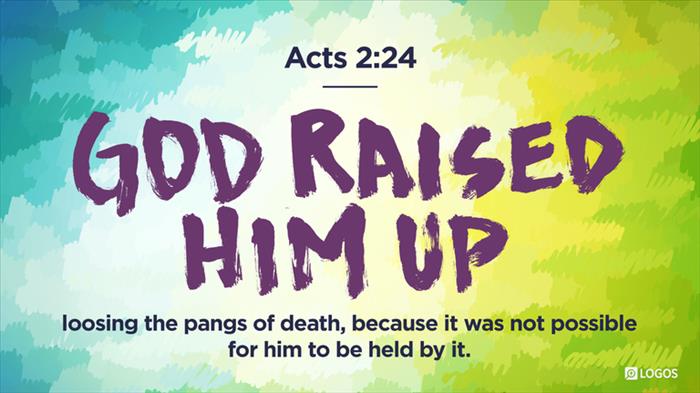
Peter speaks of Jesus resurrection in his first sermon in Acts 2:24 God raised him up, loosing the pangs of death, because it was not possible for him to be held by it. Every sermon in the early church was an Easter sermon.

Steven prayed to the risen Jesus in Acts 7:59-60 And as they were stoning Stephen, he called out, “Lord Jesus, receive my spirit.” And falling to his knees he cried out with a loud voice, “Lord, do not hold this sin against them.” And when he had said this, he fell asleep.

Paul meets the risen Christ (Acts 9:1-9) and writes about Him (Rom. 8:11)  If the Spirit of him who raised Jesus from the dead dwells in you, he who raised Christ Jesus from the dead will also give life to your mortal bodies through his Spirit who dwells in you.

The writer of Hebrews says Jesus is risen:  Heb. 13:20 Now may the God of peace who brought again from the dead our Lord Jesus, the great shepherd of the sheep, by the blood of the eternal covenant, 21 equip you with everything good that you may do his will, working in us that which is pleasing in his sight, through Jesus Christ, to whom be glory forever and ever. Amen.

Apostolic Fathers:

Clement of Rome (circ. 80 a.d.)  “Let us consider, beloved, how the Lord continually proves to us that there shall be a future resurrection, of which He has rendered the Lord Jesus Christ the first-fruits by raising Him from the dead.” (1 Clement Chapter 24)

Polycarp (circ. 155 a.d.)  “But He who raised Him up from the dead will raise up us also, if we do His will, and walk in His commandments, and love what He loved, keeping ourselves from all unrighteousness, covetousness, love of money, evil speaking, false witness;”  (Polycarp’s Epistle to the Philippians chapter 2)

Ignatius (circ. 108)  Jesus Christ, who was descended from David, and was also of Mary; who was truly born, and did eat and drink. He was truly persecuted under Pontius Pilate; He was truly crucified, and [truly] died, in the sight of beings in heaven, and on earth, and under the earth. He was also truly raised from the dead, (Epistle of Ignatius to Trallians, Chapter 9)

Non-Christian Historian:

The Jewish historian, Flavius Josephus, a contemporary of Paul, wrote this:  “At this time there was a wise man called Jesus, and his conduct was good, and he was known to be virtuous. Many people among the Jews and the other nations became his disciples. Pilate condemned him to be crucified and to die. But those who had become his disciples did not abandon his discipleship. They reported that he had appeared to them three days after his crucifixion, and that he was alive. Accordingly, he was perhaps the Messiah, concerning whom the prophets have reported wonders. And the tribe of the Christians, so named after him, has not disappeared to this day” (Antiquities 18.63-64, ca. AD 93 Agapian version).

Most Importantly

Jesus Himself claimed to have been raised in the same body that died on Calvary, not a spirit, not someone else created for this purpose.  Jesus left no room for misunderstanding this:

Luke 24:36-43 (ESV)  As they were talking about these things, Jesus himself stood among them, and said to them, “Peace to you!” But they were startled and frightened and thought they saw a spirit. And he said to them, “Why are you troubled, and why do doubts arise in your hearts? See my hands and my feet, that it is I myself. Touch me, and see. For a spirit does not have flesh and bones as you see that I have.” And when he had said this, he showed them his hands and his feet. And while they still disbelieved for joy and were marveling, he said to them, “Have you anything here to eat?” They gave him a piece of broiled fish, and he took it and ate before them.

Why is this important?

There are people today who deny the bodily resurrection of Jesus even within what we might call Christianity yet they can hardly be called Christian if they deny the central miracle upon which our faith is based. 

1 Cor. 15:12-14 (ESV)  Now if Christ is proclaimed as raised from the dead, how can some of you say that there is no resurrection of the dead? 13 But if there is no resurrection of the dead, then not even Christ has been raised. 14 And if Christ has not been raised, then our preaching is in vain and your faith is in vain.

Good Friday

Since this coming Friday is Good Friday, I thought I’d share some Scriptures that mean a lot to me concerning that day:

Concerning Jesus, Col. 1:15-18 (ESV) says,  He is the image of the invisible God, the firstborn of all creation. For by him all things were created, in heaven and on earth, visible and invisible, whether thrones or dominions or rulers or authorities—all things were created through him and for him. And he is before all things, and in him all things hold together. And he is the head of the body, the church. He is the beginning, the firstborn from the dead, that in everything he might be preeminent.

Paul says Jesus is the image of the invisible God, and I got to thinking how we get an image from Someone Who is invisible.  Hebrews 1:3 says Jesus is “the exact imprint of [God’s] nature.”  The term is used of a signet wring and the exact impression it leaves.  It means what God is Jesus is.  In that way, Jesus is the image of God the Father: Identical in nature. Jesus told Philip, “If you’ve seen me, you’ve seen the Father.”

The next term we might misunderstand is that Jesus is “the firstborn of all creation.”  At first glance, we might think Jesus was the first one born of creation.  We know that can’t be what it means because the passage itself says Jesus created “all things.”  He didn’t create all other things or He would be one of the things created.  The passage doesn’t allow for that.  So, what can “firstborn” mean.

It turns out sometimes “firstborn” means just that.  Jesus is called Mary’s firstborn son in Luke 2:7.  However, “firstborn” means much more.  It means the preeminent one and that’s not always the first one born.  Manasseh is called Joseph’s firstborn and Ephraim his second in Genesis 41:51-52, but Ephraim is called the firstborn in Jeremiah 31:9.  In Psalm 89, David is called God’s firstborn but was the youngest of 8 sons, hardly the first one born.

No.  Firstborn means the preeminent one in the family or in a people, such as in David’s case, or in all of creation as with Jesus since He created it all and is before all things.  Jesus is also called the “firstborn from the dead” though He was certainly not the first to die and rise.  He Himself raised the son of the widow at Naim (Luke 7:11-16), Jairus’s daughter (Luke 8:49-56), and Lazarus (John 11:1-44).  So, Jesus was not the first one raised from the dead but is the firstborn of the dead.  He is the preeminent over those who have died.

Col. 1:18 also says Jesus is the beginning.  What do you suppose that means?  The Greek word for beginning here is arche.  We use it in English to indicate the beginner of a building, the architect.  This simply indicates Jesus is the builder and designer of the universe.

Why is this important?

We’ve looked at how magnificent Jesus is.  He is God, the God of the universe, the God of creation, the God of all.  Now I think we should look at just what He did that we observe on Good Friday:

Phil 2:5-8 (ESV)  Have this mind among yourselves, which is yours in Christ Jesus, who, though he was in the form of God, did not count equality with God a thing to be grasped, but emptied himself, by taking the form of a servant, being born in the likeness of men. And being found in human form, he humbled himself by becoming obedient to the point of death, even death on a cross.

Jesus, the preeminent, awesome, omnipotent, omniscient God the Son, is the absolute authority over all of creation.  Yet this omnipotent God chose to step from the highest throne, empty Himself of His glory, and step into time and space in order to humble Himself by becoming flesh and allowing that flesh to die for you and for me.  How much greater sacrifice could there be for us?

One more point, though, in Philippians:

Phil. 2:1-4 (ESV)  So if there is any encouragement in Christ, any comfort from love, any participation in the Spirit, any affection and sympathy, complete my joy by being of the same mind, having the same love, being in full accord and of one mind. Do nothing from selfish ambition or conceit, but in humility count others more significant than yourselves. Let each of you look not only to his own interests, but also to the interests of others.

The short four verses before Philippians 2:5 tell us to have the same mind as Christ and to do that by encouraging, loving, doing nothing from selfish ambition or conceit, but humbly counting others more significant than ourselves.  That’s the sort of observance Jesus would like to see on Good Friday and every day of our lives. 

How Did God Harden Pharaoh’s Heart?

Ex 4:21 (ESV)  And the Lord said to Moses, “When you go back to Egypt, see that you do before Pharaoh all the miracles that I have put in your power. But I will harden his heart, so that he will not let the people go.

“How could God be so unfair to hold Pharaoh responsible for decisions he made after God forced him to have a hardened heart?”  Have you ever heard that?  I certainly have, and it has bothered me for years for the very reason stated.

Of course, I believe whatever God says or does is good since He Himself is the standard for good.  I just don’t understand the fairness issue.  Then last night I was in a discussion with some friends when the idea came to me I’d like to present here.  I must admit I haven’t checked it through yet, and I may need to come back and apologize for this.  After all, “New truth is almost always old heresy,” as a hero of mine used to say, but it is certainly a good explanation considering the nature of God.

We all have to deal with our pride at times and our competitiveness.  When we’re really good at something and have been on the top of our game for years we begin to think no one can do better.  Then someone comes along, usually an “outsider,” who is so much better than we are we can’t stand it.  It may be pride or it may be jealousy, but we just can’t stand that person. The better they are, the more we “harden” ourselves against them.

Imagine what it must have been like for Pharaoh to be the head guy, the ultimate god of his realm, for decades.  No one would dare challenge him, and certainly no one had more power than he.  Then this sheep herder (Moses) comes to Pharaoh and tells him he has a God greater than Pharaoh himself.  So much greater, in fact, if Pharaoh doesn’t yield to the wishes of this hick’s invisible God, he would be sorry.

Moses comes to Pharaoh and tells him his God says to let the Israelites go.  Pharaoh’s response is just what anyone might do.  He asks “Who is this God that I should obey Him?  In fact, let me show you what I can do.”  Then Pharaoh tells them they have to gather their own straw to make their bricks and still make the same number of bricks every day.  I’m sure Pharaoh thought that would be the end of it.  He’s a little angry, a little prideful, maybe even a little insulted this shepherd is trying to persuade him to release the Israelites, but he’s exerted his authority and one-upped the shepherd and his God. It’s done!

Pharaoh’s heart hasn’t hardened yet.  He’s a bit perturbed at the upstart hicks coming and demanding release of his slaves.  But now he thinks he’s dealt with the problem, and no one will mess with him again.

It’s when Moses and Aaron return we read God hardens Pharaoh’s heart.  Moses threw Aaron’s rod down and it became a snake. So, Pharaoh had his magicians do the same, but God’s snake ate the magicians’ snakes.  Pharaoh was one-upped.  Now Pharaoh has Someone who has more power than he.  The plagues begin and Pharaoh fights back every time being shown to be less powerful than the God of Moses.  This makes him angrier and angrier.  His pride has been destroyed and his authority challenged.

Why is this important?

Just as with you and me, when some newcomer show himself better at something than we are, better at something we think we are really good at, we are tempted to reject that person.  Like kids in a schoolyard, we might talk down the abilities of the person, try to show them up.  In effect, our hearts have become hardened toward them.

I believe it’s the same thing with Pharaoh.  He was the ultimate authority, the ultimate god. Then this God of a sheep herder comes up with all these tricks bettering him at every turn.  He became angrier and angrier with this God until there was no coming back to a reasonable response.  His heart was hardened and God, by His presence and His actions trying to persuade Pharaoh. Pharaoh’s ego caused him to hate Him to the point of madness. 

God hardened Pharaoh’s heart indirectly, not directly.  It was still Pharaoh who was creating the hardening.  God, simply by the fact He was greater than Pharaoh caused Pharaoh’s jealousy to harden his heart.  Naturally, God new it would happen and knew His actions would cause Pharaoh’s heart to harden, but it was Pharaoh’s free will to hate God which hardened him.

Rom. 9:14-18 (ESV)  What shall we say then? Is there injustice on God’s part? By no means! 15 For he says to Moses, “I will have mercy on whom I have mercy, and I will have compassion on whom I have compassion.” 16 So then it depends not on human will or exertion, but on God, who has mercy. 17 For the Scripture says to Pharaoh, “For this very purpose I have raised you up, that I might show my power in you, and that my name might be proclaimed in all the earth.” 18 So then he has mercy on whomever he wills, and he hardens whomever he wills.

The Divine Jesus

Last week we looked at whether Jesus, the historic figure, existed.  We saw there was good evidence supporting the fact He did and, of course, still does.  The next natural step would be to ask if the “Jesus of Faith,” as liberal Catholic theologian, John Dominic Crossan calls the Jesus of miracles, the Jesus identified as God’s Son, the divine Jesus. 

How might we answer those who doubt the Jesus of Faith existed historically.

First we’d mention the existence of the church.  The church didn’t spring up in New Deli, Lower Eyelid, Montana, or some other far off land where people were ignorant of the divine Jesus.  No, the church began right in the very city where Jesus had been crucified and where His followers claimed He was raised from the dead: Jerusalem. And that church was formed only a few short weeks after Jesus’ crucifixion.  Imagine, if you will, someone trying to start a religious movement in Dallas Texas claiming the resurrected JFK.  It would never wash.  The Dallas locals had seen John Kennedy shot and knew he had been buried and stayed buried.  The early church in Jerusalem consisted of thousands of Jerusalem residents and foreign visitors who would know the story and if it were true.

Next, we’d point to the conversion of the apostle Paul.  He began as an enemy of the church arresting and possibly killing Christians.  In just a few moments, Paul was changed from an enemy of the church to one if its greatest evangelists. How do you suppose that happened unless what he said were true, that he had met the risen Christ?

Then we could bring to their attention the disciples: twelve men, eyewitnesses to the divine Jesus and His works, who all died a miserable or violent death (except for John) never going back on their story of the divine Jesus.

How about the Apostolic Fathers, the disciples of the disciples?  Polycarp, a disciple of the Apostle John, says the following showing Jesus as divine:

“Now may the God and Father of our Lord Jesus Christ, and the eternal High-priest Himself the Son of God Jesus Christ, build you up in faith and truth, and in all gentleness and in all avoidance of wrath and in forbearance and long-suffering and in patient endurance and in purity; and may He grant unto you a lot and portion among His saints, and to us with you, and to all that are under heaven, who shall believe on our Lord and God Jesus Christ and on His Father that raised him from the dead,” (Polycarp, Letter to the Philippians, Chapter 12).

Ignatius, another of the Apostle John’s disciples penned this claim to Christ’s godhood as well:

For our God, Jesus Christ, was, according to the appointment of God, conceived in the womb by Mary, of the seed of David, but by the Holy Ghost.  (Ante-Nicene Fathers: Volume I: The Apostolic Fathers, Justin Martyr, Irenaeus (Kindle Locations 3097-3098). Veritatis Splendor Publications. Kindle Edition).

Lastly, but certainly not the least of the sources is the New Testament documents.  Three of the four gospels were written by actual eyewitnesses to the ministry and resurrection of Jesus and bear testimony of what they saw. 

Each of the four gospels state Jesus is divine, equal with the Father, by using the term “Son of God.”  John tells us this term is equal to the term “God the Son:”

John 5:18 (ESV)  This was why the Jews were seeking all the more to kill him, because not only was he breaking the Sabbath, but he was even calling God his own Father, making himself equal with God.

So, the Jews and the disciples all recognized Jesus was claiming to be God.  Each of the gospel writers uses this term to describe Jesus: Matthew 14:33; Mark 1:1; Luke 1:35; John 5:18.

Now, some will say many of these are biased Christian sources written long after the events took place.  To them I would ask, if you walked with a man for three years, if He told you He would die and then rise from the dead, and you saw that happen, would you not put your faith in Him and become a Christian?

Written later? We have copies of the gospels within 100 years of their writing including a manuscript of John’s gospel dated within 30 years of the original. Manuscript authority is strong for the New Testament.

The apostle Paul tells us the risen Jesus showed Himself to more than 500 people after His resurrection and challenges doubters to talk with them to verify his claims (1 Cor. 15:6).  In effect, Paul is saying “If you don’t believe me, check with these people!”

Why is this important?

Our faith is founded on fact.  These events happened in real time and space.  They are not just figments of the writers’ imaginations.  Except for John, each of the New Testament writers and other characters died a horrible death and never retreated from their testimonies.  Some preached the gospel message with their final breaths.  According to Church history, Bartholomew was skinned alive, Paul, Matthew, Lazarus, and James the son of Zebedee were beheaded. Peter, Philip, and Andrew were crucified. James the Just (Jesus’ half brother) was thrown down from the temple wall in Jerusalem then beaten and stoned to death. Mark planted churches in Egypt and was dragged to death behind two horses there. Thomas planted seven churches in western India and died from a spear wound but finished preaching first. Jude (Jesus’ half brother) was beaten to death in Persia. Luke was hanged from an olive tree in Greece at age 84, James the son of Alphaeus and Simon the Zealot were martyred in Persia (no record of how).

These men all died holding the truth of Gospel of Jesus as most sacred and with a personal relationship with the Son of God, Jesus Christ. We should as well.

Did Jesus Exist?

Like you, I’m sure, I’ve had folks tell me I can’t even prove Jesus ever existed.  The first couple of times I heard this, I was caught flatfooted.  I didn’t know what to say.  It seemed so obvious to me that Jesus is a real historical figure, I couldn’t believe anyone doubted it at that level.  People do, though, so let’s look at some of the evidence for Jesus’ existence:

The New Testament:  Of course we have 27 historical documents that speak of Jesus of Nazareth in a lot of ways.  He is man, God, Messiah, example, friend, etc.  Of these 27 books, all but four – Luke, Acts, Hebrews, and Jude – were written by eyewitnesses to the resurrected Jesus, and we’re not sure about the writers of Hebrews and Jude.  They may have seen Him as well.

Extrabiblical Writings.  Here is a list of ancient historians and philosophers who mention Jesus Christ (this list is taken from Excavating the Evidence for Jesus: The Archaeology and History of Christ and the Gospels by Titus M. Kennedy PhD): 

Flavius Josephus  “At this time there was a wise man called Jesus, and his conduct was good, and he was known to be virtuous. Many people among the Jews and the other nations became his disciples. Pilate condemned him to be crucified and to die. But those who had become his disciples did not abandon his discipleship. They reported that he had appeared to them three days after his crucifixion, and that he was alive. Accordingly, he was perhaps the Messiah, concerning whom the prophets have reported wonders. And the tribe of the Christians, so named after him, has not disappeared to this day” (Antiquities 18.63-64, ca. AD 93 Agapian version).

“Festus was now dead, and Albinus was but upon the road; so he assembled the Sanhedrin of judges, and brought before them the brother of Jesus, who was called Christ, whose name was James” (Josephus, Antiquities 20.200, ca. AD 93).

Tacitus  “Hence to suppress the rumor, he falsely charged with the guilt, and punished with the most exquisite tortures, the persons commonly called Christians, who were hated for their enormities. Christus, the founder of the name, was put to death by Pontius Pilate, procurator of Judea in the reign of Tiberius; but the pernicious superstition, repressed for a time, broke out again, not only through Judea, where the mischief originated, but through the city of Rome also” (Tacitus, Annals 15.44, ca. AD 116).

Suetonius   “Since the Jews constantly made disturbances at the instigation of Chrestus, he expelled them from Rome” (Suetonius, Divus Claudius 25, ca. AD 121).

Pliny the Younger   “[ T] hey were in the habit of meeting on a certain fixed day before it was light, when they sang in alternate verse a hymn to Christ as to a god…” (Letter to Emperor Trajan, ca. AD 112).

Lucian of Samosata  “He learned the wondrous lore of the Christians, by associating with their priests and scribes in Palestina… they still worship, the man who was crucified in Palestina because he introduced this new cult into the world… denying the Greek gods and by worshipping that crucified sophist himself and living under his laws” (Lucian, Passing of Peregrinus 11-13, ca. AD 166).

Celsus: “For he represents him disputing with Jesus, and confuting him, as he thinks, on many points; and in the first place, he accuses him of having ‘invented his birth from a virgin,’ and upbraids him with being ‘born in a certain Jewish village, of a poor woman of the country, who gained her subsistence by spinning, and who was turned out of doors by her husband, a carpenter by trade, because she was convicted of adultery; that after being driven away by her husband, and wandering about for a time, she disgracefully gave birth to Jesus, an illegitimate child, who having hired himself out as a servant in Egypt on account of his poverty, and having there acquired some miraculous powers, on which the Egyptians greatly pride themselves, returned to his own country, highly elated on account of them, and by means of these proclaimed himself a god’” (Origen quoting Celsus, The True Word ca. AD 176, in Contra Celsus 1.28).

Why is this important?

Believe it or not, there are millions of people in the world who doubt even the physical existence of the historical Jesus (the man born in Bethlehem) let alone the Jesus of faith (the miraculous Jesus Who walked on water).

How wide spread is the view of the Mythicists, people who deny Jesus existed?  Bart Ehrman, in an interview of his book Did Jesus Exist? The Historical Argument for Jesus of Nazareth, Bart Ehrman, historian and professor of religious studies at the University of North Carolina Chapel Hill, said this in an 2012 interview on NPR: “It was a surprise to me to see how influential these mythicists are,” Ehrman says. “Historically, they’ve been significant and in the Soviet Union, in fact, the mythicist view was the dominant view, and even today, in some parts of the West – in parts of Scandinavia — it is a dominant view that Jesus never existed.”

Even widely recognized publications such as the Washington Post have printed at least one article shedding doubt on the very existence of Jesus: Did historical Jesus really exist? The evidence just doesn’t add up. By Raphael Lataster 12/18/2014.

Did Jesus Force The Disciples Into Trials

Many of us believe when we’re facing a tough patch it’s because of poor decisions or sin in our lives, but sometimes it isn’t. Sometimes God puts us there.

Let’s look at the Gospel of John chapter six, specifically the story of Jesus walking on the water.  John’s description of the miracle is a little shorter than those in Matthew and Mark.  So, I went to Mark’s gospel to get a fuller picture, and what a picture.

My favorite portions of Scripture are those which tell us things about Jesus’ personality, His nature, how He thinks, and Mark 6:45-51 says a lot:

45 Immediately he made his disciples get into the boat and go before him to the other side, to Bethsaida, while he dismissed the crowd. 46 And after he had taken leave of them, he went up on the mountain to pray. 47 And when evening came, the boat was out on the sea, and he was alone on the land. 48 And he saw that they were making headway painfully, for the wind was against them. And about the fourth watch of the night he came to them, walking on the sea. He meant to pass by them, 49 but when they saw him walking on the sea they thought it was a ghost, and cried out, 50 for they all saw him and were terrified. But immediately he spoke to them and said, “Take heart; it is I. Do not be afraid.” 51 And he got into the boat with them, and the wind ceased. And they were utterly astounded, 52 for they did not understand about the loaves, but their hearts were hardened.

In verse 45, the word “made” means exactly that: Jesus forced them into the boat to sail to Bethsaida which was just up the coast  from where Jesus had just fed the 5,000 men.  It was not until evening that the disciples were to head for Capernaum (Mark 6:47 cf John 6:17)

The disciples were having a terrible time in the storm rowing to the other side of the Sea of Galilee.  In fact the word translated “painfully” in verse 48 is the word used to describe the torments of hell (Matt. 8:29; Mark 5:7).  So, Jesus’ disciples where having more than just a miserable time rowing across the sea.

A couple of other verses tell us how tough this journey was.  John 6:19 tells us they had only rowed about three or four miles when Jesus came by them walking on the water.  This was probably a 27 foot boat that held 17 people if needed. The ruins of such a boat dated to this time were found at the Sea of Galilee in 1986. This boat could only be rowed by four men at a time, so it was tough going in such a storm.

Verse 48 above tells us it was the “fourth watch” when Jesus came by.  The Romans divided the night into four three-hour watches: six p.m. to nine, nine to midnight, midnight to three a.m., and three to six.  So, the disciples had been rowing most of the night.  It was after three in the morning, and they had only made it three or four miles since evening.  Here I’d like to say “Hooray for the disciples” who stuck to is for so long. 

The most fascinating verse in this passage to me, though is, of course,verse 48.  Jesus was going to pass the disciples by even though they were in a torturous situation.  In fact, as we saw in verse 45, Jesus forced them into this.  He wasn’t meaning to do anything to help them?  The text seems to say “no.”

Why is this important?

From this, I get that sometimes Jesus puts us in extremely situations as He did with Job, and like this example with the disciples, He isn’t going to get us out of it unless we invite Him to. 

Let’s look at a couple of other verses before we conclude:

Again in verse 48 we see that Jesus kept His eye on them all the time.  When we face storms in our lives, God’s eyes are never diverted from us.  He keeps a close watch on us.  We also see in this same verse that the storm ceased once Jesus was in the boat with the disciples.  It hadn’t stopped when Jesus was walking on the water or when the disciples were doing their best to follow Jesus’ orders.  It stopped when they invited Him in.  Had they not invited Him in, I think He would have allowed them to suffer on their own.

Our storms are just like that.  Our own efforts are not enough, but the effects of the difficulties in our lives can cease once we invite Jesus into the boat. Yes, the difficulties themselves can continue, but the calm arrives with Jesus.

So, why would Jesus force the disciples to go through this and why do we need to do the same sometimes?  The text doesn’t say directly, but I think the same event as it is recorded in Matthew can help with this:

Matt. 14:33  (ESV)  And those in the boat worshiped him, saying, “Truly you are the Son of God.”

Storms in our lives point us to God.  Reliance on Him to “save the day” and seeing that salvation brings us to the only conclusion we can see, that He is the Son of God (God the Son –  John 5:18) and to fall on our knees and worship Him. If we just don’t get it, He will force us into situations that cause us to arrive at the same conclusion the disciples came to.

Honest Differences

Acts 15:38-39 (ESV)  38 But Paul thought best not to take with them one who had withdrawn from them in Pamphylia and had not gone with them to the work. 39 And there arose a sharp disagreement, so that they separated from each other. Barnabas took Mark with him and sailed away to Cyprus,

Sometimes I write things for which there are honest disagreements in the church.  I personally think disagreement is a good thing since it forces some folks, including me, to read more deeply or research more fully.

The concern of many who have contacted me after I post such a subject is that there might be divisions caused within the church.  If that’s true, the burden must fall on those who decide to leave or fight because of what someone else believes rather than seek an honest and peaceful resolution.  Paul tells us to test all things in his closing remarks to the Thessalonian church:

1 Thess. 5:19-21 (ESV)  Do not quench the Spirit.  Do not despise prophecies, but test everything; hold fast what is good.

This passage assumes there are things to test.

But what do we do if people disagree?  Jesus tells us we are to keep peace with our brothers:

Matt. 5:23-24 (ESV)  So if you are offering your gift at the altar and there remember that your brother has something against you, 24 leave your gift there before the altar and go. First be reconciled to your brother, and then come and offer your gift.

The best way to resolve these differences is through the method the Jews in Berea pursued:

Acts 17:10-11 (ESV)  The brothers immediately sent Paul and Silas away by night to Berea, and when they arrived they went into the Jewish synagogue. 11 Now these Jews were more noble than those in Thessalonica; they received the word with all eagerness, examining the Scriptures daily to see if these things were so.

What better way to arrive at the truth?  Scripture is the standard of Christian conduct and belief.  There is no other true source for the final word.

Why is this important?

If we still can’t arrive at an agreement with another and we attend a Bible believing church, our disagreement is probably not on a major doctrinal issue such as salvation or another central issue within our faith. 

It may be a pride issue with us being unwilling to accept the sound view of others.  Remember the church has had 2,000 years to go over the Bible and what it teaches.  It has been questioned millions of times from within the church and without.  Our constant study of Scripture should prepare us to see the truth in the views of others and perhaps the faults in our own. Chances are very high the disagreement has been addressed many times before.

Yes, there are some fairly large differences within the church which can cause dissension: Calvinism vs Traditionalism, Eternal Security, Old Earth vs. Young Earth, etc.  I’m sure I disagree on these with friends that I respect in their Christian walk and see as very knowledgeable biblical teachings.  That’s okay.  We can disagree.  It’s when we decide to push our views to the point of causing dissension in the church that we sin.  In fact that is something God hates:

Prov. 6:16-19 (ESV)  There are six things that the Lord hates, seven that are an abomination to him haughty eyes, a lying tongue, and hands that shed innocent blood, a heart that devises wicked plans, feet that make haste to run to evil, a false witness who breathes out lies, and one who sows discord among brothers.

So, if you have a doctrinal disagreement with another Christian, and it’s causing a rift between you, go to them with Bible in hand and do your best work it out.  If needed, seek church leadership for insight.  The point is, we can differ in finer points of understanding so long as we don’t cause division.

Eternal Security

Jude 24 (ESV)  Now to him who is able to keep you from stumbling and to present you blameless before the presence of his glory with great joy,

Years ago I was sitting in the steam room at a gym when two men started a conversation about eternal security, whether once saved we were always saved.  I jumped into the conversation and asked if the eternal life Jesus promises in John 3:16 began when we accepted Him or when we die.  Both men said it began when we accepted Him.  John the apostle agrees in 1 John 5:13:

(ESV)  I write these things to you who believe in the name of the Son of God, that you may know that you have eternal life.

So, my next question to the men was “If we have eternal life and God can take it away or we lose because of sin, was it really eternal or life just until our next sin?”  The steam room went silent.

There are a number of passages used by those who would deny eternal security for the believer, but because of space, I will only address the most common one here:

Heb. 6:4-5 (NASB)  For in the case of those who have once been enlightened and have tasted of the heavenly gift and have been made partakers of the Holy Spirit, and have tasted the good word of God and the powers of the age to come, and then have fallen away, it is impossible to renew them again to repentance,  bsince they again crucify to themselves the Son of God, and put Him to open shame.

This passage in Hebrews could describe even Judas who betrayed our Lord.  He was enlightened of the Gospel, tasted (but did not consume) the heavenly gift, and was a partaker of the Holy Spirit.  The word “partaker” here doesn’t mean this person received the Holy Spirit.  Here’s what Kenneth S. Wuest says in his Wuest’s Word Studies In the Greek New Testament:

“Thus the word signifies one who participates with another in a common  activity or possession. It is so used here. These Hebrews became participators in the Holy Spirit insofar as an unsaved person can do so, namely, in the sense that they willingly co-operated with Him in receiving His pre-salvation ministry, that of leading them on step by step toward the act of faith. He had led them into the act of repentance. The next step would be that of faith.”

So, Hebrews 6:4-5 in context does not mean you can lose your salvation.  It simply speaks of those who have come close but rejected the idea of receiving Jesus as their personal Savior and Lord.

As Jude says in the verse at the beginning of this post, it is God who is able to retain our eternal life for us.  It is He Who is able to keep us from stumbling, not us and not our actions.

Jesus Himself emphasizes this:  John 10:27-29 (NASB)  “My sheep hear My voice, and I know them, and they follow Me; and I give eternal life to them, and they shall never perish; and no one shall snatch them out of My hand. “My Father, who has given them to Me, is greater than all; and no one is able to snatch them out of the Father’s hand.

The term “no one” is absolute in Greek and means not one single thing or person can snatch us from the Father’s hand.  We are secure.

Why is this important?

First, of course, God makes promises and keeps them all.  He has promised eternal life and has sealed us in that eternal life by His Holy Spirit:

Eph. 1:13-14 (ESV)  In him you also, when you heard the word of truth, the gospel of your salvation, and believed in him, were sealed with the promised Holy Spirit, 14 who is the guarantee of our inheritance until we acquire possession of it, to the praise of his glory.

We need not worry about losing our salvation.  It is permanent, eternal, and sealed by God Himself.