Pharisees and Such

John 1:19-24 (ESV)  And this is the testimony of John, when the Jews sent priests and Levites from Jerusalem to ask him, “Who are you?” 20 He confessed, and did not deny, but confessed, “I am not the Christ.” 21 And they asked him, “What then? Are you Elijah?” He said, “I am not.” “Are you the Prophet?” And he answered, “No.” 22 So they said to him, “Who are you? We need to give an answer to those who sent us. What do you say about yourself?” 23 He said, “I am the voice of one crying out in the wilderness, ‘Make straight the way of the Lord,’ as the prophet Isaiah said.” 24 (Now they had been sent from the Pharisees.)

There are a lot of Israelite groups mentioned in Scripture, so many that I catch myself asking “Who are these guys?” Here’s what I found.

The Pharisees were either included in the delegation from Jerusalem or were responsible for sending them to John.  Verse 24 can be read either way in the Greek.

The name “Pharisee” means “Separated,” separated from the unrighteous whether heathens or Jews the Pharisees defined as unclean.

During the Hasmonean Dynasty (140-37 b.c.) when the Jews had taken back their country from the Greeks, many of the priests began to seek approval of the Hellenistic (Greek influenced) government rather than abiding by the Mosaic Law.  As a result the priests separated into camps or parties.  The first was the Sadducees who agreed with the idea of pleasing the political leadership.  The other was the Pharisees who wanted to stand by the Law, at least the oral law they believed was handed down by Moses.

During this time, Queen Alexandria (Queen of Judea 76-67 b.c.) saw the division taking place and in the interest of peace gave leadership to the Pharisees.  Over the next several decades, the Pharisees became so strong, they could hold kings and priests on trial.

The Sadducees in Jesus’ day sought to please Rome and were the leadership of the Sanhedrin, strangely enough..

The priests mentioned in John 1:19 are descended from Aaron.  They have been the line of priests since Moses and were in charge of all the ceremonial rituals in the temple and of the maintenance of the ceremonial items.  They were also considered advanced theologians of the Law.

The Levites mentioned in the verses above are the aids or assistants to the priests.  They were descendants of Levi just as Aaron and Moses were, but their duties were to serve those descended directly from Aaron.

The only other place Levites and Pharisees are mentioned in the New Testament are in the parable of the Good Samaritan where both pass by the man in need (Luke 10:32).

Next we have Scribes mentioned in the New Testament.  These were professional biblical scholars.  The canon of the Old Testament had become so large, the need for men who would spend their entire lives studying and explaining the Law arose.  So, these men became the Scribes.

Not mentioned in Scripture but also a major sect of Judaism at the time of our Lord’s earthly ministry were the Essenes.  These were similar to the early Christian ascetics.  They took a vow of poverty and excluded themselves pretty much from the world.  Many lived in isolated communities within cities.  Others went whole hog and moved out to the wilderness.  The Essenes of Qumran are a good example of these.  They isolated themselves in an area near the northeast corner of the Dead Sea and spent much of their time copying the Old Testament books (except for Esther).  These, of course, are known today as the Dead Sea Scrolls.

Why is this important?

When we read passages like that above, we have a much better understanding by knowing who these people are.  No doubt the delegation was made up of Pharisees to check the theology of John, priests to check out the propriety of what John was doing, and the Levites to help the priests with any appropriate rituals required if any. 

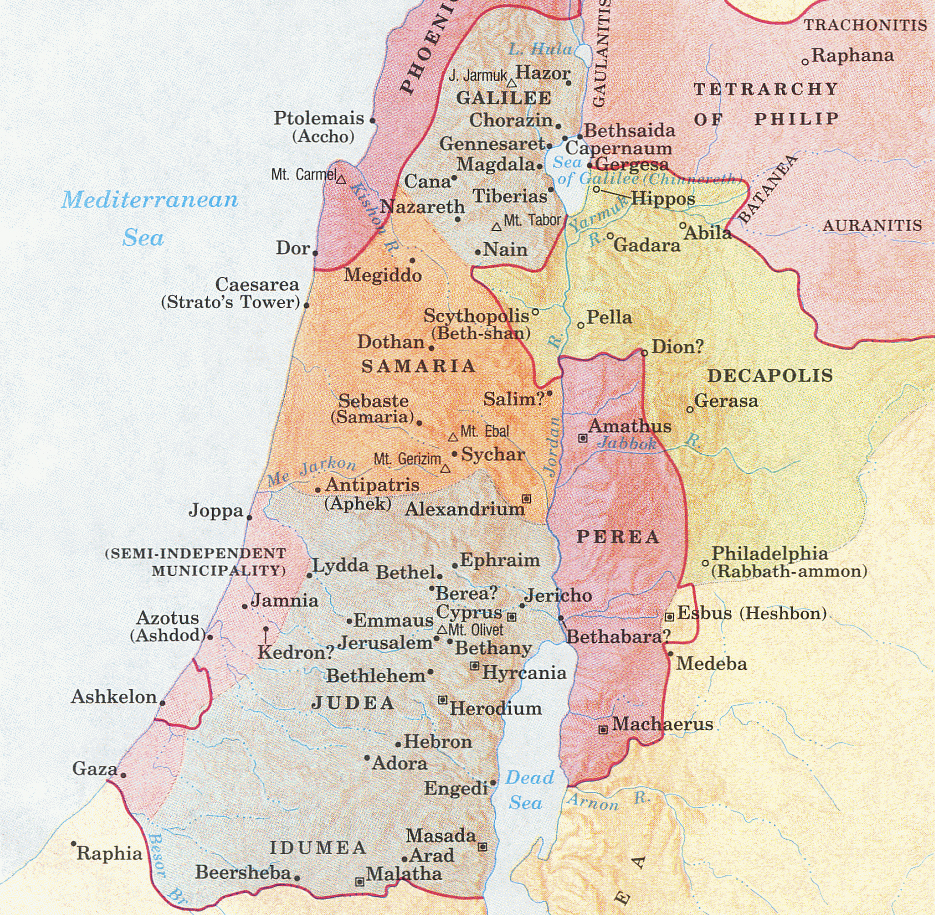
The trip from Jerusalem to where John was baptizing was at least 105 miles, a three or four day journey at least.  They were not there for polite conversation but needed to thoroughly check John out to see if he was a threat with such a large following.

Some believe John was a member of the Essenes since God called him to his ministry out of the wilderness (Luke 3:2). The Essenes practiced daily washing and lived an ascetic life as did John.

John, the Evidence

I’m always interested when a non-Christian source speaks of the truth of the Bible.  As I mentioned last week, John’s ministry didn’t really last very long; probably less than a year.  Yet, his life made such an impact that not just the Pharisees were interested in John, but he had become important enough and famous enough that a secular historian made note of his death.  Flavius Josephus, a Jewish historian and contemporary of the apostle John, was writing about Herod’s loss to his former father in-law in a battle started because of Herod’s casting aside his first wife to marry his brother’s wife, Herodias:

“Now some of the Jews thought that the destruction of Herod’s army came from God, and that very justly, as a punishment of what he did against John, that was called the Baptist: for Herod slew him, who was a good man, and commanded the Jews to exercise virtue, both as to righteousness towards one another, and piety towards God, and so to come to baptism; for that the washing [with water] would be acceptable to him, if they made use of it, not in order to the putting away [or the remission] of some sins [only], but for the purification of the body; supposing still that the soul was thoroughly purified beforehand by righteousness. Now when [many] others came in crowds about him, for they were very greatly moved [or pleased] by hearing his words, Herod, who feared lest the great influence John had over the people might put it into his power and inclination to raise a rebellion, (for they seemed ready to do anything he should advise,) thought it best, by putting him to death, to prevent any mischief he might cause, and not bring himself into difficulties, by sparing a man who might make him repent of it when it would be too late. Accordingly he was sent a prisoner, out of Herod’s suspicious temper, to Macherus, the castle I before mentioned, and was there put to death. Now the Jews had an opinion that the destruction of this army was sent as a punishment upon Herod, and a mark of God’s displeasure to him.” (Flavius Josephus, Antiquities XVIII 2)

Matt. 14:3-11 (ESV)  For Herod had seized John and bound him and put him in prison for the sake of Herodias, his brother Philip’s wife, because John had been saying to him, “It is not lawful for you to have her.” And though he wanted to put him to death, he feared the people, because they held him to be a prophet. But when Herod’s birthday came, the daughter of Herodias danced before the company and pleased Herod, so that he promised with an oath to give her whatever she might ask. Prompted by her mother, she said, “Give me the head of John the Baptist here on a platter.” And the king was sorry, but because of his oaths and his guests he commanded it to be given. 10 He sent and had John beheaded in the prison, 11 and his head was brought on a platter and given to the girl, and she brought it to her mother.

Many have tried to disprove the Bible and the history it provides.  Thus far none have succeeded.  In fact, many were so moved by the evidence of the reliability of the Bible they became believers.  Doctor Simon Greenleaf (1783-1853), an atheist law professor at Harvard and author of a three volume set on legal evidence, was challenged by some Christian students to apply the rules of evidence found in those volumes to disprove the resurrection of Christ.  When he analyzed the evidence, he became a Christian. 

More recently, Lee Strobel, an award winning investigative reporter for the Chicago Tribune set out to disprove this Christian faith his wife had accepted.  In the process of researching with a skeptical eye, Lee became a Christian and wrote The Case for Christ.

Other names come to mind as well.  Josh McDowell was an atheist turned Christian who tried to disprove the Christian narrative and published a book on his findings: Evidence that Demands a Verdict.  Frank Morrison was another newspaperman who sought to disprove the bodily resurrection of Christ and became the author of Who Moved the Stone.

There are others who believe the Bible is not of God, but the evidence is so overwhelmingly against them they would be convinced if they would only look.

John the Baptist (Part 1)

Luke 7:28 (ESV) I [Jesus] tell you, among those born of women none is greater than John. Yet the one who is least in the kingdom of God is greater than he.

John the Baptist takes up only about 20 paragraphs in the New Testament.  Yet, he was a great man according to Jesus Himself.  In fact Jesus said there were none greater.  I was wondering why so little is written about him that he is mentioned so little. The reason, of course, is the New Testament points to Jesus, and that’s the same purpose as John’s.  If Jesus says he’s so great, it is certainly worth looking into his life.

Jesus and John both had a miraculous birth.  Both were born to women who could not bear children: John’s mother, Elizabeth, because she had passed childbearing age and Mary as a virgin.  Both were announced by the same angel, Gabriel (Luke 1:19 and 1:26).  Jesus and John were related:

Luke 1:36 (ESV)  And behold, your [Mary’s] relative Elizabeth in her old age has also conceived a son, and this is the sixth month with her who was called barren.

The word relative here is syngenis which just means same family or relative.  Mary and Elizabeth were probably cousins.

John’s conception and birth were predicted six months prior to Jesus’.  This was, of course, God’s plan.  Jewish men were considered to be men when they reached 12 years of age.  They could not hold any sort of religious office or teach until they reached 30 years of age, though.  Since John’s ministry’s purpose was to announce the coming Messiah, Jesus, and to lead people to repent and be baptized for their sins, he needed to be 30 and his ministry needed to come first.

What did John do before he was called to the ministry?  His father was a priest, and his mother came from a priestly line, some think he may have been an Essene.  The Essene community in Qumran was interested in ceremonial bathing for cleansing.  The Essenes were also the men who penned the Dead Sea Scrolls.  There wasn’t much going on in the wilderness, hence the name wilderness, and the community of Qumran was not far from where John was baptizing so there was a good chance if he was in the wilderness for any length of time, he might have been an essene:

Luke 3:2-3 (ESV)  during the high priesthood of Annas and Caiaphas, the word of God came to John the son of Zechariah in the wilderness. And he went into all the region around the Jordan, proclaiming a baptism of repentance for the forgiveness of sins.

Once John began, he quickly became a very popular guy.  In John 1:19, we see the Sanhedrin sent emissaries from Jerusalem to speak to John about his ministry.  From what we’ve already seen, John was just six months older than Jesus.  I doubt either John or Jesus waited around to start their ministries, so each was probably just 30 in John 1:19. 

John’s ministry of baptism may have only been going on for six months by John 1:19.  Yet, the Sanhedrin sent representatives on a journey of over 100 miles from Jerusalem to the Jordan River where John was baptizing (The Bethany mentioned in John 1:28 is not the one close to Jerusalem but near the Jordan).

So, in about six months John became so popular that his fame had spread all the way to Jerusalem.  People were obviously ready to hear his message and, thereafter, the message of Christ.

Why is this important?

It turns out there are a lot of things we can learn from John and apply them to our lives.  He was busy doing other things until God the Holy Spirit called Him to announce the coming Messiah, Jesus.  Like John, we are called to do the same.  John 1:19 begins, “And this is the testimony of John, . . . .”  John’s testimony was the Messiah was coming and he was telling the world.  Our testimony must be the same.

Next week, we’ll continue to look at John and what both the Bible and at least one non-Christian source says about him.

Has Anyone Seen God?

John 1:14, 18 (ESV)And the Word became flesh and dwelt among us, and we have seen his glory, glory as of the only Son from the Father, full of grace and truth. . . . 18 No one has ever seen God; the only God, who is at the Father’s side, he has made him known.

No one has seen God?  But, the Word is God (John 1:1), and John 1:14 says Jesus is the Word.  How can this be?

I get questions like this more often than I would like to think.  The two verses seem to contradict, but do they?

First, we can see from the writings of John he was not irrational or unintelligent.  He would not have written a contradiction within five verses of each other even if he were not inspired.  Secondly, there is a difference between a statement that is contrary (seems contradictory but isn’t) and an actual contradictory statement.  Let’s look at this briefly.

“I have a monitor on my desk.  I have no monitor on my desk.”  So long as these two statements are speaking of the same time, place, and under the same conditions, the two statements are contradictory.

“I was in New York today.  I was in California today.”  These two statements at first seem contradictory, but they can both be true.  Then they are contrary.  How does this apply to “No one has ever seen God?” I’m getting there.

Jesus is God the Son Who has taken on the form of a man:

Phil 2:5-8 (ESV)  Have this mind among yourselves, which is yours in Christ Jesus, who, though he was in the form of God, did not count equality with God a thing to be grasped, but emptied himself, by taking the form of a servant, being born in the likeness of men. And being found in human form, he humbled himself by becoming obedient to the point of death, even death on a cross.

So, Jesus took on human form, but He was still God.  If He stopped being God and became only a man, we would have a God who had changed His nature.  God would only be two Persons: the Father and the Holy Spirit.  The Son would no longer be God.  God cannot cease to exist, and God doesn’t change (Mal. 3:6).

So, as Jesus walked the earth as a man, He was still fully God.  He claimed this by calling God His Father (John 5:18) which made Him equal with God.

So, okay, Jesus is both God and man.  How does that make any difference?

God is spirit.  Jesus said so Himself:  John 4:24 (ESV)  God is spirit, and those who worship him must worship in spirit and truth.”

We don’t see spirit individuals unless they manifest themselves as physical beings like the angels at Jesus’ empty tomb (Matt. 28:1-7)

Let me put this together now.  Jesus is both human and divine.  We cannot see the divine because the divine, the God nature, is invisible.  His followers only saw the man, Jesus, not His divine nature.  No one has seen God at any time.

Why is this important?

We face a lot of challenges to our faith from all sides.  We need to be able to answer questions, put up a defense of our faith, whether the questions are easy or, as in this case, more difficult:

1 Peter 3:15 (ESV)  but in your hearts honor Christ the Lord as holy, always being prepared to make a defense to anyone who asks you for a reason for the hope that is in you; yet do it with gentleness and respect,

Better understanding of Scripture is also a powerful weapon against doubt.  The fewer questions we have of our faith, the more certain we understand it to be.

Deity of Christ (In John)

Rom. 10:9 (ESV)  because, if you confess with your mouth that Jesus is Lord and believe in your heart that God raised him from the dead, you will be saved.

One of the beliefs required for Salvation according to Romans 10:9 is to believe Jesus is Lord.  This isn’t just saying we must just believe He existed, or that we must make Him Lord of our lives, but we must believe and agree that Jesus is the Lord God. 

Lately I’ve been studying  the prologue of the gospel of John.  In that prologue, John explains the things he will prove in his gospel, the deity of Christ being first among them.  I’d like to share some of what John tells us about the deity of Jesus. John begins with the very first verse in the very first chapter:

John 1:1 (WSV)  In the beginning was the Word, and the Word was with God, and the Word was God.

Here, John identifies a Person called the “Word,” Who we understand to be Jesus according to verse 14:

John 1:14 (ESV)  And the Word became flesh and dwelt among us, and we have seen his glory, glory as of the only Son from the Father, full of grace and truth.

So, the Word is God and Jesus is the Word, therefore, Jesus is God.

John also tells us in chapter 5 verse 18 that in calling Himself the Son of the Father, Jesus was claiming to be equal with God:

John 5:18 (ESV)  This was why the Jews were seeking all the more to kill him, because not only was he breaking the Sabbath, but he was even calling God his own Father, making himself equal with God.

Then in chapter 8 and verse 58, Jesus was having a long drawn out argument with the Jewish leaders about who He is.  At the end of the chapter, He makes this statement:

John 8:58-59 (ESV)  Jesus said to them, “Truly, truly, I say to you, before Abraham was, I am.” 59 So they picked up stones to throw at him, but Jesus hid himself and went out of the temple.

They picked up stones to kill Jesus because He used the divine name, “I Am.”  Jesus was telling them He was the very God who spoke to Moses from the burning bush:

Ex. 3:13-14 (ESV)  Then Moses said to God, “If I come to the people of Israel and say to them, ‘The God of your fathers has sent me to you,’ and they ask me, ‘What is his name?’ what shall I say to them?” 14 God said to Moses, “I am who I am.” And he said, “Say this to the people of Israel: ‘I am has sent me to you.’ ”

The punishment for blasphemy was stoning, so the Jews were about to stone Jesus for what they believed was blasphemy.  We see this more clearly later in John chapter 10:

John 10:33 (ESV)  The Jews answered him, “It is not for a good work that we are going to stone you but for blasphemy, because you, being a man, make yourself God.”

The Jews clearly saw what Jesus was saying. He was claiming to be God Himself, but they didn’t believe Him.

The final passage I’d like to share is John 20:28-29 where Thomas, the tough-to-convince Thomas, identifies Jesus as his God:

John 20:28-29 (ESV)  Thomas answered him, “My Lord and my God!” 29 Jesus said to him, “Have you believed because you have seen me? Blessed are those who have not seen and yet have believed.”

If Jesus were not God, it was incumbent upon Him to rebuke Thomas for blasphemy.  Instead, Jesus confirmed Thomas’ statement.

Why is this important?

Many deny Jesus is God Himself.  They say He is a great teacher, a great man, but never God Himself. 

C. S. Lewis in his book, Mere Christianity, said  “You can shut Him up for a fool, you can spit at Him and kill Him as a demon; or you can fall at His feet and call Him Lord and God. But let us not come up with any patronising nonsense about His being a great human teacher. He has not left that open to us. He did not intend to.”

Jesus really is Who He claimed to be, He is the one true God in the Person of God the Son, second Person of the Trinity.

Light & Darkness

John 1:3-5 (ESV)  All things were made through him, and without him was not anything made that was made. In him was life, and the life was the light of men.The light shines in the darkness, and the darkness has not overcome it.

We began a study here in the first chapter of John on December 3 and would like to continue with that.

The prologue of John, the first 18 verses, lays the foundation for all that comes afterward.  We saw the first two verses spoke of Jesus’ preexistence, that there has never been a time when the Word (Jesus) did not exist.  He is the Son, second Person of the eternal God, Yahweh.

Now I’d like to continue with the next three verses.  Verse 3 tells us Jesus is the Creator and nothing was made by any Other.  This is very similar to Colossians 1:16-18:

 For by [JESUS] all things were created, in heaven and on earth, visible and invisible, whether thrones or dominions or rulers or authorities—all things were created through him and for him.And he is before all things, and in him all things hold together.And he is the head of the body, the church. He is the beginning, the firstborn from the dead, that in everything he might be preeminent.

John along with Paul, the writer of Colossians, are both telling us Jesus is God, the Creator of all things.

Verse 4 of John chapter 1 supports verse 3 to show in Jesus alone was life.  He created life itself and created creatures like you and me with that life.  And the fact that life [Jesus] was the light of men tells us beforehand Jesus is the light of the world, that He is bringing a new light not clearly seen in the Old Testament.  This is the gospel, the new contract (testament) God is making with man.  No longer will we be under the Law but under grace.

Jesus Himself says this later in John’s gospel:

John 9:5 (ESV) As long as I am in the world, I am the light of the world.

He also tells us He has turned this responsibility over to us.  We are to be the light now (Matt. 5:14).  It is our job to spread the light every chance we get.

Next is John 1:5 – The light shines in the darkness, and the darkness has not overcome it.  Did you know light is something and darkness is nothing; it is the absence of light. 

“Photography” is a word meaning light drawing.  Digital sensors or photographic film will not record darkness.  It is absent.  The photographer “draws” only with the light reflected by the object.  For us to refuse the light Jesus gives is to stand in darkness, to not see the subject, the truth, the light.

Why is this important?

To understand the very nature of God is the ultimate quest for man.  The God we have living within us carries that light and we can share that light to ignite a candle in another so to speak.

In a totally dark room, a candle can be lit and the darkness cannot affect that candle.  The flame, however, brings light that can be measured anywhere in that room.  It drives darkness from the room.  That small light, like the light in each of us, touches every part of the room.  No longer is there darkness, and the closer you get to the candle, the brighter the light.

In photography we have what’s called The Inverse Square Rule.”  It says light increases exponentially the closer you get to the source.  If you measure the light from a candle from 10 feet, the light will be four times brighter in half that distance or nine times brighter in one third the distance.  The closer we bring someone to Jesus, the closer Jesus comes to them.  The clearer they can see Him.  It’s exponential.

Jesus has told us we are the light of the world.  When we stand in the midst of darkness, it is His light in us that can drive darkness away.

Man and the Birds

John 14:8, 9 (ESV)  Philip said to him, “Lord, show us the Father, and it is enough for us.” Jesus said to him, “Have I been with you so long, and you still do not know me, Philip? Whoever has seen me has seen the Father.

Broadcaster Paul Harvey used to tell a wonderful story, a parable really, each year on his last broadcast prior to Christmas.  I’ve always loved the story and thought it would be fitting to post it this day before Christmas for your pleasure:

The man to whom I’m going to introduce you was not a scrooge, he was a kind decent, mostly good man. Generous to his family, upright in his dealings with other men. But he just didn’t believe all that incarnation stuff which the churches proclaim at Christmas Time. It just didn’t make sense and he was too honest to pretend otherwise. He just couldn’t swallow the Jesus Story, about God coming to Earth as a man.

“I’m truly sorry to distress you,” he told his wife, “but I’m not going with you to church this Christmas Eve.” He said he’d feel like a hypocrite. That he’d much rather just stay at home, but that he would wait up for them. And so he stayed and they went to the midnight service.

Shortly after the family drove away in the car, snow began to fall. He went to the window to watch the flurries getting heavier and heavier and then went back to his fireside chair and began to read his newspaper. Minutes later he was startled by a thudding sound…Then another, and then another. Sort of a thump or a thud…At first he thought someone must be throwing snowballs against his living room window. But when he went to the front door to investigate he found a flock of birds huddled miserably in the snow. They’d been caught in the storm and, in a desperate search for shelter, had tried to fly through his large landscape window.

Well, he couldn’t let the poor creatures lie there and freeze, so he remembered the barn where his children stabled their pony. That would provide a warm shelter, if he could direct the birds to it.

Quickly he put on a coat, galoshes, tramped through the deepening snow to the barn. He opened the doors wide and turned on a light, but the birds did not come in. He figured food would entice them in. So he hurried back to the house, fetched bread crumbs, sprinkled them on the snow, making a trail to the yellow-lighted wide open doorway of the stable. But to his dismay, the birds ignored the bread crumbs, and continued to flap around helplessly in the snow. He tried catching them…He tried shooing them into the barn by walking around them waving his arms…Instead, they scattered in every direction, except into the warm, lighted barn.

And then, he realized that they were afraid of him. To them, he reasoned, I am a strange and terrifying creature. If only I could think of some way to let them know that they can trust me…That I am not trying to hurt them, but to help them. But how? Because any move he made tended to frighten them, confuse them. They just would not follow. They would not be led or shooed because they feared him.

If only I could be a bird,” he thought to himself, “and mingle with them and speak their language. Then I could tell them not to be afraid. Then I could show them the way to safe, warm…to the safe warm barn. But I would have to be one of them so they could see, and hear and understand.”

At that moment the church bells began to ring. The sound reached his ears above the sounds of the wind. And he stood there listening to the bells – Adeste Fidelis – listening to the bells pealing the glad tidings of Christmas.

And he sank to his knees in the snow.

Handling Difficult Passages

Worried man reading the Holy Bible.

2 Peter 3:15,16  And count the patience of our Lord as salvation, just as our beloved brother Paul also wrote to you according to the wisdom given him, 16 as he does in all his letters when he speaks in them of these matters. There are some things in them that are hard to understand, which the ignorant and unstable twist to their own destruction, as they do the other Scriptures.

As Christians and Bible students, we can come across things in our study that we just can’t grasp.  They are hard to understand.  Even Peter had trouble with passages his fellow Apostle, Paul, had written.  If Peter had a tough time understanding parts of Scripture, what are we supposed to do?

There are some ways that will help us in our quest.  First, pray.  God the Holy Spirit moved holy men of God to write the Bible (2 Tim. 1:21), so we can turn to Him to help us understand.  After all, having the Author right there to instruct us is a benefit few have with other written works.  The Holy Spirit asks us to do this.

Jeremiah 33:3  Call to me and I will answer you, and will tell you great and hidden things that you have not known.

We also need to read things in context.  The Bible is the best commentary on itself.  Sometimes verses taken out of context are confusing and can lead to a bad interpretation of the verse. 

Matt. 27:5  And throwing down the pieces of silver into the temple, he departed, and he went and hanged himself.

Luke 10:37c  And Jesus said to him, “You go, and do likewise.”

This was a silly example, but you can see how people can be misled.  We need to read the verses before and after the verse that confuses us.

If the verse is still a puzzle to you, look at the cross references in most modern Bibles.  Those will lead you to other passages that might be helpful.

If you know how to use an exhaustive concordance like Strong’s or Young’s, you can use that to help resolve an issue with a difficult verse.  If you don’t know how to use an exhaustive concordance, it’s really not very difficult and not very expensive.  The concordance itself usually has instructions in the front of the book.

Commentaries can be helpful but are a step away from Scripture itself.  You’re dealing with someone telling you what God said.  The methods above have kept you in Scripture making them a safer bet.  I use commentaries, don’t get me wrong.  I use a commentary or two at the end of my study to see if I’ve made an obvious error someone else more learned than I had spotted.

My way of buying commentaries is to look first at the publisher.  There are a lot of publishers out there that will print just about anything.  Also, look online at reviews of various publishers and authors.  Some are wonderful. 

Jameson, Fausett, and Brown have a good solid basic commentary of the whole Bible.  I like Barnes Notes for the New Testament.  The Expositors Bible Commentary is excellent but expensive and large.

Why is this important?

Whether we understand Scripture or not is extremely important.  It is God’s main way of speaking to His children.  If we misunderstand something, we can pass along poor doctrine.  Scripture itself speaks against that.

God wants us to stay close to Him.  Study is a great way to do that.  When we study deeply into a particular verse or passage, God blesses us with so much more than we expected.  Study and you will hear God’s voice.

Hell

The word “hell” certainly appears in Scripture but doesn’t always mean the place of eternal torment.  The English word “hell” is often translated from three different words, one in Hebrew and two in Greek.

Sheol is the word usually translated as “hell” in the Hebrew of the Old Testament.  Sheol is a very general word and is used as just the resting place of the dead, not as the grave but where spirits dwell after physical death.  The word describes the place where both the righteous and unrighteous dwell (See Isa. 38:10 and Numbers 16:33 for comparison).

Hades is one of the Greek words often translated as “hell.”  Like sheol, hades is a general term meaning the state between death and physical resurrection.  We see this best defined by Jesus’ story of the rich man and Lazarus in Luke 16:19-31.  In verses 22 and 23, we get a brief description of what this hades is like:

Luke 19:22, 23   The poor man died and was carried by the angels to Abraham’s side. The rich man also died and was buried, and in Hades, being in torment, he lifted up his eyes and saw Abraham far off and Lazarus at his side.

Both the rich man and Lazarus are here and can see each other.  The righteous Lazarus is in a place of privilege, at Abraham’s side.  The unrighteous rich man is tormented but can communicate with Abraham.  Verse 26 tells us there is a great chasm separating the two areas of Hades, the Abraham’s area and the area where the unrighteous are punished.

Some believe this is a parable of Jesus and as a parable the facts and description of Hades are not accurate.  I don’t think so.  There are some commonalities in Jesus’ parables we don’t see here.  The major one is the fact Jesus never used names in His parables but did in other stories.  He also never used unrealistic situations in His parables.  They weren’t fairy stories but actual situations to which He applied spiritual lessons.  We don’t see this here.

Hades is where God has sent angels when they sinned.  They are in chains there in gloomy darkness until the judgment:

2 Peter 2:4   For if God did not spare angels when they sinned, but cast them into hell and committed them to chains of gloomy darkness to be kept until the judgment

Ephesians 4:8, 9 tells us Jesus descended then led captives to heaven.  The early church believed this to have been Hades where Jesus during the time His body was in the tomb; went to Hades, preached to the lost explaining the prophecies of old had been fulfilled in Him, and led the righteous from the side of Abraham to heaven:

Therefore it says, “When he ascended on high he led a host of captives, and he gave gifts to men.” (In saying, “He ascended,” what does it mean but that he had also descended into the lower regions, the earth?)

One line of the Apostles Creed says “He descended into hell [Hades].”  This may be a reference to that early belief.

Gehenna is the second Greek word often translated as “hell.”  This is a reference to the valley of Hinnom, a place of Jewish apostasy, their celebration and worship of the false gods Chemosh and Molech took place (1 Kings 11:7).  King Josiah converted it into a place where dead bodies were thrown and burned, an example of eternal fire for the lost:

2 Kings 23:13, 14  And the king defiled the high places that were east of Jerusalem, to the south of the mount of corruption, which Solomon the king of Israel had built for Ashtoreth the abomination of the Sidonians, and for Chemosh the abomination of Moab, and for Milcom the abomination of the Ammonites. 14 And he broke in pieces the pillars and cut down the Asherim and filled their places with the bones of men.

Gehenna is different from Hades in that it is clear Gehenna is solely a place of punishment and fire:

Matt. 5:22  But I say to you that everyone who is angry with his brother will be liable to judgment; whoever insults his brother will be liable to the council; and whoever says, ‘You fool!’ will be liable to the hell [gehenna] of fire.

Jesus uses the idea of eternal punishment by fire when speaking of the future of the lost:

Matt. 3:12  His winnowing fork is in his hand, and he will clear his threshing floor and gather his wheat into the barn, but the chaff he will burn with unquenchable fire.”

Matt. 25:46  And these will go away into eternal punishment, but the righteous into eternal life.”

Why is this important?

A story is told of how famous evangelist and founder of Moody Bible Institute and Moody Publishers, D. L. Moody, ran into an old seminary friend.  They talked about old times until Moody asked “How’s your theology?”  His friend replied, “Oh, I don’t believe in hell anymore.”

Moody became very agitated and poked his finger into the man’s chest pushing him against the wall.  “Who can turn,” Moody said, “Who can turn from telling the lost of what awaits them should they deny the free gift of God?”

The gospel is not just about what the saved are headed to.  The gospel is also about what we are saved from.

In the Beginning was the Word

John 1:1-5 (ESV)  In the beginning was the Word, and the Word was with God, and the Word was God. He was in the beginning with God. All things were made through him, and without him was not any thing made that was made. In him was life, and the life was the light of men. The light shines in the darkness, and the darkness has not overcome it.

Can you imagine the upheaval of both the Jewish and Greek belief systems when this statement was made?  It must have been earth shaking.

Look at the word “Word.”  The Jews knew the “Word” as the Word of God (1 Sam. 9:27, 16:23).  So, when John started his gospel with the fact the Word was in the beginning, the idea was one deeply seated in Judaism.  It was nothing new for them.

The Greek word translated “Word” is the word logos.  In Greek philosophy, the Logos was understood to be the force that regulated the universe, kept the sun rising and setting, brought the seasons, and such.  So, the Greeks also felt comfortable with the beginning of verse one of John’s gospel.

When John tells us the Word was with God the Jews and Greeks were still nodding their heads in agreement. It’s when John says the Word was actually God and then was with God that stunned both cultures, the Jews more than the Greeks.  For a first century Jew to think God was more than one Person was unthinkable even though some Old Testament writers implied to this.

Isa. 44:6 says: Thus says the Lord, the King of Israel and his Redeemer, the Lord of hosts:  “I am the first and I am the last; besides me there is no god.  He names two Persons “the Lord the King of Israel” is one.  “His Redeemer, the Lord of hosts” is another.  In both places “Lord” is the divine name, the Tetragrammaton.  So, it looks like Isaiah knew God was more than one Person.  I just doubt the first century Jews did.

John makes it clear just who the Word was.  In verse 14, He says “And the Word became flesh and dwelt among us, and we have seen his glory, glory as of the only Son from the Father, full of grace and truth.”  The Word was Jesus.

At 2 Chronicles 6:18, Solomon, when dedicating of the temple, said this: “But will God indeed dwell with man on the earth? Behold, heaven and the highest heaven cannot contain you, how much less this house that I have built!”  This is a fascinating question to ponder.  John puts it to rest, though, with a resounding “Yes!”

John continues to tell us of Jesus’ divinity.  Not only was the Word God, He was the Creator of all things in verse 3.  Verse 4 tells us Jesus was life and the life was the light of men.  The fact Jesus was the life relates to verse 3 where He created all living things.  And, He was the light of men.  Light is important for us to recognize things, to understand things more clearly, and to illuminate what is true and what is not, what is right and what is wrong.  Jesus as our Light did that.

Why is this important?

John’s gospel was written late in the first century, well after all the other apostles were martyred.  He had seen what needed to be added to Matthew, Mark, and Luke’s accounts to make it clear just who Jesus was, to complete the message.  Only about 10% of what John writes can be found in the other gospels.  He wanted to make it clear exactly who Jesus is and was.  John says so himself:  John 20:30 (ESV)  Now Jesus did many other signs in the presence of the disciples, which are not written in this book; 31 but these are written so that you may believe that Jesus is the Christ, the Son of God, and that by believing you may have life in his name.

You might wonder how being the Son of God is the same as Jesus being God since we are all children of God (John 1:12).  Jesus is the only, unique, one of a kind, Son of God.  John tells us exactly what Jesus meant when He told the Jews God was His Father:  John 4:18 (ESV)  This was why the Jews were seeking all the more to kill him, because not only was he breaking the Sabbath, but he was even calling God his own Father, making himself equal with God.”

Jesus is every bit equal with the Father and the Holy Spirit.  John gives us a clear and obvious demonstration of this.  Let us never think differently