Trust but Verify


Acts 2:42 (ESV)
42  And they devoted themselves to the apostles’ teaching and the fellowship, to the breaking of bread and the prayers.

Years ago George Will had published a new book of Baseball statistics.  During his conversation with Johnny Carson on the Tonight Show, he had spouted from memory what seemed like hundreds of statistics.  Finally, Johnny said, “I could never remember all those numbers” to which Will replied, “That’s why I wrote them down for you.”

Before the apostles died, they left us a robust body of teachings.  The New Testament is an instruction book, not just a spiritual guide.  Paul’s letters to Timothy and Titus give us the basis for running a church, for instance.  But, people think they know better sometimes and start making things up as they go along.

By the beginning of the second century, the church at Corinth was having trouble.  The younger folks in the church had overthrown the older leadership and began to run the church “their way.”  Clement, a disciple of the Apostle John and Bishop of Rome, wrote a letter to them saying the bishops (pastors) had been appointed by the Apostles. So, we should understand the authority of the bishop of Corinth was based on the fact the apostle who appointed him thought he was qualified.

At the time, there was a major force within the church, the Gnostics, fighting the teachings of the Apostles.  The Gnostics taught Jesus wasn’t really physical, that He was a sort of phantom.  They took a verse out of context from the writing of an apostle to support this:

1 Corinthians 15:50 (ESV)
50  I tell you this, brothers: flesh and blood cannot inherit the kingdom of God, nor does the perishable inherit the imperishable.

“So,” they taught, “If physical men cannot inherit the kingdom of God, Jesus couldn’t be physical.” 

Another group at the time, the Judaizers (Ebionites) taught that Jesus was only a man, not God.  Funny thing was they used the same verse to say since Jesus is a man and not a spirit, He can’t be God and inherit the kingdom.

What the church did at this point was shameful.  They went to Clement’s letter and decided the bishops in the church had the authority to rule these two heresies as wrong.  The heretics, though, used Paul’s words too and claimed theirs was apostolic teaching as well.  They made the same claim the church did.  Hmmm.  What to do.

Rather than going to what was recognized as Scripture at the time, the church decided to go back to Clement’s letter. They interpreted it as saying not only was the authority of the apostles passed down through the bishops, but the bishops’ authority was passed on through the bishops those bishops appointed as well.  That stopped the heretics in their tracks.  They could no longer claim apostolic authority since their teachings were contradicted by the bishops of the time.  The church smiled, crossed its arms, and said, “So, there!”

What also happened here was the church began to accept church tradition, the teachings of men, over what the Bible had to say.

The three things the church drew from Clement’s letter, Clement never meant:  Firstly, since Clement was Bishop of Rome, the church at Rome now had the authority to settle disputes and therefore was of a higher rank than all other churches.  Secondly, authority equal to Scripture was now entrusted to the bishops of the church (apostolic authority).  And, thirdly, this apostolic authority was handed down from bishop to bishop as they were ordained (apostolic succession).  The church now had a second source of authority alongside of the Bible, its bishops.  Later, a third source of authority would be added, “Ex cathedra” (“From the Chair”), where the Bishop of Rome, the Pope now, could sit in St. Peter’s Chair and pronounce something to be infallibly true even if it wasn’t in the Bible.  The most recent example of this was on November 1, 1950 when Pope Pius XII pronounced the assumption of Mary into heaven as dogma.

Don’t think I’m blaming the Catholics for this problem.  This was all settled upon long before Luther and Calvin stepped into the arena.  My point is that we drift far away from God’s Word when we begin to accept what we are told by men.  True, God has put godly men in pulpits and other teaching positions who accurately and honorably represent Him and teach His Word clearly.  The good ones tell us to check what they teach.

When we start to believe what men tell us without first looking into what God has said, we are setting ourselves up for trouble.  Like George Will, God has written all this down so we can see what the full truth is.  When Paul and Silas came to Berea from headquarters and taught about our Lord, the Bereans received it but checked it out:

Acts 17:11 (ESV)
11  Now these Jews were more noble than those in Thessalonica; they received the word with all eagerness, examining the Scriptures daily to see if these things were so.

Our response to the teachings of men should always be the same.  Receive but check it out.  “Trust but verify.”

Examples and Commands

So, I’m talking with some friends the other day, and the topic came up on how deacons should be chosen in a Christian church.  According to Acts chapter six, deacons were chosen by the people as directed by the Apostles.  They were voted on by the congregation.  The argument then came up that deacons should be voted on in our church since it was right there in Scripture how deacons are chosen.

This is really a fairly common mistake.  Something is done in Scripture by a Christian leader or even Christ Himself, and we decide it’s a command.

What we really need to do is see the Bible, in a way, like the local newspaper.  Sometimes, newspapers are just telling you how something happened.  Just because it happened that way, doesn’t mean we need to make it happen that way.  In my church, deacons are chosen by the pastor.  That’s fine.  If Acts chapter 6 tells us they did it another way, we don’t need to do it that way.  We aren’t commanded to follow their example.

We do need to do things we are commanded to do such as communion and baptism.  Those aren’t optional.  But, things like how church governments are run, how churches are run, is pretty much up for grabs so long as no one disobeys a command of God.

We have lots of examples of things in Scripture that are no more than just that, examples.  For instance, Jesus had a group of 72 followers that He broke into pairs and sent them out to evangelize:

Luke 10:1 (ESV)
1  After this the Lord appointed seventy-two others and sent them on ahead of him, two by two, into every town and place where he himself was about to go.

So, why aren’t we arguing that we can’t evangelize unless we gather 72 people and divide them into pairs?  You get the point.  Commands are different from examples in Scripture just as they are in the newspaper.

If you’re wondering how to tell the difference between the two, commands and examples, commands are said directly:

Matthew 28:19-20 (ESV)
19  Go therefore and make disciples of all nations, baptizing them in the name of the Father and of the Son and of the Holy Spirit,
20  teaching them to observe all that I have commanded you. And behold, I am with you always, to the end of the age.”

Examples are just part of the narrative.  As an example of an example, there are three types of church government mentioned in Scripture.  There’s an implied congregational form (Acts. 6) where the congregation votes on everything.  In Acts 20:28, we see implied the Presbyterian form where the church is run by a board of elders, and in 1 Timothy, we see an example of an Episcopal form of church government where the Pastor is in charge.  None of those are commanded forms of government, just examples.

Jesus, however, told us we should observe communion (1 Cor. 11:23-25).  He told us to be baptized (Matt 28:19-20).  These are commands, not suggestions or examples.

So, next time someone tells you need to wear a robe because Jesus did or walk everywhere, or you name it, ask them where is that commanded in Scripture.  You’re life will be much less complicated and freer in Christ.

Scripture Twisting

Have you ever had someone try to use Scripture to explain something, and you just know he’s abusing the passage but aren’t really sure just how?  Well this problem is as old as the New Testament:

2 Peter 3:15-16 (ESV)
15  And count the patience of our Lord as salvation, just as our beloved brother Paul also wrote to you according to the wisdom given him,
16  as he does in all his letters when he speaks in them of these matters. There are some things in them that are hard to understand, which the ignorant and unstable twist to their own destruction, as they do the other Scriptures.

This is a pretty neat passage.  It identifies Paul’s letters as Scripture at a time when they were still very new and  that Scripture twisting is at least 2,000 years old.  But how do people do this, twist Scripture.  There are lots of ways.  Here are just three of the most common ones.

Some will take a passage out of context to try to prove something entirely different from what the passage says.  Look at 1 Cor. 8:6 –

1 Corinthians 8:6 (ESV) yet for us there is one God, the Father, from whom are all things and for whom we exist, and one Lord, Jesus Christ, through whom are all things and through whom we exist.

Jehovah’s Witnesses will tell you this proves that Jesus isn’t God because for us there is only one God; the Father.  But, if you read the surrounding context, you’ll see the passage says there are many lords and gods as there were in that culture – so, it’s comparing cultures.  It’s saying there may be many called gods but for us, there is just one.  Another problem here if you’re trying to prove only the Father is God is that logic leads you to say only Jesus is Lord.  Even Jehovah’s Witnesses don’t believe that.

Here’s another.  Some people will quote the Bible to draw you into their way of thinking.  Mormons will tell you that Joseph Smith prayed for wisdom using James 1:5:

James 1:5 (NASB77)
5  But if any of you lacks wisdom, let him ask of God, who gives to all men generously and without reproach, and it will be given to him.

Smith tells us he prayed for wisdom as James told him to, and he was visited by two heavenly beings who told him all the churches were wrong.

Smith should have recognized a couple of things here, first the fact when we pray it isn’t only God who hears.  And, secondly, to check on who shows up, we should test what we are told in Acts:

Acts 17:11 (ESV)
11  Now these Jews were more noble than those in Thessalonica; they received the word with all eagerness, examining the Scriptures daily to see if these things were so.

Smith should have checked what he was told by these two “heavenly personages”  just as you and I should and as the Bereans did and were commended for it.  James 1:5 isn’t the only verse in the Bible.

Galatians 1:8 (ESV)
8  But even if we or an angel from heaven should preach to you a gospel contrary to the one we preached to you, let him be accursed.

Don’t listen to “heavenly beings” just because they look authoritative.  The Bible tells us to test things we hear:

1 Thessalonians 5:20-21 (ESV) 20  Do not despise prophecies, 21  but test everything; hold fast what is good.

Lastly for this post is the fact some people will misquote Scripture for their own advantage.  The Maharishi Mahesh Yogi once said,  “Christ said, ‘Be still and know that I am God.’ Be still and know that you are God and when you know that you are God you will begin to live Godhood, and living Godhood there is no reason to suffer.”

There are several things wrong with this, of course.  Jesus didn’t say this.  This is a quote from Psalm 46:10.  The original meaning of the statement is completely different.  It’s telling us to trust in God, not ourselves.  The passage has nothing to do with us being gods.

So, just like the Bereans, we need to be careful in how people use Scripture to convince us of something we don’t recognize as truth.  As Walter Martin used to say, “New truth is almost always old heresy.”

Do Miracles Happen

Do Miracles really happen?  Miracles are important to Christians.  Our very faith rests on the miracle of Christ rising from the dead.  Paul, just a few years after Jesus’ death, wrote this:

1 Corinthians 15:14 (ESV)
14  And if Christ has not been raised, then our preaching is in vain and your faith is in vain.

If Christ has not been raised, Christians are in bad shape.  Our faith is just a bunch of rituals and fantasies.  So, miracles are important.  But, can they be defended?

David Hume, an 18th Century Scottish philosopher, said something very interesting that has stood in the way of Christians for four centuries.  He said that extraordinary claims require extraordinary evidence.  Sounds right, doesn’t it?  Claiming a body was fully dead, stored in a cold damp tomb sealed from outside tampering could rise after being dead for three days – well, that’s just silly.  We’ve never seen anything like that happen before.  The evidence to prove it would need to be phenomenal, don’t you think?  Hume thought so.

Hume’s argument, like so many other philosophical ideas, sounds intellectual, brilliant, and logical.  But, is he right?  Do we really need extraordinary evidence to show Jesus rose from the dead?  No.

The soldier who pronounced Jesus dead on the cross pronounced people dead for a living.  He was very aware of what it meant to die on a cross.  Just to make sure, though, a spear was thrust through Jesus’ side, and the blood and water that gushed out was proof of His death.  So, we’re certain Jesus was dead.  No doubt about it.  If he hadn’t been quite dead, three days in a cold damp tomb after being scourged, crucified, and speared would have certainly finished the job.

Now the question is if He was alive three days later.  Well, He was seen by quite a number of people, people who were very familiar with Him.  He showed Himself to His disciples demonstrating He was alive.  He asked them to feel His body to show He was alive.  This is all well documented in the gospels.  The genuineness of the gospel of Luke is confirmed by biblical critics as a first century document written by Doctor Luke.  This is all in that gospel.

Paul’s first letter to the Corinthians, also a document confirmed as genuine by biblical critics, tells us all the disciples saw Him alive as well as James, His brother, and over 500 others.  Seeing if someone is alive is not extraordinary evidence.  It’s common sense anyone can verify.  If He’s walking, talking, and physically present – if He was confirmed dead just a few days earlier, He has risen from the dead.

A friend of ours had lumps in her breasts.  Several of us prayed for her.  When she went in the next morning to have them removed, the doctor couldn’t find them.  He looked at the previous tests, and there they were.  Then he felt her breasts to find the lumps, and they weren’t there.  No extraordinary evidence.  Like the rising of Christ, something was true one moment and false the next.  She had been healed by the hand of God.

So, don’t be bullied by folks who tell you miracles can’t happen, and if you claim they do, you need extraordinary evidence to prove them.  The evidence needed is usually pretty simple and there if you want to see it.

The Interests of Others

Philippians 2:3-4 (ESV)
Do nothing from selfish ambition or conceit, but in humility count others more significant than yourselves.  Let each of you look not only to his own interests, but also to the interests of others.

Years ago, Gale Sayers, a Hall of Fame player for the Chicago Bears, wrote a book I Am Third.  In the book, Sayers tells of his Christian priorities in life.  Jesus Christ is first.  Others are second, and he is third.  I think we’ve lost the real meaning of that book and the passage in Philippians.

Sure, you and I do our best to help others.  We reach out to ministries to those in need.  We give of our finances and our time.  That’s good, and it is included in what Paul is saying in the text above.  But, there might be more, a deeper concern for the good of the unlovable, even for those we fear.

Polycarp, a disciple of John the apostle, was arrested by Roman soldiers in 155 a.d.  He was to be burned in the Roman arena at Smyrna (in present day Turkey).  His response when he was approached by the soldiers was to offer them dinner.  He must have heard what Jesus told us in Luke 2:31 which tells us to treat others the way we would like to be treated.  Jesus doesn’t qualify the word “others.”  It’s just others – all others.  How do we serve those wishing to hurt us, though?  God presents ways.

Maybe Polycarp was thinking of Philippians 2:4 when he thought to serve the hungry soldiers.  They had the authority to take food if they wanted, but Polycarp saw the need in his enemy and supplied it before he was asked.

I guess offering dinner to those who were sent to arrest you and eventually kill you is the Christian thing to do, but I don’t have that heart.  I wish I did, but I don’t have it yet.

At a talk she was giving in postwar Germany in 1947, Corrie Ten Boom was approached by a guard who had tortured her and her fellow inmates at Ravensbrück Prison Camp where she had seen her beloved sister, Betsie, die just a few years earlier.  The guard had become a Christian and, while Jesus had forgiven him of his terrible sin, could Corrie?  She did.  She shook his hand and offered the forgiveness he asked for.  It was difficult, but she did it.

When she did, she felt bitterness flow from her.  Peace flooded over her, but that isn’t all there is to the story.  The guard needed her forgiveness.  Jesus had forgiven him, but now his need was for forgiveness from someone he had hurt.  When Corrie reached out her hand to shake his, she was meeting the needs of another, a past enemy.  He had become a Christian.  Now he was seeking peace from her as well as the Lord.

Louie Zamperini  had been in a similar camp on the other side of the world, a Japanese WWII POW camp.  He had been beaten and tortured there, too.  On a speaking tour in 1952, Zamperini had the chance to meet with the prison guards of Sugamo Prison where he had been held.  He asked to speak to the guards who had treated him so cruelly.  A Christian now, Zamperini wanted to tell the guards he had forgiven them and God would forgive them as well.

Zamperini’s story is different from Corrie’s in that the guards he spoke with were not seeking his forgiveness though he offered it freely.  True it helped Louie deal with some things, but it also gave the guards something they needed, maybe they didn’t even know they needed, forgiveness.  Zamperini had released them from the guilt they had for how they had treated him.  Louie considered the needs of others over his own discomfort returning to Sugamo Prison.

When Polycarp offered dinner to his guards, when Corrie shook the hand of that former Nazi, when Zamperini offered grace to his captors, they were fulfilling a command of God.  They were also fulfilling their needs.  Grace and provision mean the most to someone when it is the hardest for us to give.

When we think of the people who have hurt us, people we fear, people who threaten our very existence, do we seek to fulfill their needs, to help or provice for them? When we don’t we are denying the words of both Paul and Jesus Himself.

Cleansed Lepers

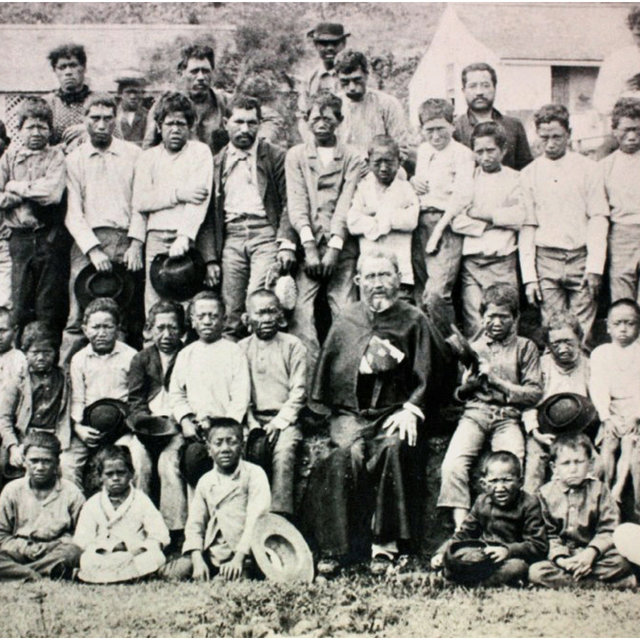
Father Damien at the Molokai Leper Colony (circ. 1865)

Leprosy, also known as Hansen’s Disease, is a horrible affliction.  It can attack the body’s nervous system and cause the victim to no longer feel pain.  Once he cannot feel pain, the victim is unaware of injuries or infections resulting in the loss of limbs.  The body just literally rots away.

Symptoms are characterized by white spots appearing on the skin which penetrate below the surface.  The spot becomes a circle with raw skin at the center.  The hairs of the infected area turn white.  Leviticus chapter 13 is dedicated to recognizing this disease and the procedure for preventing its spread.

In Scripture, when someone was healed of leprosy, the healing was described as a cleansing rather than a healing. That’s appropriate since leprosy is more easily transmitted in unsanitary conditions.  If you and I had close contact with lepers, careful bathing every day would go a long way to prevent contracting the disease. 

Father Damien as an example, headed the leper colony on Molokai, Hawaii for 16 years.  He ate out of the same bowls as the lepers and worked closely with them building homes, schools, and roads.  He bathed regularly and so did not show any symptoms of the disease for 11 years.  Though he did eventually die of the disease in 1889, he showed us close attention to personal hygiene can go a long way in prevention.

In biblical times, leprosy was a long and lingering death sentence.  One needed to be inspected by the priests to confirm the disease (Leviticus 13 deals exclusively with leprosy). Those who had the disease were separated from the community and had to call out “unclean” whenever they were near others.  Imagine the loneliness and isolation for these people.  They could only mingle with other lepers.

We’ve looked at leprosy as such an ultimate example of filth and infection. Now, let’s look at the other extreme, the holiness and purity of God. 

God is free from evil and sin.  He is “without spot.” When man stands before God, he must feel he is nothing but “unclean.”

Isaiah 6:5 (ESV)
And I said: “Woe is me! For I am lost; for I am a man of unclean lips, and I dwell in the midst of a people of unclean lips; for my eyes have seen the King, the LORD of hosts!”

This is why Paul says his greatest achievements are trash compared to Christ:

Philippians 3:7-8 (ESV)
Indeed, I count everything as loss because of the surpassing worth of knowing Christ Jesus my Lord. For his sake I have suffered the loss of all things and count them as rubbish, in order that I may gain Christ

So, we have looked at the contrasts between the clean priests and the unclean lepers; between the holy spotless God and filthy sinful man.  The separations are tremendous. 

When I reach out to God in prayer and feel His presence, I feel as though, Like Isiah, I should shout “UNCLEAN!”  Yet that holy and pure God Who took on human form feels compassion on me as He did 2,000 years ago.  Jesus, as a flesh and blood man Who was not to touch the diseased person reached out to touch the dirtiest human in that society, the leper:

Matthew 8:3 (ESV)
And Jesus stretched out his hand and touched him, saying, “I will; be clean.” And immediately his leprosy was cleansed.

Jesus doesn’t move away from us because we’re unclean but reaches out to us to cleanse us no matter how filthy or diseased we may be by sin.  If He will touch the leper, He will touch us too. If we let Him, we can become “cleansed lepers.”

Why Go to Church?

Many individuals have said over the years they don’t need to go to church.  They pray, they read the Bible, they know Jesus, they feel close to God just walking through His creation. So, why should they need to go to church?

There are several good reasons to be involved in a local church. Let’s look at some of them.

 Fellowship is a good reason.  Christians aren’t meant to be loners.  God is a communal God, He likes interacting with His children, and He’s designed us to be communal creatures.  We find it hard to walk the Christian walk without other Christians around to help us. When adversity strikes, it’s good not to face it alone. We are encouraged by others in our Christian life.

Hebrews 10:24-25 (ESV)
24  And let us consider how to stir up one another to love and good works,
25  not neglecting to meet together, as is the habit of some, but encouraging one another, and all the more as you see the Day drawing near.

Reproof.  In this case, “reproof” can mean to rebuke.  A Christian might no longer realize he’s living with sin.  Normally, the Holy Spirit will convict him of the sin, but repeatedly practicing that sin will harden his heart. He can become jaded to the point he no longer thinks of it as sin.  Sometimes a Christian is aware of his sin but rationalizes it away.  Obedience to God’s reproof is a blessing:

Proverbs 1:23 (ESV)
23  If you turn at my reproof, behold, I will pour out my spirit to you; I will make my words known to you.

Correction is different from reproof.  It’s meant to keep our beliefs straight.  I was supposed to present a Bible study at a rest home a few weeks ago.  I came across a portion of Scripture I didn’t understand which made me dig deeper, and I came up with a pretty odd explanation of the passage.  No commentary addressed what I was thinking, so I called a learned friend of mine who agreed it was a little too spooky to be teaching without a solid basis.  After all, teachers are held to a higher standard (James 3:1).

That’s what I mean by correction.  We watch out for each other and are there for one another.  Proverbs 27:17 says this: “Iron sharpens iron, and one man sharpens another.”   You don’t get sharpened or corrected much by walking around in the woods.

Accountability sort of comes with fellowship but is much more personal.  I meet with a group of Christian guys once a week, and actually all six points of this blog are addressed in that group.  We share what is going on in our lives, the areas we need to work on, our doubts, our understanding of Scripture, and our prayer needs.  We also ask each other how we’re doing with things we’ve shared previously.  We’re held accountable.  Because of our openness and vulnerability, these men have become some of my closest friends.  Accountability is not something a Lone Ranger Christian can do.  We need each other.

Instruction is pretty apparent.  In the local church, we have the opportunity to learn from people who know the Bible better than we do. It’s a place where we can ask questions and hear solid biblical answers. It’s also a place where we hear from people who have been through trials we’re currently facing.  All learning isn’t “book learnin.”  God uses others to speak to us.

Ministry, and this is the hardest lesson for us to learn about the local church.  It seems the majority of Christians see the church solely as a place to be served.  They go there to learn, to see friends, even for financial help, or a listening ear.  Once we’ve been a Christian for a while, we should begin to see the church as a place where we can minister to others as well.  We should also see the local church as a base from which we can reach out to our communities with the love of Christ.  

So, let’s not look at our relationship with Christ as exclusively an individual experience.  We need other Christians around us.  Besides, God tells us not to forsake the fellowship of other believers (Heb. 10:25).  God knows we need each other.  Don’t we all really know that too?

Christianity and Philosophy

Colossians 2:8 (ESV)
8  See to it that no one takes you captive by philosophy and empty deceit, according to human tradition, according to the elemental spirits of the world, and not according to Christ.

Philosophy, like most things, can be used for good or for evil.  You can use philosophy to convince people of absolutely foolish ideas.  Moral relativism is the idea that moral (ethical) standards should be set by either the individual or the culture.  It has cost millions of lives over the past century and damaged even more.  In a marketing class years ago we were discussing business ethics, the instructor said, “what is legal is what is ethical.”  I objected and pointed to 1950s America where it was legal to pay women and minorities less for the same labor.  “Was that ethical?” I asked.  Then I asked if Simone De Bouvier and Martin Luther King should have been expunged from our society for going against culture and saying people should be judged by the content of their character and not their skin color or sex.  She was stunned and said she needed to teach what was in the textbook.  Sad, but the class saw my point.

We see this sort of thing deeply embedded in our culture today.  No one can say what’s right or wrong without someone else being offended.  Moral relativism is at the root of many of our problems.  Accompanying moral relativism is epistemological (factual) relativism: “What’s true for you isn’t necessarily true for me!”  Recognize it?  If there is no objective truth, there can be no standards.

Philosophy can be used for good too, of course.  In previous posts, we’ve looked at the philosophical arguments and evidence for the existence of God.  Using logic (a discipline within philosophy) we’ve looked at many arguments against biblical truth and found them wanting. 

So, how do we tell the difference between godly and evilideas?  As Paul says in Col. 2:8, if we listen to the philosophy of the world we will be taken captive, deceived.  Some lies sound perfectly plausible and even attractive, so we need to be watchful.  We need to be so familiar with the truth lies are easily recognized.  The Bible is the standard for truth and morality not man.

If we follow philosophy according to Christ, if we search for actual truth, if we look for the real answers to the world around us, we end up on solid ground.  A Christian philosopher, Rene’ Descartes, told us that truth can be identified by its consistency.  Lies are inconsistent.  While some lies are complex, and the inconsistencies are well buried, they will eventually be found out.

There is a difference between one’s personal philosophy and philosophy as a discipline.  Your personal philosophy is the filter through which you view the world.  If you’re a Christian, you see the universe as a creation of God.  Because of what an atheist believes, he sees something very different.  That doesn’t mean they’re both true.  In fact, it means at least one is false. 

There is a considerable amount of philosophy in the Bible.  Jesus often reasoned with the Pharisees.  The Sermon on the Mount is very philosophical.  At least seven times in the book of Acts, we are told that Paul “reasoned” with the Jews and with the Greeks.  His argument starting in chapter 17:22 was a demonstration of logical reasoning to convince another of a specific truth.  James tells us wisdom (sophia from which we get philo-sophia, the love of wisdom – philosophy) is open to reason.  That’s a good definition of godly philosophy.

James 3:17-18 (ESV)
17  But the wisdom from above is first pure, then peaceable, gentle, open to reason, full of mercy and good fruits, impartial and sincere.

Christian philosophers over the past century have been making a difference.  They have taken the stance that all truth is God’s truth.  Alvin Plantinga has shown that evil and a loving God can exist at the same time.  William Lane Craig has given mountains of evidence pointing to the resurrection of Jesus as a historical fact.  Francis Beckwith has done amazing work for the pro-life movement, Greg Koukl has been fighting relativism, and the list goes on.

So, next time someone says something derogatory against philosophy, remember, much of what we believe is based in it.  Besides, “Philosophy is foolish,” is a philosophical statement.

Isaiah 1:18a (ESV)
18  “Come now, let us reason together, says the LORD:

What Child is This?

This past week, a few others and I went to a couple of nursing homes to sing Christmas carols.  A very creative friend of mine came up with the idea of arranging 14 of them to tell the Christmas story.  It really worked beautifully.  My role was that of a narrator.

In reading the stories behind some of these carols, it became clear to us what a wonderful, marvelous really, event this was.  Think about it.  A bunch of shepherds are out in the fields at night watching their sheep when an angel appears to tell them of the birth of Christ in nearby Bethlehem.

Angels aren’t an everyday occurrence for most of us, and angels themselves must be very frightening.  After all, one angel killed 185,000 Assyrians in one night (2 Kings 19:35).  So, this angel must have been quite a sight.  In fact, Luke tells us they were very afraid.  You tend to listen to a guy like that.

Then, to make matters even scarier, a whole army of these guys appears shouting, “Glory to God in the highest!”  Since the first angel spoke of the babe born in Bethlehem, the shepherds went to see this child.

What child is this that an army of angels appears to announce His birth?

Matthew tells us soon after some “wise men” came from the east to visit this child, to see this king which was prophecied about more than 500 years earlier (Jer. 30:9).  The wise men or “maji” were astrologers from Babylon and had traveled some 900 miles to see the king.

Remember the Israelites were captured by the Babylonians back around 586 b.c.  During their captivity, Jeremiah had prophecied the coming Messiah, and Babylonian astrologers had been watching for a sign ever since.  Just in case you think this is some sort of endorsement by God of astrology, please note their astrology took them to Herod who wanted to kill the child, not to Bethlehem to worship Him.  That information was found in Scripture for them by one of Herod’s scribes.

Imagine the sight of these Maji, probably more than the three the song tells of, coming to this small town with their entourage.  We live next to a small town called Dewey.  The town is so small, they only have one employee at the post office.  No mail is delivered.  Everyone has a P. O. box.  Dewey is a sort of modern day Bethlehem, a very unimportant, unnoticed, little community.  Yet the King of kings was born in this hick town, Bethlehem, in as lowly a surrounding as could be imagined.  This birth brought both hard working shepherds and very wealthy and influential men to see the miracle of His birth.

What child is this.  The Holy Spirit says it best through Paul:

Philippians 2:5-11 (ESV)
5  Have this mind among yourselves, which is yours in Christ Jesus,
6  who, though he was in the form of God, did not count equality with God a thing to be grasped,
7  but emptied himself, by taking the form of a servant, being born in the likeness of men.
8  And being found in human form, he humbled himself by becoming obedient to the point of death, even death on a cross.
9  Therefore God has highly exalted him and bestowed on him the name that is above every name,
10  so that at the name of Jesus every knee should bow, in heaven and on earth and under the earth,
11  and every tongue confess that Jesus Christ is Lord, to the glory of God the Father.

The Great God of the universe came to earth in the form of a servant, a man, willing to wash their feet, touch the lepers, cure the sick, and die violently, painfully, humiliated for our sakes.

There is a beautiful song written about 25 years ago entitled, “Mary did you know.”  One of the lines of the song goes like this, speaking of Mary, “when you kiss your little baby, you’ve kissed the face of God.”

What Child is this?  He was the Child mankind was waiting for since the fall.  He is the man who forgives our sins and gives us peace.  He is Christ the Lord.

God and Gays

What exactly does God think of gay people, and how should we treat them? 

Certainly, God condemns the practice of homosexuality.  Lev. 18:22 says, “You shall not lie with a male as with a woman; it is an abomination.”  Romans 1:26-27 says “For this reason God gave them up to dishonorable passions. For their women exchanged natural relations for those that are contrary to nature; and the men likewise gave up natural relations with women and were consumed with passion for one another, men committing shameless acts with men and receiving in themselves the due penalty for their error.”  So, we can be pretty sure since both the Old and New Testaments call this a sin, it was sin before Christ and still is.

If homosexuals are sinners, how is the Christian supposed to treat them?  Christians have been more harsh toward the sin of homosexuality than pretty much any other sin.  We will allow an adulterer or a drug addict attend church with us.  After all, they need the Lord and to repent, right?  But, many churches don’t allow homosexuals through their doors.    

We have all sinned, so why do you suppose homosexuality is treated like a mega-sin?  Maybe because many see it is a sin against nature as well as a sin against God, a kind of double sin.  But, is that biblical?  I don’t see gradations of sin in the Scripture, so a homosexual is no more of a sinner than an adulterer. 

Can gay people be changed by God and become straight?  In 1 Cor. 6:9-11, Paul says “Or do you not know that the unrighteous will not inherit the kingdom of God? Do not be deceived: neither the sexually immoral, nor idolaters, nor adulterers, nor men who practice homosexuality, nor thieves, nor the greedy, nor drunkards, nor revilers, nor swindlers will inherit the kingdom of God.  And such were some of you. But you were washed, you were sanctified, you were justified in the name of the Lord Jesus Christ and by the Spirit of our God.

So, we see that some of the men at the church at Corinth were no longer practicing homosexuals.  Either they were changed by God or chose to abstain from the practice.

I was on the church’s elder board a few years ago, and we faced this problem. We wanted homosexuals to come to our church and hear the gospel, but at what point are we condoning the lifestyle? We came to the following decisions: 1. If a homosexual repents and ends their relations with other gays as well as abstaining from homosexual practices, they are welcomed into membership of the church. 2. If they are still seeking God, and we can see a change in their lives, they are encouraged to stay. 3. If they continue to attend, but we see no change after several months of instruction, they may continue to attend but not cause dissention within the body. 4. If they do cause dissent or division, they they would be asked to leave.

That moves us to the next natural question, “Can there be gay Christians?” That’s like asking can there be Christian sinners?  You and I sin and are Christians, so I’m sure the answer is yes.  To be a Christian, though, we are to no longer practice sin.  The test of a true Christian walk is if the Christian practices sin, yet 1 John 1:9, written to Christians, says we Christians need to confess our sins and be forgiven.   So, Christians aren’t sinless no matter how hard we try. Some Christians are addicted to a particular sin: drunkenness, pornography, drugs, and more.  They may need help, and there are plenty of ministries out there offering.  It may be the same with homosexuality.  Legend tell us Michelangelo was gay but abstained his entire life because he knew practicing homosexuality was sin.  I think this is evidence of a Christian life.

Michelangelo’s choice to abstain also addresses the question, “What if I was born like this?”  We hear this pretty often.  Well, even if you were born this way, God says to practice homosexuality will keep you from His kingdom (1 Cor. 6:9-11).  So a homosexual who wishes to become a Christian is just like anyone else, he needs to repent, confess his sin before God, and ask God to take control of his life.  Like adulterers, thieves, addicts, and all the rest of us, they need to give up the practice of sin.  We were all born with the same sin nature.  Even if being born a homosexual is true, it’s not an excuse. 

Christians aren’t innocent.  Withholding God’s love from those we see as unlovable doesn’t excuse us from God’s instruction to love one another.  Jesus didn’t separate out gays as a group not deserving of hearing the gospel. Paul says in Romans 5:18 that Christ died for all men.  Not all men except gays but for all men, gays included.

Remember all the sin in your life?  Remember how God was able to forgive you and save you from hell?  Homosexuals are also people for whom Christ died.  In that sense, they are no different from the rest of us.  Let’s love more and judge less.  It’s God’s way – the best way.