
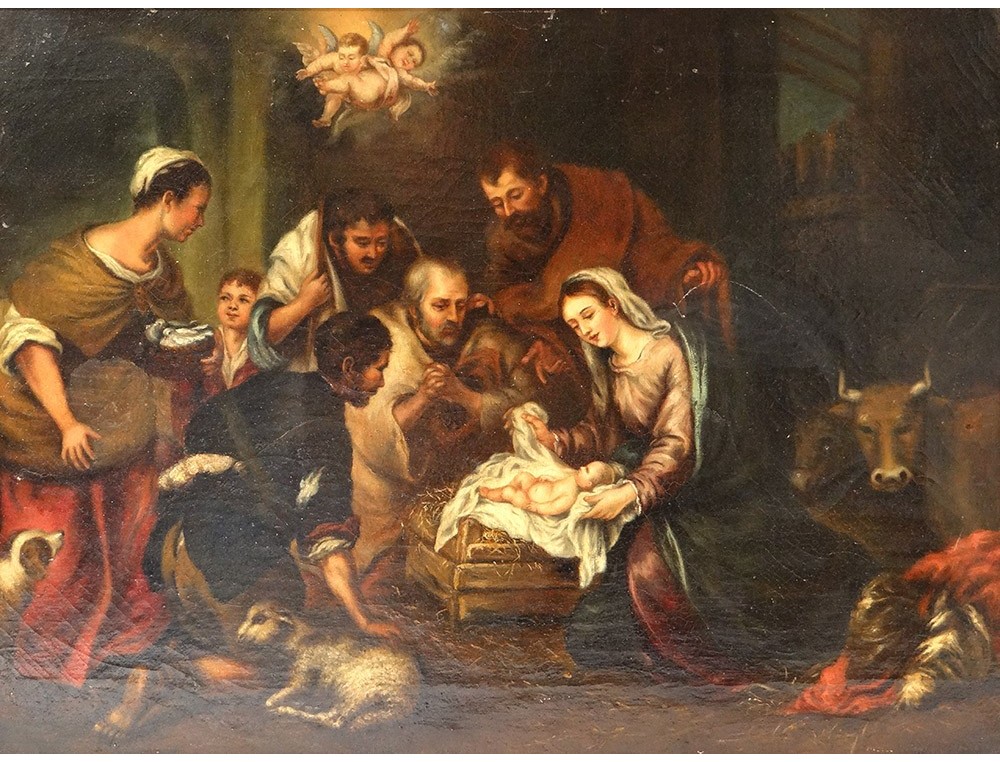
When the angels went away from them into heaven, the shepherds said to one another, “Let us go over to Bethlehem and see this thing that has happened, which the Lord has made known to us.” 16 And they went with haste and found Mary and Joseph, and the baby lying in a manger. 17 And when they saw it, they made known the saying that had been told them concerning this child. 18 And all who heard it wondered at what the shepherds told them. (Luke 2:15-18)
Today is the day we celebrate the birth of Jesus. Pretty much every Christian knows Jesus was almost certainly not born on December 25th. In Bethlehem, the winters can grow cold. Shepherds have come inside well before the end of December. Jesus may well have been born in the Spring, but there is no definite birth date. Yet, this is the day agreed upon by most of the Christian world to celebrate that great event.
To the early Christians, Christmas wasn’t observed. Easter was the main day to remember. After all, it was that day things changed for us. We now had the opportunity to receive eternal life by asking Jesus to take charge of our lives.
Christmas wasn’t recognized as an important day until in 350 a.d. Julius I, Bishop of Rome, declared December 25th the birth date of Jesus. History isn’t too clear as to whether it was actually Julius, but it was widely recognized around this time.
The reasoning behind why December 25th was chosen varies, though we can be pretty sure it wasn’t an attempt at accuracy. Most think it was an attempt to bring pagans to Christ.
There were ancient pagan celebrations in many cultures around the Winter solstice. The Scandinavians celebrated “Yule” on December 21st by cutting down a huge log and setting it on fire. During the time it burned, the Scandinavians would celebrate their upcoming new year. At this time, the wine had fermented and the animals had been slaughtered for market, so all was available for a huge party that lasted as long as the log burned: sometimes as long as 12 days.
The Romans celebrated the passage of the sun through the winter in a month-long celebration called Saturnalia. This honored the Roman god, Saturn, the god of agriculture. Many other pagan traditions continued worldwide. Julius I supposedly decided to offer a Christian holiday so the pagans could still celebrate but this time celebrate Jesus’ birth.
As a result, until somewhat recent history, Christmas was celebrated much like Mardi Gras with drinking, dancing in the streets, the exchanging of gifts, and singing.
Because of the decadence and the fact no one really knows Jesus’ birth date, the Puritans under Oliver Cromwell cancelled Christmas in England in 1645 until Charles II took the throne in 1661. Christmas was even banned in Boston from 1659-1681. The celebrations were just too perverted.
Raucous celebrations continued in America until after the American Revolution when British celebrations became unpopular. It wasn’t until 1870 that Christmas became a national holiday in the United States.
In 1819, Washington Irving wrote a series of short stories titled The Sketchbook of Geoffrey Crayon, Gent. These stories presented the celebration of Christmas as a quiet family affair, and Christmas changed in the U.S to what we see today.
Why is this important?
There are those both in the church and outside who tell us we shouldn’t celebrate on December 25th. After all, it’s derived from pagan celebrations, and we really aren’t sure of the date anyway. When we criticize people for celebrating on a certain day of the year, month, week, or not celebrating at all, we go against Scripture:
One person esteems one day as better than another, while another esteems all days alike. Each one should be fully convinced in his own mind. 6 The one who observes the day, observes it in honor of the Lord. The one who eats, eats in honor of the Lord, since he gives thanks to God, while the one who abstains, abstains in honor of the Lord and gives thanks to God. (Rom. 14:5-6)
December 25th is just a date to the Christian. It’s a day we set aside each year to worship our Savior and to thank God for sending Him. It could be any date. The Eastern Orthodox calendar designates Christ’s birth on or around our January 7th. They use a different calendar, but the date doesn’t really matter so long as we spend time praising God for His greatest gift to man.
11 For unto you is born this day in the city of David a Savior, who is Christ the Lord. 12 And this will be a sign for you: you will find a baby wrapped in swaddling cloths and lying in a manger.” 13 And suddenly there was with the angel a multitude of the heavenly host praising God and saying, “Glory to God in the highest, and on earth peace among those with whom he is pleased!” (Luke 2:11-14)
 Believers Armed and Dangerous
Beautifully written. I am spiritually fed.. Thank you.
LikeLike
I love it. Thank you for sharing. 😊
LikeLike