
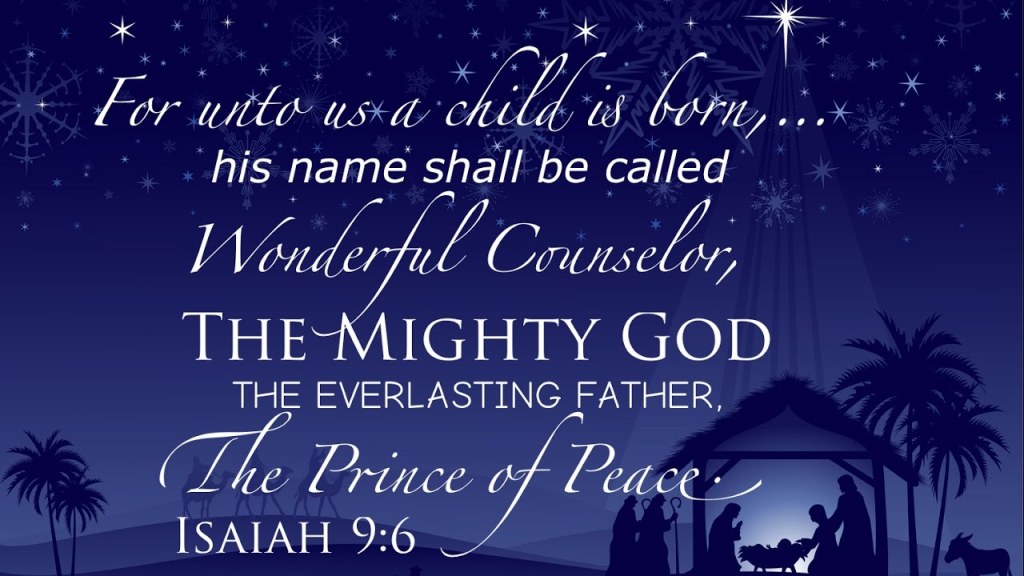
For to us a child is born,to us a son is given; and the government shall be upon his shoulder,and his name shall be called Wonderful Counselor, Mighty God,Everlasting Father, Prince of Peace. (Isa 9:6)
I was asked this week how Jesus could be the “Everlasting Father” in Isa. 9:6. The passage is obviously talking about Jesus: “a child is born, a son is given.” But how does the title Everlasting Father make sense? This has bothered me for years, but this week I was reading in Genesis, the creation account, and I saw this:
20 The man called his wife’s name Eve, because she was the mother of all living. (Gen. 3:20)
Here in Genesis, Eve is described as the mother of all living when she was not yet a mother. So, the word “mother” must be figurative as the source of all humans who follow. The Hebrew tradition can call a source by a parental name. It works the other way, too. Jesus is called the “Son of David” while He is not really David’s son but a descendent of David.
So, when Jesus is called “Everlasting Father” in Isa. 9:6, He is simply being called the Source or Creator of Eternity. This title is not referring to the Trinity but to Jesus alone Who is Creator of all things:
All things were made through him, and without him was not any thing made that was made. (John 1:3)
16 For by him all things were created, in heaven and on earth, visible and invisible, whether thrones or dominions or rulers or authorities—all things were created through him and for him. 17 And he is before all things, and in him all things hold together. (Col 1:16-17)
The Septuagint even translates the term in question as “Father of Eternity.” So, all this would seem to prove Jesus as the eternal Creator.
Secondly, I’d like to look at the first phrase in this verse:
For to us a child is born, to us a son is given;
Note it was the child which was born. It was the Son which was given. This speaks of the two natures of Christ: the promised child Jesus is the reason we celebrated Christmas last week. Jesus was a human just like us but perfect. In His human form, He walked the earth just as you and I do. He had the same temptations but without sin. Our salvation required a sacrifice that corresponded to Adam’s sin. Adam gave up the sinlessness of our race when He fell. The wages of sin is death, so death was required, death of the same sort as the sinner. That perfect human died for us on the cross and rose again to prove His power over death.
“A Son is given.” This points to God’s Son, the Word (John 1:1, 14). He was given to show us God. In Him all the fullness of the Godhead dwelt. (Col. 2:9) He told Philip, “If you have seen me, you have seen the Father.” (John 14:9)
The child and Son natures suffered through the pains of humanity and the pain of His sacrifice. The Son, though, the divine nature of Jesus, did not die. God cannot die. It was His divine nature which raised His human nature from the tomb (John 2:18-22).
Why is this important?
We as Christians need to understand our Lord as best as we can. When I teach Bible study methods, I tell my class, we need to understand our study result well enough to explain it to someone else. It is the same thing with understanding our God. We cannot know Him wholly, but we must be able to explain Him within our own limits.
One of our assignments here on earth is to answer questions for those who ask about Jesus and our salvation (1 Pet. 3:15). In order to do that, we need to understand well enough to pass on what we know to others.
Jesus is God the Son. He is not the Father or the Holy Spirit, but He is every bit as much God as the Father and Spirit. The Nicene Council said the three Persons are all of the same essence, the same substance. That same God in the Person of the Son emptied Himself, took on human form, and died for us horribly by execution. We need to tell others about such a humble and sacrificial act.

