
Prior to the introduction of the Tora, sin was seen in the ancient world as acting against cultural norms much like in the West today. Then it was called sin. Today we know that as Cultural Relativism: the need to adhere to the cultural norms.
When I was in school, I took an Introduction to Business class. The instructor defined ethics as whatever is legal. I disagreed and said it was legal for minorities and women to be paid a lower wage in 1950s America and asked her if that was ethical since it was legal. She said no but she had to teach what was in the book.
The instructor pushed an interesting point though. She said whatever is legal is ethical. That means, since laws change, ethics are subjective and open to interpretation. Ethics should be based on moral standards, objective moral standards. They shouldn’t change.
The serial killer, Ted Bundy, recorded his killings which began with discussions with the victims about morals before he killed them. He believed morality was subjective and could be founded on an individual’s preferences. Since his preference was to take pleasure in raping and killing young women, he felt it was completely ethical to do so.
Communist cultures like China and the Soviet Union believe their culture sets the ethical standard. As a result, they collectively killed 94 million people in the 20th century.
When humans no longer believe ethics are based on objective moral values, and this happens with the rejection of God, then they can do as they wish. This ends in sin and eventually in the destruction of a culture.
Sin, according to the Lexham Bible Dictionary is “Human activity which is contrary to God’s will.” I think that’s a nice short definition we can work with.
The Hebrew word for “sin” is hatta and is a very general word meaning “transgressions” of many kinds. The Greek word for “sin” is much more specific. It is harmartia and means “missing the mark” or “not a martyr.”
Anyone who has read about the martyrs of old who were fed to wild beasts, burned on crosses, and tortured to death might wonder if they could ever withstand such a thing. We must.
Paul puts it this way in Romans 6:11
So you also must consider yourselves dead to sin and alive to God in Christ Jesus.
So, if we’re not dead to sin, we’re not martyrs, we’re in sin. That’s pretty shocking. Breaking the sin habit is pretty tough (impossible) especially now that even our thoughts can be sinful. But thanks to 1 John 10:9, we can be restored to our martyr position by confessing our sins. God has promised He will forgive them and cleanse us from all unrighteousness.
God has a set of rules. The two most important are these:
And [the lawyer] answered, “You shall love the Lord your God with all your heart and with all your soul and with all your strength and with all your mind, and your neighbor as yourself.” 28 And [Jesus] said to him, “You have answered correctly; do this, and you will live.” (Luke 10:27-28)
That’s pretty simple huh, two short commands. Heck, the Old Testament had over 600 commands. We have it pretty easy. The moral portion of those Old Testament commands, though, are condensed into these two. Most of us know them by heart having heard them so often.
The issue for us is living up to these two commands. They are so broad when you think about them. Imagine all that is involved in loving God and loving everyone else. Anything less, though, is sin. I’m exhausted just thinking about it. It makes me want to sit home and never go out. It’s so hard to love everyone.
Loving God, I’m foolish enough sometimes to think I can do, but I fall into loving myself instead. That’s where that battle lies. The other commandment, love everybody else is tough as well. Some of the people out there are not so lovable. Some are downright scary. There isn’t a loophole in the command, though. It’s ours to do.
Why is this important?
We don’t get to be like the world and decide for ourselves what moral standard if any we want to follow. We have bought into this whole Jesus deal lock, stock, and barrel. We aren’t the first who have fallen and broken God’s heart:
And the man Micah had a shrine, and he made an ephod and household gods, and ordained one of his sons, who became his priest. 6 In those days there was no king in Israel. Everyone did what was right in his own eyes. (Judges 17:5-6)
It’s human nature. Without a King, we do what we want. Without a king, there’s chaos. But we Christians have a King. It’s when we ignore our King that we miss the mark, that we’re not martyrs.
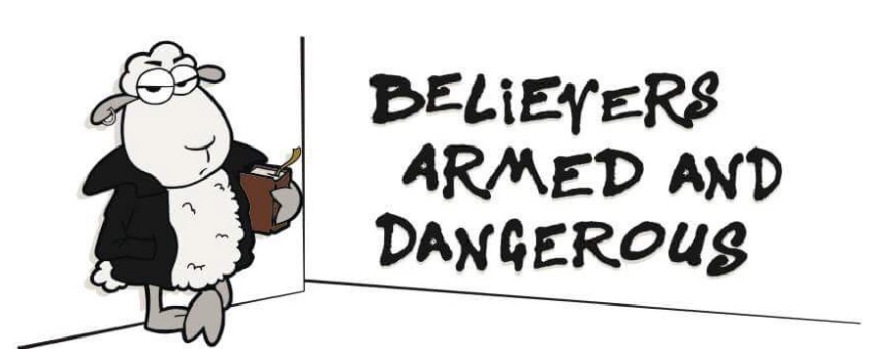
 Believers Armed and Dangerous