I’d like to start by giving a definition of a Greek or Hebrew text. An original language text is the compilation of several original language manuscripts that have been examined and criticized in order to produce what the textual critic believes is a Greek work closest to the original autographs (original writings). This work is called a text. We have more than 6,000 Greek manuscripts of the New Testament currently. These are examined and weighed to judge which are the most reliable. From these, we have two major Greek texts of the New Testament: the Textus Receptus (TR) and the Westcott and Hort 1885 (W&H) text.
There are two main philosophies of texts: the older the better (W&H) and the more the better (TR). Most of the reliable modern translations come from these two philosophies. Within those, the majority are from the older the better approach. These texts are then translated into our languages (English in our case) to produce the Bibles we have today.
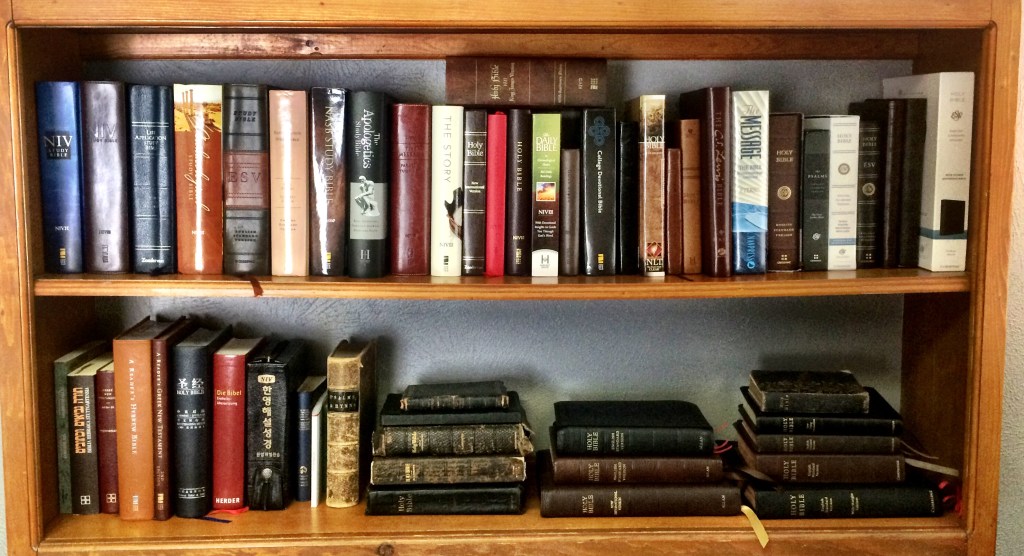
When we look at various Bibles, we see most are called versions rather than translations, and there is a reason for that. Technically, the first translation of the original languages into another language, like English, is called a translation. For instance, Tyndale’s Translation (c. 1526) is the first English translation of the New Testament. All translations of the New Testament after that should technically be called versions – someone else’s version of the Bible in English – the King James Version, New King James Version, English Standard Version, the New International Version, etc. The New American Standard now just calls itself a Bible rather than a version. According to the American Bible Society, there are currently about 1,000 English translations of the Bible.
Within these there are different philosophies of translations. There is the word-for-word approach where the translator tries his best to give as exact a representation of the original language text in a given language like English. We’ll consider English the typical example from here on. Word-for-word translations are best for serious Bible studies especially if you want to do word studies and original language studies because they best represent the original text. King James, New American Standard, English Standard, and New King James are excellent examples of word-for-word translations.
Second are the Dynamic Equivalence (DE) translations. These are a thought-for-thought type of translation. Rather than giving the actual wording of the original text, these give the idea of what is being said. They are considered translations since they are attempting to give the mood and feel of the original text. The New Living Translation is the most popular of these translations. If you are confused reading a passage in your word-for-word translation, read it in a DE translation. Then go back to the word-for-word. You’ll get the idea of the passage in the DE and be able to better understand what is being said when you return to a direct translation.
Third are paraphrases. A paraphrase is not a translation at all but an attempt to present what the paraphraser thinks the passage says. The most popular paraphrase is the Living Bible. This was written by Kenneth N. Taylor beginning in 1971 as a way to read Bible stories to his children for family devotions. Taylor did have his PhD in Theology but was not a Greek scholar.
Paraphrases are a step further away from the word-for-word translation of God’s Word, but they have their benefits. The New Testament in Modern English by J. B. Phillips is a much more scholarly paraphrase. Phillips was a genuine Greek scholar.
The next category is what I like to call horrible translations. The most popular currently is the New World Translation of the Holy Scriptures published by Jehovah’s Witnesses. This is not a translation but an attempt to bias the Word of God to reflect the doctrines of the cult. Words are added or removed and whole passages have been reworded in order to purposely change the obvious meaning of the passage.
My favorite horrible translation, though, is the Twentieth Century New Testament. This was translated at the end of the 19th century when a woman wrote a Christian publisher because she was frustrated by the archaic language in the King James Bible. The publisher wrote back asking her to produce one. She formed a committee of homemakers, local businessmen, pastors and other non-scholars and they produced “this translation.” It’s horrible, but it is another good example of how some of these oddball translations come about.
Why is this important?
Translations/versions are at the center of the Christian’s growth. The Holy Spirit will work through the written Word of God to teach us and sanctify us. We need to be sure we use a reliable translation we can depend on.
Word-for-word translations are the best for study and we each should use at least one of those as our go to Bible. The translators have tried to help us best understand how words, figures of speech, and other devices are used in the original text.
We should be very careful who translated our Bible. We need to make sure genuine and reputable scholars in the original languages were the translators or we can fall into all sorts of problems and even error.
 Believers Armed and Dangerous
I think your explanation of text, translations, and versions is very informative.
I will share it with sister and brother in law as they are both new Christians.
Thank you Mike
LikeLike