
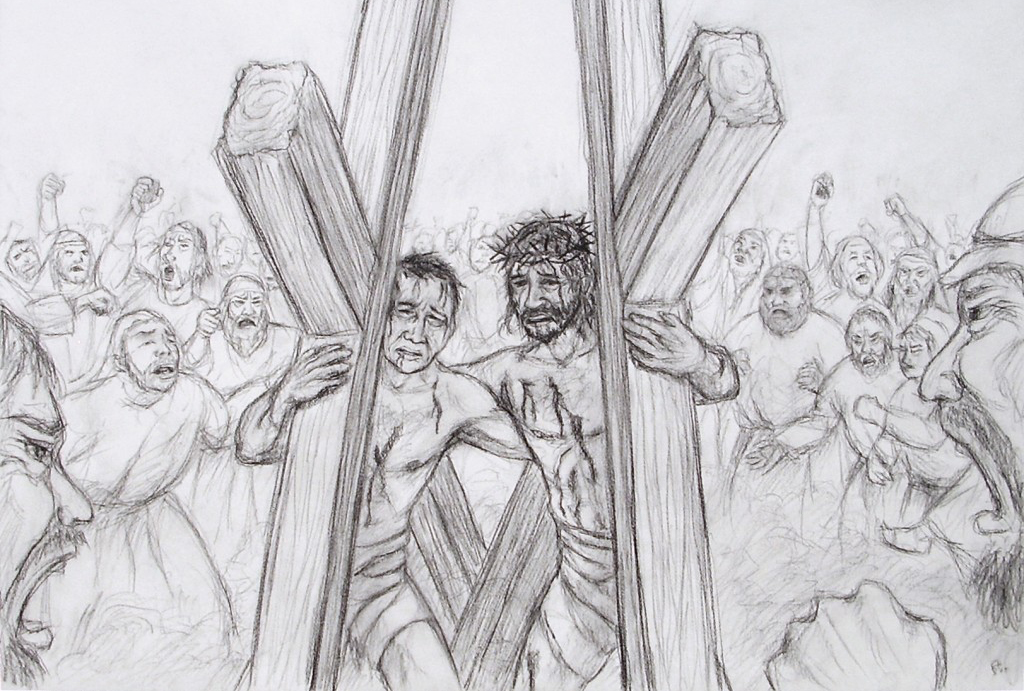
Phil. 3:10 (NASB) that I may know Him, and the power of His resurrection and the fellowship of His sufferings, being conformed to His death;
“The fellowship of His sufferings,” what a strange thing to say. How would our sufferings create a greater fellowship with Jesus?
Someone once said the world has yet to see a man completely sold out to our Lord. If Paul wasn’t that man, he was very close to it. Here he sees Jesus’ sufferings on an equal footing with the glory and power of His resurrection. Paul deeply desired to share in full all Jesus faced while here on earth.
I have friends who have been in combat, military combat. They tell me while it was no cake walk, it drew them closer to the other men with them than anything else could. There is a brotherhood with men and women who have experienced combat. Likewise, there is the same sort of closeness with those who have experience deep suffering.
How severe was Jesus’ suffering? Speaking of the beaten and crucified Jesus, Isaiah said this:
Isa. 52:14 (ESV) As many were astonished at you— his appearance was so marred, beyond human semblance, and his form beyond that of the children of mankind
Paul was willing to share this kind of suffering for the privilege of sharing it with his glorious Lord.
Earlier in the chapter, Paul tells us he gave up everything to honor God. His desire was so great to share everything with Jesus he sought to allow nothing to stand in his way.
There is a practice among Christians I sometimes follow: to pray the Scriptures, to apply a particular passage to yourself in prayer. I’m certainly not strong enough to do so with this passage. I deeply want to know Him as Paul did and does. I certainly want to know the power of His resurrection, but to pray to suffer as He did, to have the flesh torn from my back as I endure a Roman scourging, to feel spikes driven through my wrists and ankles, then feel myself raised on a cross and struggle for hours for each breath. I ask myself if I love Jesus that much. I like to think I do, but truthfully, I don’t know.
Do I want all Jesus has for me? Could that include such torture? Probably not. I may never have to make that decision whether or not to suffer for Him to this extent.
Some early Christians saw martyrdom as more than a privilege. They saw it as something to be pursued. There was no greater honor than to give your life for Christ. They welcomed the suffering. This was not the case, however, with a man named Attalus.
A blacksmith who lived in Lyons in Gaul in 177 a.d. during the persecution of Roman Emperor Marcus Aurelius, Attalus was discovered to be a Christian. He was arrested and scheduled to be made an example. He was taken along with four others (the five known as the Martyrs of Lyons) to the local Roman arena and stripped. A sign was hung around his neck which read “Attalus, a Christian.” The Romans had a highly effective method of torture using an iron chair. They used this on Attalus in an attempt to persuade him to deny his faith. The chair was heated until it was cherry red and the Roman soldiers forced Attalus to sit in it. They then marched the severely burned man around the arena commanding him to deny his faith. Instead of this, he held up the sign for the crowd to see and shouted “Attalus a Christian.”
He was a physically powerful man and survived this process for three days while all of Lyons could watch. Attalus never faltered in his faith, proclaiming it until his death.
Why is this important?
Corrie Ten Boom said we are not given the strength to suffer for God until the point of suffering. If anyone could know, she would, having watching her sister die at the hands of the Nazis during WWII. I hope that’s true. Maybe Paul knew this after all he had already been through
2 Corinthians 11:24-27 (ESV) Five times I received at the hands of the Jews the forty lashes less one. Three times I was beaten with rods. Once I was stoned. Three times I was shipwrecked; a night and a day I was adrift at sea; on frequent journeys, in danger from rivers, danger from robbers, danger from my own people, danger from Gentiles, danger in the city, danger in the wilderness, danger at sea, danger from false brothers; in toil and hardship, through many a sleepless night, in hunger and thirst, often without food, in cold and exposure.
I wonder if, in the suffering of both Paul and Attalus, they found a closeness to their Christ they found in no other way. Praying for that fellowship of His sufferings does seem more reasonable now.

