
Prov. 7:1 (ESV) My son, keep my words and treasure up my commandments with you;
Lately, in classes I teach, I’ve noticed myself repeating the phrase “It’s all true!” The more I study, the more real it becomes personally. I’ve known Jesus for nearly 50 years now, and I’ve known He’s real and the things He said in His Word are true, but it’s been becoming more real to me lately how it is all true, not just the things said in Scripture but the reasoning behind it and the consequences of the life it encourages for its followers.
This verse in the Book of Proverbs leads the reader into warnings against fleshly desires. So, why should we be careful of these? Well, giving in to fleshly desires becomes problematic. Let’s take sex, for instance. Sex outside of marriage leads to children without a father, venereal disease, attachments to strangers or to people we don’t know well but just feel attracted to, etc. Saving sex until marriage by both partners leads to none of these. Here’s the important part: God seems to know what He’s doing giving us guidelines to happier households and reducing the chances of single parent families.
Let’s look at the first of the Ten Commandments, “You shall have no other gods before (or beside) me.” The worship of other gods had convinced just a little fewer than 1 million Hindus in India to live a vegetarian lifestyle. Due to this Hindu teaching, about a third of the Indian population lives near starvation. I wrote a paper in college promoting the Christian evangelization of India as a solution to the starvation in that nation. My professor was convinced enough to send contributions to Christian organizations working to evangelize India. The important part is neither my school nor my professor were Christian. The Christian worldview worked best for the welfare of the Indian population.
The Old Testament had a welfare system. Gleaning was allowed where the farmers were not to harvest all of their crops but leave some for the poor to collect (glean) enough for their own needs. They would have to work just as hard as the farm workers for their grain, grapes, and fruit, but they could exist. The Important part? This assured the able bodied poor still had to work in order to provide for their families encouraging a good work ethic and self image without having to beg.
If a man still wasn’t able to provide for his family, he could become an indentured servant, with the agreement his master would provide for his family in exchange for their work. It was a sort of employment where the servant could be freed after a period of time unless that servant wanted to stay on.
Widows unable to fend for themselves could also glean in the fields. There were also several festivals each year where the widows were to be included. This helped them to supplement their diets. The important part in all of this is few are uncared for unless they choose to be.
All this got me thinking about how many other things God instructs us in that are true whether one can point to Scripture or not. Many of the people I speak with are not Christian or “Bible believing” cultists. I speak with atheists, agnostics, and with some who have no opinion of God and don’t care. How do we reach them if we can’t use the Bible truth? We reach them by pointing to things they already believe to be true then point to the Bible to show God said it first.
Let’s take the Big Bang for instance. It was less than 100 years ago that the Big Bang Theory became popular through cosmological observations by Hubble showing the galaxies are moving away from each other. 3500 years ago, Moses said petty much the same thing, that the universe sprang into existence through the effort of an all powerful God. The cosmologists have no cause for the Big Bang except they know the laws of physics as we know them did not cause it. In fact those laws didn’t exist prior to the Big Bang. In other words, this universe did not create itself but came from a separate cause. The Kalam Cosmological Argument would indicate this cause had to be greater than the universe it created, had to be an agent (Person) Who decided to create it, and had to be super intelligent (omniscient) to know how to create this. The importance: all this points to the God of the Bible.
Why is this important?
What we read in the Bible is true. The commands and “rules” are there for a reason, for our own good. If we follow them we will have a happier life, a more fulfilled life, a more peaceful life than those who choose to disregard those guidelines.
Besides that, what we are told in Scripture is not just true in that it “works” (pragmatically true), but it is true because it corresponds to reality (correspondently true). God knows what He is doing. He made this universe and gave us a manual to understand how it works and how to live happily within it. Follow the manual, and things will work generally well for you. Decide to ignore the manual, and things will work generally poor for you.
Sure Christians face trials, and some are not of their own making, but those trials are meant to make us more like our Lord. They are teaching devices. The Christian’s life isn’t always easy, and for some it is almost never easy, but it is easier, it is less of a struggle since we have the peace of the God who created the cosmos and the rule book that came with it.
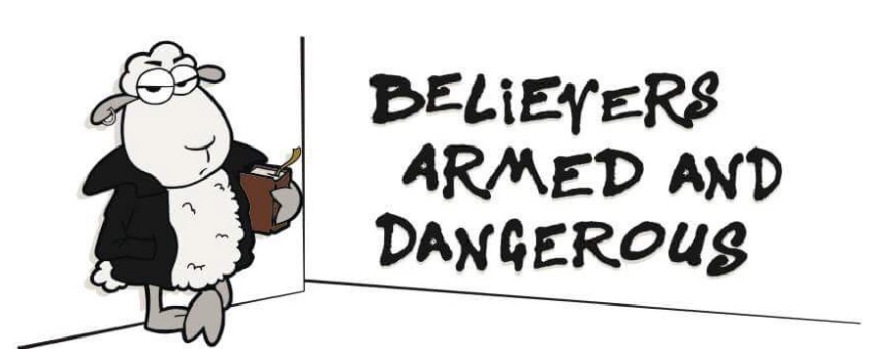
 Believers Armed and Dangerous