
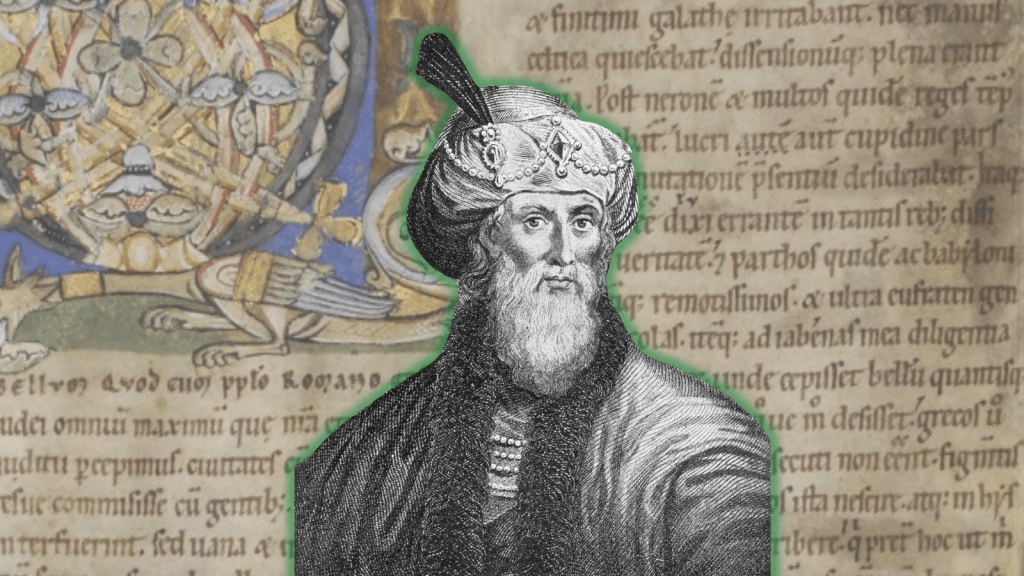
“Now there was about this time Jesus, a wise man, if it be lawful to call him a man; for he was a doer of wonderful works, a teacher of such men as receive the truth with pleasure. He drew over to him both many of the Jews and many of the Gentiles. He was [the] Christ. And when Pilate, at the suggestion of the principal men amongst us, had condemned him to the cross, those that loved him at the first did not forsake him; for he appeared to them alive again the third day; as the divine prophets had foretold these and ten thousand other wonderful things concerning him. And the tribe of Christians, so named from him, are not extinct at this day.” (Josephus, Flavius. The Complete Works of Flavius Josephus: Josephus’s work, translated by William Whiston in 1737 . Kindle Edition.)
There is a very controversial passage in ancient historian Flavius Josephus’ work Antiquities (18:63-64) called the Testimonium Flavianum (the Testimony of Flavius). The passage is controversial for a few reasons. First, it is a very early record of Jesus of Nazareth by a non-Christian writer/historian. Secondly, it identifies Jesus as “the Christ.” Thirdly, it says He was a worker of miracles. Fourthly, it tells of His crucifixion. And fifthly, it speaks of His resurrection. You can see why many scholars, secular scholars in particular but many Christian scholars, would see this as an early “fake.” Most believe Jesus is mentioned in the original, but not the extensive description of His miracles, death, and resurrection.
Many believe the controversial portions were inserted later, perhaps two centuries or more later, by Christians who wished to embellish the memory of Jesus. This controversy may have been settled to a degree late last year.
In August of 2025, Dr. T. C. Schmidt, a PhD graduate of Yale University specializing in the Historical Jesus, early Christian history, and the background of the New Testament, published the book: Josephus and Jesus, where he challenged the popular view of the TF.
Using AI, Dr. Schmidt researched the complete writings of Josephus and his potential sources, exploring the relationships between Josephus and those possible sources he may have encountered. His findings were that the passage is authentic. In other words, Schmidt believes Josephus wrote it and wrote more than is currently widely accepted. Here are some reasons why he believes this:
The TF fits Josephus’ narrative flow too well to be a later insertion.
The TF sits inside a continuous political narrative in the chapter
The surrounding sections concern Roman governors, public unrest, executions under Pilate.
If you remove the TF entirely, the paragraph break becomes awkward and Josephus’ pattern of cataloging disturbances is disrupted.
A later Christian interpolator would not have been able to insert a paragraph that perfectly matches Joesphus compositional habits at this point in the narrative.
The core language is recognizably Josephus’ Greek.
Josephus’ characteristic sentence rhythm.
The vocabulary is the same as Josephus uses elsewhere
This is not a Christian confessional formula but is consistent with how Josephus describes other figures (prophets, teachers, troublemakers)
The Christian-sounding lines stand out because they are intrusive. Rather than weakening, Schmidt argues the opposite:
“if indeed one ought to call him a man”
“he was the Christ”
“appeared to them alive again”
You don’t get this kind of stylistic consistency unless something original was already there.
Josephus had direct access to people who knew Jesus’ movement (one of the strongest points)
Josephus personally knew Ananus and family, the high priestly elites, herod Agrippa II, and Roman governors such as Felix and Festus:
Josephus also mentions James, “the brother of Jesus who was called the Christ” two chapters later without having to reintroduce Jesus.
Once Josephus has named Jesus in Book 18, the James reference makes sense.
Without the TF, the James mention becomes oddly abrupt. This suggests Josephus already expected his readers to know who Jesus was.
The TF is too restrained to be a Christian invention
It’s what the TF does not say: no virgin birth, no atonement theology, no fulfillment of prophecy, no exalted Christology.
Instead Jesus is a teacher who was executed by Pilate and followed by a persistent group.
Why Is This Important?
Dr. Schmidt’s work draws us much closer to show a non-Christian Jewish historian who was a contemporary of the Apostle John, spoke of Jesus, His marvelous works, and His crucifixion. As a result of his work, Schmidt is confident in the following version of the TF’s core language:
“At this time there appeared Jesus, a wise man. For he was a doer of surprising deeds, a teacher of people who receive the truth with pleasure. He won over many Jews and also many Greeks. And when Pilate, on the accusation of our leading men, condemned him to the cross, those who had loved him did not cease. And to this day the tribe named after him has not disappeared.”
The Greek word for miracles can mean “surprising deeds,” so to give as conservative a translation as possible, Schmidt changes it here. Schmidt also felt justified in removing the resurrection claim as having possibly been added later. Josephus was a Roman and Jewish historian and kept theological comments out of his writings.
Even Schmidt’s conclusion gives historical evidence for the life of Christ, His crucifixion at the hands of Pilate due to the prompting of the Jewish leaders of the time, and that Jesus followers did not cease to follow even after His death.
Historical evidence for our faith is often like a puzzle: it comes a piece at a time rather than a full flood of evidence. We will need to wait for more evidence perhaps supporting the full TF. God gives us enough to strengthen our faith but seldom enough to turn it into certainty.
 Believers Armed and Dangerous