Son of God

How many sons of God are there?  There are millions, I’m sure.  Romans 8:14 says For all who are led by the Spirit of God are sons of God.  So, all Christians are called sons of God or children of God.  Job 1:6 seems to say angels are called “sons of God” as well: Now there was a day when the sons of God came to present themselves before the Lord, and Satan also came among them.  So, how is Jesus different if He’s a Son of God, too?

The difference is Jesus not “a” son of God but “The” Son of God, the one and only Son of God.  In John chapter 5, Jesus calls God the Father His own Father rather than “Our Father,” the general term the Jews used.  The Jewish leaders He was speaking to saw this and decided to kill Him for what they saw as blasphemy because of it:

John 5:18 (ESV)  This was why the Jews were seeking all the more to kill him, because not only was he breaking the Sabbath, but he was even calling God his own Father, making himself equal with God.

The Jews, of course, thought God was only one Person even though there were hints He was more:

Isa. 44:6 (ESV)  Thus says the Lord, the King of Israel and his Redeemer, the Lord of hosts: “I am the first and I am the last; besides me there is no god.

Isaiah mentions two divine Persons here: Yahweh, the King of Israel and a second Person, His Redeemer, Yahweh of hosts, yet together they are identified as the one God.

So, like many, the Jews had an insufficient understanding of their own Scriptures.  But Jesus didn’t shy from the fact they understood He was claiming equality with their God.  He began to build on it.  He started comparing Himself to God the Father Who they already believed in.  He said first He does nothing by Himself.  This is again pointing to His equality and relationship with the Father.  He says in verse 19 “For whatever the Father does, that the Son does likewise.”  The Father and Son are working in union.  In this case, Jesus does not point to the Father as the one doing the work but that He and the Father are working together to achieve their common work.  In verse 21, Jesus says “For the Father raises the dead and gives them life, so also the Son gives life.”  If Jesus was just saying the Father raises the dead through me, He certainly didn’t convey that thought.  It was a cooperative effort. Both were working together.

The Jewish leaders believed only God could raise the dead.  He used people to do so, but it was obvious God was doing the work.  Here Jesus is saying both the Father and the Son can each raise the dead again claiming equality with the Father.

Most important of all, Jesus points to the Jewish leaders’ purpose in life, the worship and honor paid by them to God, and in verses 22-23, Jesus says they must do the same for Him as well: For the Father judges no one, but has given all judgment to the Son, that all may honor the Son just as they honor the Father.  Whoever does not honor the Son does not honor the Father who sent Him.

Jesus went on in this same chapter to provide five witnesses that He is the Son of God: John the Baptist (vs. 33-35), Jesus’ works (vs. 36), God the Father (vs. 36), the Scriptures (vs. 39-40), and Moses (vs. 45-47)

Throughout the New Testament, Jesus is recognized as the Son of God by every gospel writer, by Satan (Matt. 4:3), by demons (Matt 8:29), by the disciples (Matt. 14:33), by bystanders at His crucifixion (Matt. 27:54), by the angel Gabriel (Luke 1:35), Jesus Himself (John 10:36), and of course by God the Father (Heb. 1:8)

Why is this important?

We need to gather from just these few verses in the fifth chapter of John that Jesus is equal to the Father, that even when He walked the earth, He did many things in His own power alongside the Father, and we are to offer the same worship, honor, and praise to Him as we offer to the Father.  According to Jesus’ own words, to honor the Father alone or to honor the Father in a greater way than we honor the Son is to dishonor the Father.

Looking at all that Jesus said here, we must see the term “the Son of God” is equal to the term “God the Son,” and with the centurion, we should realize “Surely this man was the Son of God.” (Mark 15:39)
Jehovah’s Witnesses and Christmas

Jehovah’s Witnesses and Christmas

It has been five years since I last centered on Jehovah’s Witnesses who claim 8.7 million followers worldwide and 1.238 million in the US alone.  According to their own figures, that’s one out of every 272 Americans is a JW.

At this time of the year, we will often hear from JWs to tell us Christmas should not be celebrated by God’s people.  I thought it would be good to look at why.  These six objections are taken directly from their website

For the most part, these complaints boil down to a logical fallacy: guilt by association.  Because some pagans did something or something evil happened on a particular day, we must link all similar days and celebrations to the sins or pagan practices of that day. This is akin to saying “Hitler loved dogs, so all dog lovers should be careful of loving their dogs. It’s a Nazi practice:”

  •  Celebrating a birthday   JWs like to point to evil events which happened on birthdays in the Bible to discourage birthday celebrations of all sorts: Pharaoh hanged the chief baker on his birthday and Herod ordered John the Baptist beheaded at his birthday party, “so,” they say, “we shouldn’t celebrate birthdays.” 

In contrast to Pharaoh and Herod, Jesus’ birth was, of course, a joyous occasion attended by the angels of heaven (Luke 2:13-14) and announced by the angel, Gabriel himself (Luke 1:26), who stands in the presence of God (Luke 1:19).

Job’s sons also celebrated their birthdays with the full approval and even consecration of Job, a blameless and upright man (Job 1:1-5). 

  • The fact Christmas is celebrated on December 25th.  “There is no proof that Jesus was born on that date. Church leaders likely chose this date to coincide with pagan festivals held on or around the winter solstice.” (Watchtower)

Of course, very few Christians believe Jesus was born on December 25th.  We don’t know exactly when Jesus was born, and the Bible doesn’t tell us.  If the shepherds were in the fields with their flocks, it was more likely earlier in the year. December would have been too cold.

The early Church didn’t celebrate Christmas.  Most likely the December date was chosen in 336 a.d. when the Christian Roman Emperor, Constantine, decided to make this date important in order to draw pagans away from the Saturnalia celebration.  So, Rome’s Christian emperor invited the lost to our party rather than the pagan’s, and this helped bring them to Christ.  I’m not saying this was a good thing necessarily, it was man’s choice 1700 years ago. Certainly today’s celebration doesn’t involve or commemorate Saturnalia or any other pagan practice.

It doesn’t matter which day we celebrate the birth of our Savior.  If we want to celebrate it on December 25th, who’s to keep us from doing so? 

  • Gift-giving has pagan roots.  The Watchtower brings Saturnalia into the mix here as well claiming gifts were given at that celebration and feast.  So, their implication is gift-giving at Christmas is just another pagan ritual being repeated. 

    Actually, gifts are very biblical.  They are mentioned 126 times in the Bible: gifts to God, gifts as a returned favor, gifts to one another as a sign of friendship, and God even gives us gifts (Lev. 1:10; Gen. 24:10, 25:6; Eph. 2:8-9). Gift-giving is hardly pagan.
     
  • Christmas Lights.  Here, once again, is guilt by association.  They claim because Europeans often decorated their homes with lights and candles to celebrate the Winter solstice and ward off evil spirits, so displaying candles and Christmas light must be evil.  The logic escapes me.  It is just an attempt to keep the Jehovah’s Witnesses from celebrating Jesus in any way.
  • Mistletoe and Holly.  “’The Druids ascribed magical properties to the mistletoe in particular. The evergreen holly was worshiped as a promise of the sun’s return.’”—The Encyclopedia Americana.”  Once again, because the Druids used mistletoe and holly in a particular way, we shouldn’t see it that way too rather than use it in our homes for the holiday. 
  • Christmas Trees.  Pagans worshiped trees, so having a Christmas tree must be a pagan practice. 

Why is this important?

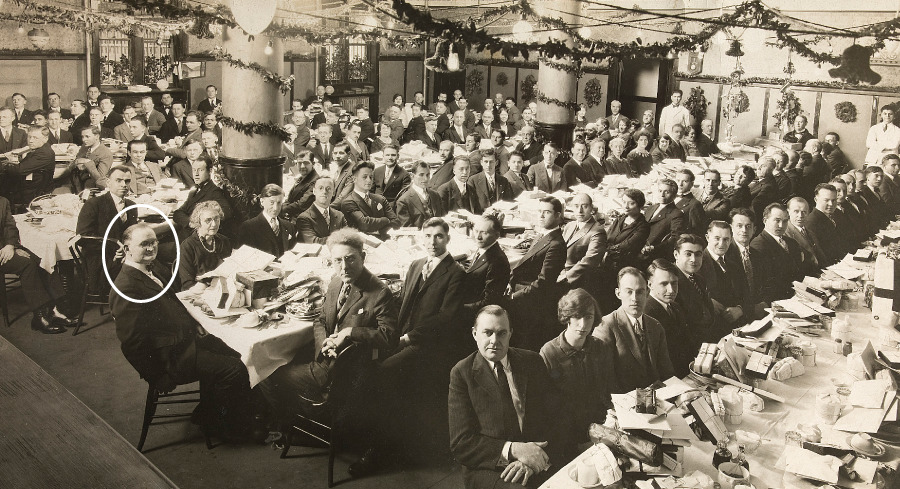
Jehovah’s Witnesses used to celebrate Christmas.  The photo at the top of this blog is of the 1926 Christmas party at their headquarters in Brooklyn, NY.  But, it just gave too much attention to Christ, so they ended the practice.

It all comes down to this: celebrate Christmas in your own way.  If you’re praising God for His greatest Gift, His Son, you’re on solid ground.  The Watchtower Bible and Tract Society, Jehovah’s Witnesses’ organization, seeks to keep any sort of honor from God’s Son, and their attack on our celebration of His birth is just another feature of this quest.

Rom. 14:5-6a (ESV)  One person esteems one day as better than another, while another esteems all days alike. Each one should be fully convinced in his own mind.  The one who observes the day, observes it in honor of the Lord.

You Search the Scriptures

John 5:39-40 (ESV)  You search the Scriptures because you think that in them you have eternal life; and it is they that bear witness about me, yet you refuse to come to me that you may have life.  

This is a part of a talk Jesus had with the Jewish leaders right after He healed the man at the Pool of Bethesda.  Like much of Scripture, there is more than one application to this passage.  The first, of course, is to the Jewish leaders.  These guys had spent their entire adult lives studying the Scriptures, and Jesus said it’s not enough, not even close.  They needed to come to Him for salvation.

The world is filled with people in various groups who think study will bring them favor with God and even salvation.  They’re wrong.  Jesus says to them exactly what He said to the Jewish leaders here.  So far as salvation is concerned, Bible study doesn’t do it.  Only Jesus can save you:

Acts 4:11-12 (ESV)  This Jesus is the stone that was rejected by you, the builders, which has become the cornerstone. And there is salvation in no one else, for there is no other name under heaven given among men by which we must be saved.”

So, studying the Bible is an excellent way to grow as a Christian, it does nothing by itself for someone to become a Christian.

Bible study is a work.  It’s a good work, but it’s still a work.  It won’t save you because we aren’t saved by works:

Titus 3:4-6 (ESV)  But when the goodness and loving kindness of God our Savior appeared, he saved us, not because of works done by us in righteousness, but according to his own mercy, by the washing of regeneration and renewal of the Holy Spirit, whom he poured out on us richly through Jesus Christ our Savior,

This idea of works bleeds into other areas of our Christian life, of course.  We are created for good works but not concerning our salvation:

Eph. 2:8-10 (ESV)  For by grace you have been saved through faith. And this is not your own doing; it is the gift of God, not a result of works, so that no one may boast. For we are his workmanship, created in Christ Jesus for good works, which God prepared beforehand, that we should walk in them.

So, works are important but have nothing to do with our salvation.  Works are the result of salvation not a requirement for salvation.  In fact works are expected.  They are to be a natural part of the Christian’s life.  Visiting orphans and widows, for instance, is one thing the church is expected to:

James 1:26-27 (ESV)  If anyone thinks he is religious and does not bridle his tongue but deceives his heart, this person’s religion is worthless. Religion that is pure and undefiled before God the Father is this: to visit orphans and widows in their affliction, and to keep oneself unstained from the world.

Rejecting the works God has given to the church is to reject God’s commands.  Of course, one Christian can’t do it all, but Christians as a whole cannot long ignore God’s commands.  We are expected to do something.  We are not thrilling God because of what we do as the Jewish leaders thought.  A servant is expected to do the will of the master. 

Luke 17:7-10 (ESV)  “Will any one of you who has a servant plowing or keeping sheep say to him when he has come in from the field, ‘Come at once and recline at table’? Will he not rather say to him, ‘Prepare supper for me, and dress properly, and serve me while I eat and drink, and afterward you will eat and drink’? Does he thank the servant because he did what was commanded? 10 So you also, when you have done all that you were commanded, say, ‘We are unworthy servants; we have only done what was our duty.’ ”

Many of us think, “Well, if I just do this little thing here and another there, God will be pleased,” yet, it is impossible to do more than is expected by God.  The blessings we receive don’t come from gratitude for a good job.  They are simply God’s grace poured out on His child.

Why is this important?

The first thing we can learn from John 5:39-40 is knowing Jesus is so much more important than knowing about Jesus.  I know a bit about the apostle John, but I don’t know him.  Jesus said our first priority is Him.  After we come to Jesus as He Himself tells us to do, then we can work on knowing more about Him.

The Fellowship of His Sufferings

Phil. 3:10 (NASB)  that I may know Him, and the power of His resurrection and the  fellowship of His sufferings, being conformed to His death;

“The fellowship of His sufferings,” what a strange thing to say.  How would our sufferings create a greater fellowship with Jesus?

Someone once said the world has yet to see a man completely sold out to our Lord.  If Paul wasn’t that man, he was very close to it.  Here he sees Jesus’ sufferings on an equal footing with the glory and power of His resurrection.  Paul deeply desired to share in full all Jesus faced while here on earth.

I have friends who have been in combat, military combat.  They tell me while it was no cake walk, it drew them closer to the other men with them than anything else could.  There is a brotherhood with men and women who have experienced combat.  Likewise, there is the same sort of closeness with those who have experience deep suffering. 

How severe was Jesus’ suffering? Speaking of the beaten and crucified Jesus, Isaiah said this:

Isa. 52:14 (ESV) As many were astonished at you— his appearance was so marred, beyond human semblance, and his form beyond that of the children of mankind

Paul was willing to share this kind of suffering for the privilege of sharing it with his glorious Lord.

Earlier in the chapter, Paul tells us he gave up everything to honor God.  His desire was so great to share everything with Jesus he sought to allow nothing to stand in his way.

There is a practice among Christians I sometimes follow: to pray the Scriptures, to apply a particular passage to yourself in prayer.  I’m certainly not strong enough to do so with this passage.  I deeply want to know Him as Paul did and does.  I certainly want to know the power of His resurrection, but to pray to suffer as He did, to have the flesh torn from my back as I endure a Roman scourging, to feel spikes driven through my wrists and ankles, then feel myself raised on a cross and struggle for hours for each breath.  I ask myself if I love Jesus that much.  I like to think I do, but truthfully, I don’t know.

Do I want all Jesus has for me?  Could that include such torture? Probably not.  I may never have to make that decision whether or not to suffer for Him to this extent.

Some early Christians saw martyrdom as more than a privilege.  They saw it as something to be pursued.  There was no greater honor than to give your life for Christ. They welcomed the suffering. This was not the case, however, with a man named Attalus.

A blacksmith who lived in Lyons in Gaul in 177 a.d. during the persecution of Roman Emperor Marcus Aurelius, Attalus was discovered to be a Christian.  He was arrested and scheduled to be made an example.  He was taken along with four others (the five known as the Martyrs of Lyons) to the local Roman arena and stripped.  A sign was hung around his neck which read “Attalus, a Christian.”  The Romans had a highly effective method of torture using an iron chair.  They used this on Attalus in an attempt to persuade him to deny his faith.  The chair was heated until it was cherry red and the Roman soldiers forced Attalus to sit in it.  They then marched the severely burned man around the arena commanding him to deny his faith.  Instead of this, he held up the sign for the crowd to see and shouted “Attalus a Christian.”

He was a physically powerful man and survived this process for three days while all of Lyons could watch.  Attalus never faltered in his faith, proclaiming it until his death.

Why is this important?

Corrie Ten Boom said we are not given the strength to suffer for God until the point of suffering.  If anyone could know, she would, having watching her sister die at the hands of the Nazis during WWII.  I hope that’s true.  Maybe Paul knew this after all he had already been through

2 Corinthians 11:24-27 (ESV)  Five times I received at the hands of the Jews the forty lashes less one. Three times I was beaten with rods. Once I was stoned. Three times I was shipwrecked; a night and a day I was adrift at sea; on frequent journeys, in danger from rivers, danger from robbers, danger from my own people, danger from Gentiles, danger in the city, danger in the wilderness, danger at sea, danger from false brothers; in toil and hardship, through many a sleepless night, in hunger and thirst, often without food, in cold and exposure.

I wonder if, in the suffering of both Paul and Attalus, they found a closeness to their Christ they found in no other way.  Praying for that fellowship of His sufferings does seem more reasonable now.

What are Texts, Translations, and Versions?

I’d like to start by giving a definition of a Greek or Hebrew text.  An original language text is the compilation of several original language manuscripts that have been examined and criticized in order to produce what the textual critic believes is a Greek work closest to the original autographs (original writings).  This work is called a text. We have more than 6,000 Greek manuscripts of the New Testament currently.  These are examined and weighed to judge which are the most reliable.  From these, we have two major Greek texts of the New Testament: the Textus Receptus (TR) and the Westcott and Hort 1885 (W&H) text.

There are two main philosophies of texts: the older the better (W&H) and the more the better (TR).  Most of the reliable modern translations come from these two philosophies.  Within those, the majority are from the older the better approach.  These texts are then translated into our languages (English in our case) to produce the Bibles we have today.

When we look at various Bibles, we see most are called versions rather than translations, and there is a reason for that.  Technically, the first translation of the original languages into another language, like English, is called a translation.  For instance, Tyndale’s Translation (c. 1526) is the first English translation of the New Testament.  All translations of the New Testament after that should technically be called versions – someone else’s version of the Bible in English – the King James Version, New King James Version, English Standard Version, the New International Version, etc.  The New American Standard now just calls itself a Bible rather than a version.  According to the American Bible Society, there are currently about 1,000 English translations of the Bible.

Within these there are different philosophies of translations.  There is the word-for-word approach where the translator tries his best to give as exact a representation of the original language text in a given language like English.  We’ll consider English the typical example from here on.  Word-for-word translations are best for serious Bible studies especially if you want to do word studies and original language studies because they best represent the original text.  King James, New American Standard, English Standard, and New King James are excellent examples of word-for-word translations.

Second are the Dynamic Equivalence (DE) translations.  These are a thought-for-thought type of translation.  Rather than giving the actual wording of the original text, these give the idea of what is being said.  They are considered translations since they are attempting to give the mood and feel of the original text.  The New Living Translation is the most popular of these translations.  If you are confused reading a passage in your word-for-word translation, read it in a DE translation.  Then go back to the word-for-word.  You’ll get the idea of the passage in the DE and be able to better understand what is being said when you return to a direct translation.

Third are paraphrases.  A paraphrase is not a translation at all but an attempt to present what the paraphraser thinks the passage says.  The most popular paraphrase is the Living Bible.  This was written by Kenneth N. Taylor beginning in 1971 as a way to read Bible stories to his children for family devotions.  Taylor did have his PhD in Theology but was not a Greek scholar. 

Paraphrases are a step further away from the word-for-word translation of God’s Word, but they have their benefits.  The New Testament in Modern English by J. B. Phillips is a much more scholarly paraphrase.  Phillips was a genuine Greek scholar.

The next category is what I like to call horrible translations.  The most popular currently is the New World Translation of the Holy Scriptures published by Jehovah’s Witnesses.  This is not a translation but an attempt to bias the Word of God to reflect the doctrines of the cult.  Words are added or removed and whole passages have been reworded in order to purposely change the obvious meaning of the passage. 

My favorite horrible translation, though, is the Twentieth Century New Testament.  This was translated at the end of the 19th century when a woman wrote a Christian publisher because she was frustrated by the archaic language in the King James Bible.  The publisher wrote back asking her to produce one.  She formed a committee of homemakers, local businessmen, pastors and other non-scholars and they produced “this translation.”  It’s horrible, but it is another good example of how some of these oddball translations come about.

Why is this important?

Translations/versions are at the center of the Christian’s growth.  The Holy Spirit will work through the written Word of God to teach us and sanctify us.  We need to be sure we use a reliable translation we can depend on.

Word-for-word translations are the best for study and we each should use at least one of those as our go to Bible.  The translators have tried to help us best understand how words, figures of speech, and other devices are used in the original text. 

We should be very careful who translated our Bible.  We need to make sure genuine and reputable scholars in the original languages were the translators or we can fall into all sorts of problems and even error.

The Books of the Bible

When I was a new Christian trying to find my way around the Bible, I was confused.  The books of the Bible are not arranged in alphabetical order; nor are they in chronological order.  So, in what sort of order are they listed in the Christian Old and New Testament?

The order actually makes a lot of sense unlike other religious books such as the Q’uran which orders the Suras (Chapters) by size alone.

In the Protestant Christian Bible, the first five books are the Law: the Pentateuch, the books written by Moses.  After this, we have the historical books, Joshua through Esther.  Then come the poetic books sometimes called the “writings:” Job through Song of Solomon.  After this come the prophets: first the Major Prophets, Isaiah through Daniel, then the Minor Prophets, Hosea through Malachi.  The Major Prophets are no more important than the Minor Prophets, they are just longer.

In the New Testament, the category order is pretty much the same.  First we have the biographies, the Gospels, Matthew through John.  Next we have the historical book of Acts.  After this come the writings, the epistles and, no, an epistle is not the wife of an apostle.  These epistles are usually broken up into Paul’s epistles and the others are called the General Epistles.  This is because Paul’s epistles were written to specific churches such as the Romans, Galatians, Corinthians, etc. or to individuals such as Timothy and Titus. 

The General Epistles were written to the church at large and by writers other than Paul: James, Peter, John, Jude, and we’re not sure who wrote Hebrews.

Sometimes Paul’s epistles are broken down even further, and the Prison Epistles which Paul wrote from captivity around 60-62 a.d.: Epistles, Philippians, Colossians, and Philemon are seen as separate.

Last of all comes the prophetic book of the New Testament: Revelation.

This only covers the books of the Protestant Bible.  Though we have 39 books of the Old Testament, the Rabbinic Jewish canon (recognized books) only has 24 books, but the books outside of the Torah, the five books of Moses, and the Prophets, are “fluid;” the number can change.  The Jewish view of inspiration is different than the Christian. 

Within Christianity, there are different canons (lists of inspired books).  The Protestants recognize 66 inspired books while the Catholic Bible currently contains 73 books.  The additional seven books are the Old Testament books of Tobit, Judith, Wisdom, Sirach, Baruch, 1 Maccabees, and 2 Maccabees.  These are seen by the Catholic Church as important and added to the Bible in the 16th century at the Council of Trent.  The Protestants see them as “apocrypha,” books accepted by some as inspired but not by others.

The question arises how the Protestant Bible came about, how did they know the books that are included in their canon?  In A General Introduction to the Bible by Geisler and Nix, a list of tests is given that were used by the early church to discover which books were inspired. 

A New Testament book needed to be written by someone with Apostolic Authority.  That meant the book needed to be written by an apostle or someone closely related to an apostle.  Luke wasn’t an apostle, but he was a close associate of Paul’s and traveled extensively with him.  James and Jude were the Lord’s half brothers.  Paul calls James an apostle in Gal. 1:19.  We don’t know the author of Hebrews, but it passed the other tests.

A book needed to be widely recognized as inspired by the church.  It also needed to be consistent with those books already accepted as inspired, and it must carry the power of God.

The New Testament Canon was not agreed upon until 367 a.d. when Athanasias included his list of the 27 books in his Easter letter.  There was no rush on this as the early church didn’t recognize a need to form a “collection” of inspired books.  In fact, the first list of books doesn’t appear until 100 years after the death of all the apostles but John. It was in 170 a.d. when 23 of our current New Testament books were contained in what is known as the Muratorian Canon.  The only books not listed were 2 Peter, Hebrews, and two of John’s epistles.  By then the other 23 were accepted.  In fact, as early as late in Peter’s ministry, he tells us Paul’s epistles were accepted as Scripture (2 Peter 3:16).

Why is this important?

To defend the Bible against those who would attack its reliability and inspiration, we need to understand what it is and how it came to be.  Christians don’t cling to some old random collection of ancient documents for direction.  The Bible is a very carefully compiled collection of 66 books written by more than 40 authors over a period of 1500 years.  Christians believe in it strongly enough to defend it robustly and eagerly. 

How accurate is our modern Bible? Astrophysicist, Dr. Hugh Ross, went on a search for the Creator God of the universe he saw.  He felt this God might want to communicate with His creation, and so began to read the writings of all the major world religions.  He left Christianity for last but discovered great accuracy in the writings of the Bible when compared with the universe around us and gave his life to Christ.

The book we know as the Bible is as trustworthy as the reality of the universe and its Creator it describes.

The Pool at Bethesda

John 5:2-7 (ESV)  Now there is in Jerusalem by the Sheep Gate a pool, in Aramaic called Bethesda, which has five roofed colonnades. In these lay a multitude of invalids—blind, lame, and paralyzed. One man was there who had been an invalid for thirty-eight years. When Jesus saw him lying there and knew that he had already been there a long time, he said to him, “Do you want to be healed?” The sick man answered him, “Sir, I have no one to put me into the pool when the water is stirred up, and while I am going another steps down before me.”

This fellow Jesus healed seemed a little unappreciative to say the least.  No “thank you,” no sign of appreciation at all.  He just took up his bed and walked away.  Later in verse 11, the man turns Jesus in to the Jews for healing him on the Sabbath.  Leon Morris, in his commentary on John, describes the man this way: “The man was not of the stuff of which heroes are made. He put the whole blame on the shoulders of him who had healed him.”  Let’s look at the man for a moment:

There was a multitude of invalids surrounding the pool.  This pool area has been excavated and found to be 360 feet by 130 feet and 75 feet deep, not a small wading pool as we see in the movies.  It was probably built as a sort of mote to protect the temple from invaders.  So there was room for a lot of people waiting to get into the pool.  In fact, the Greek word translated multitude is plethos from which we get the English word plethora: an abundance or excess of something. 

Among this plethora of people was a man who had been disabled for 38 years.  From his response to Jesus’ question, “Do you want to be healed?” the man started in on how he expected to be healed.  The tradition was that an angel stirred up the pool, and the first one into the pool after this would be healed.  We don’t see this part in most modern translations. If you’ll look at the quote above, part of verse 3 and all of verse 4 have been excluded.  It’s included in the NKJV and reads this way:

John 5:3-4 (NKJV)  In these lay a great multitude of sick people, blind, lame, paralyzed, waiting for the moving of the water. For an angel went down at a certain time into the pool and stirred up the water; then whoever stepped in first, after the stirring of the water, was made well of whatever disease he had.

This passage is not included in the ESV or many modern translations because it does not appear in the earliest manuscripts, those before the third century.  Because of this, most modern translators don’t believe it appeared in the original.  So, they leave it out.

The excluded passage, however, does record the tradition held by the Jerusalem Jews at the time and was no doubt added by a scribe in the second or third century.  Think about this for a second, though.  Does our God really say something like “First one in the pool will be healed?”  God doesn’t make competition a condition for blessings.  He walks up, as Jesus did, and heals whom He would.

Why is this important?

The man was a Jew, no doubt, and probably expect God to heal him at first.  But as the years wore on, the pool became the center of his attention.  He felt if God was going to act and heal him, He would do so through the stirring of the water in the pool

Sometimes, like this man and the pool, we fixate on something, some way we expect God to act when He has a completely different way and time frame to accomplish His will.  We keep looking at the “pool” so long it becomes an idol: maybe the only way God may work in our lives.  So it becomes the object of our attention rather than God Himself.  This man had God in the flesh standing next to him asking if he wanted to be healed, and all he could think of was getting into the pool.

We need to leave ourselves open to God’s working in our lives no matter how He wants to do it.  And, we need to listen for Him to ask “Do you want to ….?”  He might ask “Do you want to serve Me,” and our answer may be “yes, of course, I serve as an usher, a teacher, a pastor” when God had other plans. 

Someone sent me this quote the other day, and I think it fits perfectly here:

“Is your focus on your immediate need blinding you to a greater purpose that God is working out? Would you choose to be patient and simply trust Him? Sometimes God does not answer our immediate prayer because He has something greater in store for us.” Excerpt from “Longing For More of Jesus, My Heart’s Cry” by Anne Graham Lotz

Legalism

John 5:8-12 (ESV)  Jesus said to him, “Get up, take up your bed, and walk.” And at once the man was healed, and he took up his bed and walked.

Now that day was the Sabbath. 10 So the Jews said to the man who had been healed, “It is the Sabbath, and it is not lawful for you to take up your bed.” 11 But he answered them, “The man who healed me, that man said to me, ‘Take up your bed, and walk.’ ” 12 They asked him, “Who is the man who said to you, ‘Take up your bed and walk’?”

Sometimes it is so hard to spot legalism, isn’t it?  We have rules within our faith, but can these rules be broken or bent?  In secular life, there is a hierarchy of laws.  If we hear a child next door drowning and screaming for help, it is perfectly legal for us to trespass on our neighbor’s land to save that child.  So, even our civil laws recognize leniency according to situations and so should the rules of our faith.

In this passage above, Jesus healed a man who had been an invalid for 38 years.  The problem for the Jewish leaders was He did it on the Sabbath.  Did he break the actual Sabbath law, though? Here is the simple instruction from God on observing the Sabbath: 

Exodus 20:6-10 (ESV)  “Remember the Sabbath day, to keep it holy. Six days you shall labor, and do all your work, 10 but the seventh day is a Sabbath to the Lord your God. On it you shall not do any work, you, or your son, or your daughter, your male servant, or your female servant, or your livestock, or the sojourner who is within your gates.”

After the Maccabean Revolt, a bit over 200 years before this scene, the Pharisees became the legal arm of the Jewish religious culture.  They spent much of that time creating specific and restrictive rules that were to apply to the Mosaic Law. It was considered work.  Among these restrictions were 39 sets or “classes” of regulations to define what qualified as work on the Sabbath.  In these man-made rules was a rule against carrying a bed on the Sabbath.  Strangely, you could carry a bed if someone was in it but not if it was empty. 

This wasn’t the silliest rule.  There was a rule against throwing something into the air and catching it was the same hand.  The jury is still out on if it could be caught legally with the other hand.  Jesus saw how silly these regulations were and pointed it out a few times to the “Jews” (John’s term for Pharisees, scribes, and Priests):

Matt. 12:11-12 (ESV)  He said to them, “Which one of you who has a sheep, if it falls into a pit on the Sabbath, will not take hold of it and lift it out? 12 Of how much more value is a man than a sheep! So it is lawful to do good on the Sabbath.

Luke 13:15 (ESV)  15 Then the Lord answered him, “You hypocrites! Does not each of you on the Sabbath untie his ox or his donkey from the manger and lead it away to water it?

Mark 2:27 (ESV)  And he said to them, “The Sabbath was made for man, not man for the Sabbath

As with modern civil law, mitigating circumstances should be taken into account.  The heavily restrictive and foolish laws the Pharisees forced on the people were uncalled for and caused great hardship.

Why is this important?

The Jewish leaders who confronted the man who had been healed questioned him about the man-made law he was breaking not God’s Law.  When he explained he had been healed and the man who healed him told him to carry his bed, the Pharisees didn’t rejoice in his healing but then looked for someone else whom they might hold responsible or even arrest for breaking their rules.

This is the great danger in legalism.  We ignore the kindness that might be done, rejoicing in the favor God has shown to another. Instead, we might favor asserting our own authority whether actual or imagined.  It boils down to a problem of pride, of arrogance, and of self-righteousness.  I pray we never fall into this pit which replaces compassion with self-righteousness and tarnishes the reputation of our Lord.

It Is True!

Ever wonder what makes Christianity so different from the other major world religions?  Christianity is so different many Christians deny it is a religion at all.  Of course it is a religion: it consists of a set of doctrines and practices centered around a divine figure, the triune God.  But, what makes it different from the other religions?

C. S. Lewis said what makes Christianity different is grace.  The God of Christianity is reaching out to man.  All other major religions are about man reaching out to God.  I think there is a second major difference.  In 1 Corinthians 15, Paul argues for the resurrection of Jesus as an objective truth.

12 Now if Christ is proclaimed as raised from the dead, how can some of you say that there is no resurrection of the dead? 13 But if there is no resurrection of the dead, then not even Christ has been raised. 14 And if Christ has not been raised, then our preaching is in vain and your faith is in vain. 15 We are even found to be misrepresenting God, because we testified about God that he raised Christ, whom he did not raise if it is true that the dead are not raised. 16 For if the dead are not raised, not even Christ has been raised. 17 And if Christ has not been raised, your faith is futile and you are still in your sins.

I teach a class on apologetics and many of the posts on this blog are dedicated to Christian apologetics.  Apologetics is simply putting up a good defense for the Christian faith.  The reason we don’t see classes on Hindu apologetics or Buddhist apologetics, or even Muslim apologetics is that Christianity is based on a particular historical event, the the fact of the resurrection of Jesus of Nazareth.  Christianity also makes truth claims that can be tested logically and historically.  Eastern religions wouldn’t think of making such claims or basing their beliefs on an event in history or even claim their faith is true.  Christianity invites investigation (2 Thess. 5:21).

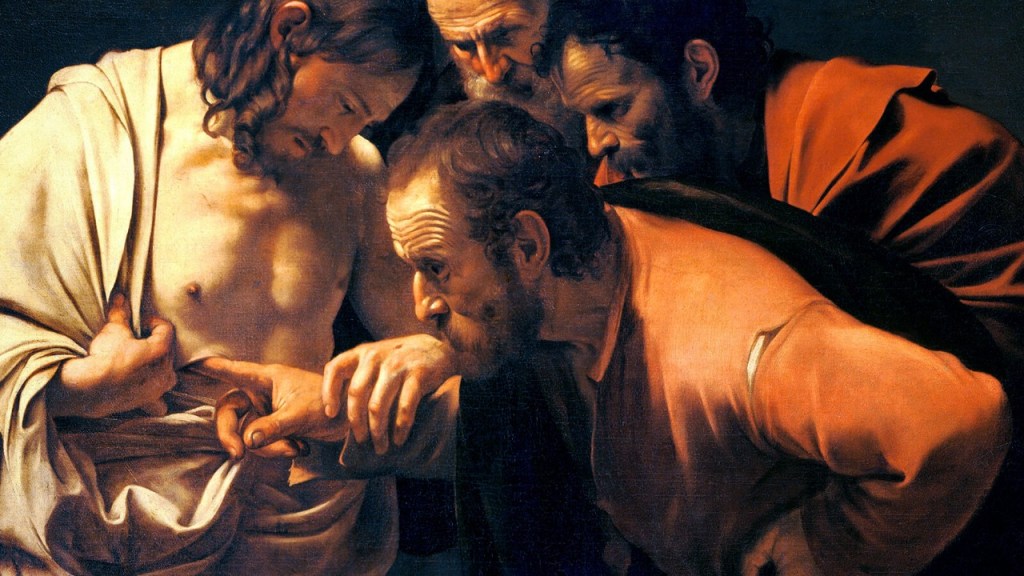
The bodily resurrection of Jesus Christ is a historical event.  Paul says so in the passage above.  In fact, the Jesus’ resurrection is the best documented event of ancient history.  We have no fewer than six eyewitness testimonies of the risen Christ from Matthew, Mark, John, Paul, James, and Peter passed down to us to this day.  These men saw Jesus tortured, John himself saw Jesus die (John 19:26) and they all saw Him raised from the dead.  Nearly the complete New Testament is written by eyewitnesses to the fact of Jesus’ bodily resurrection; all but Luke, Acts, perhaps Hebrews, and maybe Jude.  All the other books were written by witnesses to the resurrected Jesus Christ.

There is an unbroken chain of Christians who shared this truth from Paul to the person who told us about Jesus, and Paul argues the resurrection is absolutely true – corresponds objectively with reality.  How do we know the apostles believed it was true?  According to church tradition, all but John died a violent death, many were tortured for days.  Despite this, none denied the truth of Jesus’ deity or His resurrection.

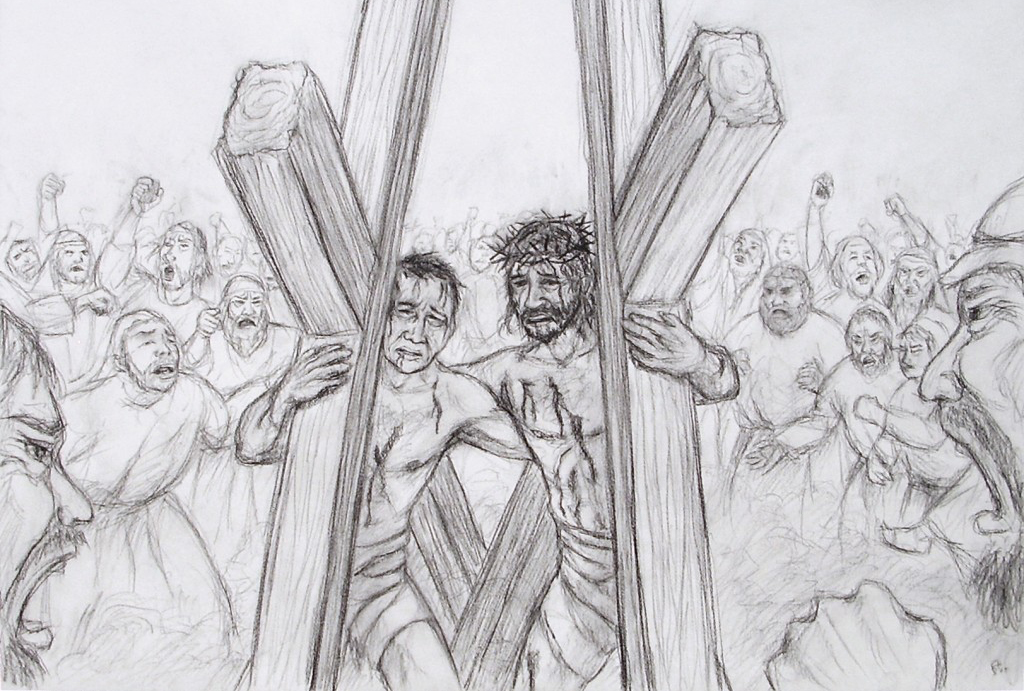
Bartholomew was skinned alive all the time telling those torturing him of Jesus.  Andrew was nailed to an “X” shaped cross and took three days to die.  He preached Jesus and His resurrection to the assembled crowd who came to watch him die.  Thomas was run throw with a sword while preaching about Jesus in India and finished his sermon.  Peter was crucified upside down after first watching his wife be crucified.  Paul was beheaded.

Why is this important?

The truthfulness of Christianity is the reason non-believers challenge it.  You can’t challenge something which has no logical or historical foundation.  Only Christianity is based on this sort of evidence.  So, when someone asks you for reasons why you believe, asks you to defend a particular teaching of the Bible, take heart.  They would and could never make such a challenge of any other world religions.  Only Christianity has these types of critics because Christianity claims to be true can invites challengers to prove it wrong.

I’ve been asked what it would take for me to give up my faith in Jesus Christ.  I always answer, “Prove to me Jesus did not rise from the dead as described in the Bible.”  Sometimes they will say that’s not fair.  Those were all biased writers: they were all Christians.  My response to that objection is “If you saw a man who claimed to be God die a horrible death, pronounced dead by a centurion whose job it was to pronounce people dead, then see the dead man walking around three days later, wouldn’t you be a Christian too?

According to God’s Riches

Phil 4:19 (ESV)  And my God will supply every need of yours according to his riches in glory in Christ Jesus. 20 To our God and Father be glory forever and ever. Amen.

This was Paul’s final prayer for the Philippians before he closed his wonderful letter.  For this week, I’d like to focus on the phrase “according to His riches” in this verse. God gives us lots of things from His riches.  What do you suppose “according to His riches” might mean.  That was my question.  I got to thinking about what the difference between giving from our wealth and giving according to our wealth might be if there was a difference at all. 

Webster says “according” means “in conformity with,” while “from” means giving as a part of a “source.”  When a wealthy golfer is finished with his round of golf, he’ll usually tip the caddie.  Giving the caddie $50 is a tip from his riches.  Giving the caddie maybe $1,000 is a gift according to – in conformity with – his righes.

So, let’s get back to Paul and his prayer for the Philippian church and for us.  He is asking for a greater blessing than just something from God’s riches in glory but to receive riches in glory in conformity with God’s great love and riches.

Delightfully, it turns out there are lots of other “according to’s” in Scripture:

Rom. 8:28 (ESV)  And we know that for those who love God all things work together for good, for those who are called according to his purpose.  Here is another blessing to be used in God’s work, for His purpose.

Col. 1:9-11 (ESV)  And so, from the day we heard, we have not ceased to pray for you, asking that you may be filled with the knowledge of his will in all spiritual wisdom and understanding, 10 so as to walk in a manner worthy of the Lord, fully pleasing to him: bearing fruit in every good work and increasing in the knowledge of God; 11 being strengthened with all power, according to his glorious might, for all endurance and patience with joy;  Too many blessings here to list, but to receive all power from God according to His glorious might should certainly wake us up, stand us on our feet, the prompt us to enter the fray.

1 John 5:14 (ESV)  And this is the confidence that we have toward him, that if we ask anything according to his will he hears us.  This verse has a little different meaning for us.  It is our responsibility to pray according to – in conformity with – God’s will if we want Him to hear our prayers.  We bear the burden to find if God wants us to pray in a particular way.  If we don’t know, we can simply ask the Holy Spirit to pray for us.  That way we can be sure to remain in God’s perfect will.

2 John 6 (ESV)  And this is love, that we walk according to his commandments; this is the commandment, just as you have heard from the beginning, so that you should walk in it.  And here’s the tough one isn’t it?  We need to walk in conformity with God’s will, with His commandments.

In Focus on the Family’s Truth Project series, teacher Del Tackett said something very interesting.  He said sin is whatever is not aligned with God’s character.  Conversely, the commands of God for us must be aligned perfectly with His will for us.  Want to know God’s will in your life?  Want to pray according to His will? Look into His commands.

Why is this important?

Understanding that God has much more for us than we can ever imagine gives us hope in the deepest trials and tests.  God is always here wishing to bless us.  He is love by nature, and all things He allows in our lives come from that center of His nature.  Can we wish for anything more than Paul wished for the Philippians or the Ephesians, for that matter?

Eph 3:20-21 (ESV)  Now to him who is able to do far more abundantly than all that we ask or think, according to the power at work within us, to him be glory in the church and in Christ Jesus throughout all generations, forever and ever. Amen.