
What About Cain’s Wife?

Where did Cain’s WIfe Come From?

Occasionally I hear questions like this or “Can God make a rock He cannot move,” or “If God made everything, who made God,” and others.  Usually, the questioner is trying to stumble a Christian. He’s not looking for a real answer.  But since we all hear these at one time or another, let’s look at some answers.

Where did Cain’s wife come from?”  The argument usually goes something like this: “All there were were Adam, Eve, Cain, and Able, right?  Well, the Bible says after Cain killed Able, he fled to the land of Nod and knew his wife.  How does that work?”  This is pretty easy to answer.  The questioner is just a Bible illiterate: The days of Adam after he fathered Seth were 800 years; and he had other sons and daughters. 5 Thus all the days that Adam lived were 930 years, and he died (Gen 5:4–5).

So, Cain married a sister.  Now you might say, that’s terrible, marrying his sister, but remember there wasn’t anyone else around.  

Incest was not a sin until the Mosaic Law (Lev. 18:1-18) probably because the gene pool was pure enough not to do damage until then.

Sarah was Abraham’s half-sister, and he married her.  Remember Abraham feared death and told King Abimelech Sarah was really his sister.  Then Abimelech almost had relations with Sarah before realizing she and Abraham were husband and wife.  Abraham confesses to Abimelech and apologizes then sort of makes light of the situation “Besides, she is indeed my sister, the daughter of my father though not the daughter of my mother, and she became my wife.”  (Genesis 20:12) So, incest was not prohibited until Moses.

If God can do anything, can God make a rock He cannot move?”  Boy, they’ve got us there, don’t you think?  There are a few things God cannot do.  He can’t learn since He is omniscient.  He can’t sin since He is holy. He also can’t do things that are logically impossible.  Since God is omnipotent, there is no logical thing He cannot create within the boundaries of His nature.  If God is omnipotent (infinitely powerful), then He can create a rock the size of the universe.  Can He move that rock?  of course.  But, since we’re dealing with infinite values here, it is logically impossible for a rock God cannot move to exist.  So, the problem is in the question, not in our faith in God’s power. The answer is “Logically, there can be no such thing as a rock God cannot move.”

If God made everything, who made God?”  I hear this most often.  There are two good answers to this.  I’ll give the short one first:  No one made God, but if someone did, it wouldn’t matter because God made you.  You are not responsible to God’s maker, but you are answerable to your maker.

The Second answer is a little more philosophical.  In the law of cause and effect, everything that begins to exist has a cause.  God did not begin to exist and so has no cause (no maker).  So this is a category error.  The questioner is confusing finite beings with an infinite being.

One of my favorite questions is “How can you be sure Jesus really died and really rose from the dead?”  David Hume (18th century philosopher) said about this that “extraordinary claims require extraordinary proof.”  That seems to be at the center of the question.  But, that’s not true, at least not in this case.  All we need is a person trained in confirming the death of crucifixion victims to prove Jesus was really dead, and we have that in the centurion.  And we need someone expert in knowing if someone is later alive.  We all qualify in that regard as did the disciples:

36 As they were talking about these things, Jesus himself stood among them, and said to them, “Peace to you!” 37 But they were startled and frightened and thought they saw a spirit. 38 And he said to them, “Why are you troubled, and why do doubts arise in your hearts? 39 See my hands and my feet, that it is I myself. Touch me, and see. For a spirit does not have flesh and bones as you see that I have.” (Luke 24:36-39)

While Jesus’s resurrection was miraculous, the proof of it was simple.

Why is this important?

We get asked a lot of silly questions at times, and even though the idea is to trip us up, it’s best to answer the question when we can.  That will make it more unlikely the question will be asked again by that person, maybe of some who might be stumbled by it.

Besides this, we are told to be ready to give an answer to everyone who asks (1 Peter 3:15).

Witnessing is Hard

19 Go therefore and make disciples of all nations, baptizing them in the name of the Father and of the Son and of the Holy Spirit, 20 teaching them to observe all that I have commanded you. And behold, I am with you always, to the end of the age.” (Matt. 28:19-20 – “The Great Commission”)

Man.  That Great Commission really sticks with us, doesn’t it.  Most of us get a little nervous, or even downright frightened, sharing our faith.  Maybe if we understand a few things first, it might help.

Rule #1 and the only rule, “Sharing should be done in love, not as a duty.”  Something a lot of us don’t understand is it’s not our job to save people.  You heard me right.  It’s our job to tell people.  What happens next is the Holy Spirit’s job:

So neither he who plants nor he who waters is anything, but only God who gives the growth. (1 Cor. 3:7)

So, it is God’s plan to share.  Then it’s God’s job to save.  He does this in a number of ways, but to simplify it, we are just to share and leave the rest up to Him.  You never know where you are along the chain for the lost person.  You might be the first person ever to tell them about Jesus.  You might be the one who God uses to support something he’s already heard, or you might be the one God has chosen to be involved in leading him to Christ.

I’ve always been struck by the fact God works on the heart of the non-believer.  He puts him in a situation where he can hear the gospel from one of us.  He puts the words in our mouth.  The Holy Spirit persuades the person of the truth of the gospel, and he’s saved.  The odd part is God gives us credit for what He did and barely involved us.

Most people reading this are looking for an easier way to share their faith.  The way I see it, different situations need different tactics.  Standing in an elevator with someone who sounds interested means you can’t tell him of God’s saving you from drugs and a murder rap, how the doctors told you your child would be born with a major handicap but was born without defect after days of prayer.  In other words, a ten second witness is all that is possible.  The guy will probably be gone in a few moments.  So practice a short witness: “You know, Jesus changed my life when I turned it over to Him.  The good news is I know He will do for you what He’s done for me.  Just ask Him.”  And, that’s it.  Maybe something even shorter is all you can share.

The most stressful times is sharing with lost family and friends.  You might need to provide a much longer message.  Maybe you do want to remind them of how Jesus got you off drugs and the miracle child you hold in your arms. Practice something so when the moment comes, you’re not caught flat-footed.

There are a lot of reasons for us to withdraw from sharing:  maybe we don’t really believe Christianity is true, maybe we feel unworthy or guilty, or we struggle with doubt.  Maybe we’re afraid they’ll ask a question we can’t answer.  There are scores of reasons not to witness, but there is one good reason to witness.  God told us to.

Why is this important?

I read the other day 95% of all Christians never lead someone to Christ.  That’s a sad statistic if true.  The growth plan of Christianity is a “pyramid  scheme.”  We tell someone about Jesus, they tell two friends, then each of those folks tell two friends, and before you know it, the whole earth is saved.  It is estimated there are 2.3 billion Christians alive on earth right now.  The total world population is approaching 8 billion.  That means if each Christian could introduce four people to Christ in their lifetime, the whole world would be saved very quickly.  That’s just at the top of the pyramid.  The reality would be much faster since the new converts would invite new converts of their own.

God tells us to do this.  There’s really no way around it.  The people I have been allowed to lead to Christ were all either one on one or in a church setting.  Currently, I witness a lot on social media.  I have the time, and I don’t run into a lot of lost people in my daily life.  Also, in my area, there are a lot of Christians.  I sometimes ask check-out clerks if I can pray for them about anything.  I’m surprised how many tell me something on their hearts.  What are they going to do if they get angry over my offer, yell at me in front of a store full of people?

Don’t sell yourself short.  After all, Jesus said “I am with you always to the end of the age,” so you’re not in this alone. Ask someone to church, share your faith, Just take the step.  God will honor it.

Is God With You?

God With Us

12 Behold, God is with us at our head, and his priests with their battle trumpets to sound the call to battle against you. O sons of Israel, do not fight against the Lord, the God of your fathers, for you cannot succeed.”  (2 Chron. 13:12)

This passage was written at a moment when Israel was going to battle against Judah.  Abijah, the king of Judah at the time, tells the Israelites they can’t win because God is with Judah.

Now I’m sure both sides believed their gods were with them.  Israelites has turned from God and sought after other gods.  Judah had stood firm under Abijah and were strong in their belief God was with them.

As Christians, we often wonder if God is with us in what we do or want to do.  Sometimes we feel as though our prayers don’t reach past the ceiling. We feel alone, cold, dry. As a result, we start to doubt our path or even our relationship with God. We want that emotional high, that closeness, we sometimes feel with our Lord. Somehow, emotion equates with closeness in our minds, but is that so?

The United Pentecostal Church is a cult.  They ordain their pastors simply by the standard of apparent personal anointing.  As a result, they have had some pastors who have not reached puberty before being ordained.  They also have not been careful to test the teachings of the pastors against the Word. So long as the pastor raises great emotional response in the congregation during the service the requirements have been met. The result is an emotion based organization without God.

Emotion is a good thing in its place.  How can we not be elated if God touches our soul?  However, dependence on emotion or experience rather than God’s Word is not of God.  We’ve all had times when we are overwhelmed by God’s presence during worship, study, or prayer.  God will certainly bless us in this way at times. But, is that emotion something to seek in place of God’s Word and clear instruction as an indicator of God’s presence in our lives? No. We seem to need both, but God’s Word, of course, is the ultimate standard.

So, this leads us to how we can know if God is with us.

The disciples walked, talked, ministered, and prayed with God Himself in flesh for three years.  Were they always on an emotional high?  Probably not.  Our God is a practical God.  He has given us instructions to follow if we want to stand in His will.  Yet we often seek other means. Paul tells us “16  aAll Scripture is inspired by God and profitable for teaching, for reproof, for correction, for training in righteousness; 17 that the man of God may be adequate, equipped for every good work.” (2 Tim. 3:16)

So, if we ask if God is with us on our current path, waiting for an emotional validation is foolish when He has given us a standard by which to test our direction.

If we can’t find direction in Scripture that precisely addresses our question, we need to ask ourselves “Does this glorify God?”  If the answer is “yes,” we should push on in that direction until or unless God closes a door.

God can speak to us in any number of ways: dreams, visions, personal prophecy, the advice of others, and more.  But, the standard is always to look to God’s Word before stepping out.  Is it God’s will?  Does it glorify God? Is God with us?

Why is this important?

6 And they passed through the  aPhrygian and Galatian region, having been forbidden by the Holy Spirit to speak the word in  cAsia; 7 and when they had come to Mysia, they were trying to go into Bithynia, and the Spirit of Jesus did not permit them; 8 and passing by Mysia, they came down to Troas. 9 And a vision appeared to Paul in the night: a certain man of Macedonia was standing and appealing to him, and saying, “Come over to Macedonia and help us.” 10 And when he had seen the vision, immediately we sought to go into Macedonia, concluding that God had called us to preach the gospel to them.  (Acts 16:6-10)

Here is a wonderful example of God’s direction.  Paul asked himself, “What can I do to glorify God?  Let’s go preach the gospel in Asia.”  God said He wanted Paul elsewhere, so He closed doors then gave direction.  God’s Word did not tell Him where He was to go, just that Paul was to go.

We often wonder if God is with us in what we are trying to do.  If we are trying to please Him and do His work, He is with us.  If He wants us somewhere else, He will direct us there.  The old saying Is true: “God can’t steer a parked car.”  We need to be moving for God to direct us.

As Christians, the emotional touch of God is not as often as we would like. Some will think their faith is dead or, at lest dry, if they don’t get that shot of emotion often. That’s just not how it works. Feeling no emotion, feeling dry, or alone are not indicators God is not active in your life. Are you praying? Are you studying your Bible? Are you serving?

We can never rest our faith on emotion.  Feelings can distract and sometimes misdirect.  We have a standard.  Let’s stand on that, God’s Word.

Decision Guidelines

With what shall I come before the Lord, And bow myself before the High God? Shall I come before Him with burnt offerings, With calves a year old?

Will the Lord be pleased with thousands of rams,Ten thousand rivers of oil?Shall I give my firstborn for my transgression, The fruit of my body for the sin of my soul?

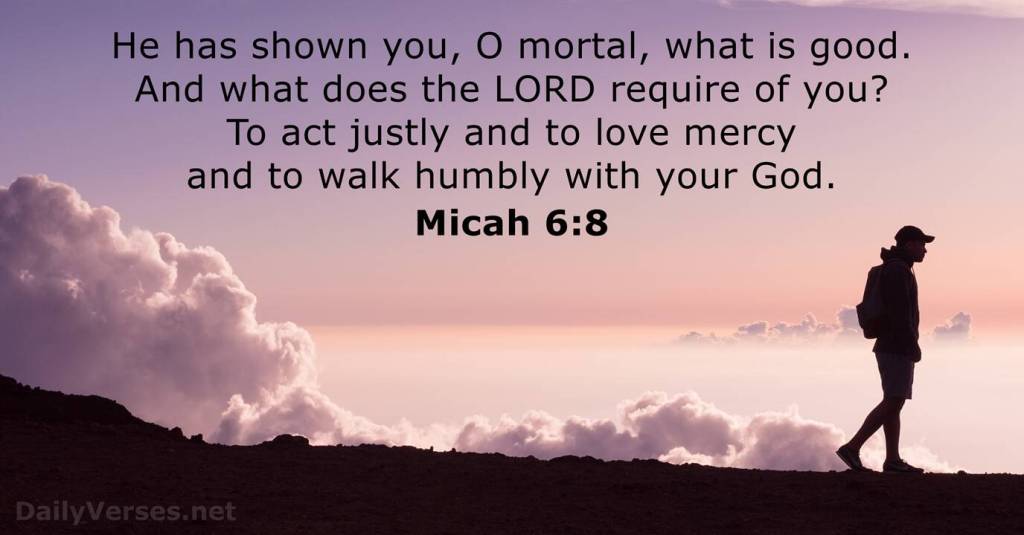
He has shown you, O man, what is good; And what does the Lord require of you But to do justly, To love mercy, And to walk humbly with your God?  (Micah 6:6-8)

I looked at this passage this week and thought of last week’s blog about the two commands Jesus gave us: to love God and love our neighbor.  This is a lot like that.  God is giving us three general guidelines by which to live our lives.  They are really tests, standards, against which we can examine our actions.

We are always wondering what we should do in this situation or that.  When someone tells us “Read your Bible.  It will tell you what to do,” we get frustrated.  We end up in the sacrifices of Leviticus or the genealogies of Matthew or Luke and don’t see a path to take.  We still need a guide.  Well here it is.  Mark the page, put in a posted note, or memorize verse 8. 

When we’re stuck on a decision or facing a storm and are unsure of what to do, the guidelines here are meant to help us.  We need to ask ourselves “Is what we want to do just, is it merciful, and am I walking humbly enough with God to have a clear view of what He wants done – and what He doesn’t?”  Pair these three with the two Jesus gave us, and we should be able to handle anything:

“Should I move in with my girlfriend?” – Does that honor God?

“Should I reach out to my hurting friend?” – Isn’t that loving your neighbor?

“I know I shouldn’t cheat on my taxes, but I need the money” – Is that acting justly?

“Can I pass up a homeless man without reaching out to him?” – We are to love mercy.

“I’m just so proud I was able to share Christ with someone I want to tell everyone what I did” – Walk humbly. 

Jesus told us to love God and love others.  Here, the Holy Spirit through Micah is telling us to calm down if our decision fits under these three categories, we’re on solid ground.  God isn’t looking for the sacrifices listed in verses 6 and 7.  Our God is a God interested in our hearts.

God often told His people in the Old Testament it was their hearts He was after, not the Law.  Yes, God required the sacrifices and festivals, but what He really wanted was willing obedience.  God knew the Law wouldn’t do the job.  Men are too flakey.   Paul tells us the Law was our tutor or schoolmaster to give us a moral basis for the coming New Covenant:

But before faith came, we were kept under guard by the law, kept for the faith which would afterward be revealed. 24 Therefore the law was our tutor to bring us to Christ, that we might be justified by faith. (Gal 3:23,24)

Why is this important?

God hasn’t changed.  He wants our obedience.  He’s given us simple guidelines to apply to all decisions.  We are without excuse.

We shouldn’t get so wound up in our troubles that we lose sight of God’s instructions.  Just remain calm, act justly, love mercy, and walk humbly with God.  He’s got this.

Obedience

22 And Samuel said,

       “Has the Lord as great delight in burnt offerings and sacrifices,

as in obeying the voice of the Lord?

       Behold, to obey is better than sacrifice,

and to listen than the fat of rams. (1 Sam 15:21,22)

Obedience is top drawer important to God.  He not only seeks our obedience, He expects it:

“Will any one of you who has a servant plowing or keeping sheep say to him when he has come in from the field, ‘Come at once and recline at table’? Will he not rather say to him, ‘Prepare supper for me, and dress properly, and serve me while I eat and drink, and afterward you will eat and drink’? Does he thank the servant because he did what was commanded? 10 So you also, when you have done all that you were commanded, say, ‘We are unworthy servants; we have only done what was our duty.’ ” (Luke 17:7-10) 

Serving God is our duty.  We aren’t supposed to do it seeking some sort of reward.  It is natural for servants to serve. 

So, what do we obey God in?  We feel good if we just keep the Ten Commandments, but there are at least 613 commandments in the Old Testament alone.  No wonder the Jews had such a tough time before Christ.

Fortunately for us, Jesus gave us just two commandments: to love the Lord our God with all our heart, soul, mind, and strength and to love our neighbor as ourselves (Mark 12:30, 31).  That’s our commandments to follow.  Simple, eh?  Simple, yes, but easy, no!

We are to love God with all our heart.  We are to place no one and nothing ahead of God in our love and devotion.  God is to be the center of our lives.

We are to love God with all our soul.  We are to constantly relate to Him.  We are to pray always (1 Thess. 5:16).  Our soul should be in constant contact with God, filled with His Holy Spirit and guided by Him.

We are to love God with our mind.  We are to study (2 Tim. 2:15) regularly.  We are to think, meditate, on God’s Word (Josh 1:8) and be ready to give answers to those who ask (1 Pet. 3:15).

We are to love God with all our strength.  That means we need to be ready to work for Him at any moment and for a lifetime if asked.  As Christians we don’t have the option of sitting around and not serving our Lord.  He has work for us all to do, and we need to be about doing it.

Sometimes the second commandment is the hardest, to love our neighbor as ourselves.  We face ornery people during our Christian walk.  Some people are disgusting to us in our flesh, but they are people for whom Christ died.  We need to treat them as such.  That’s hard for a lot of us.  But, God didn’t say we could skip plowing the field for harvest just because it might be difficult.

Why is this important?

We are God’s servants.  We should seek to serve Him every waking hour through all four points Jesus Himself said in Mark 12:30.  We have obligations set before us.  Our day should be dedicated to filling our hearts with God’s grace, filling our souls with God’s Spirit, Filling our minds with God’s Word, and filling our strength with the supernatural power God gives us to serve Him.

What God has given us in the sacrifice of His Son is a gift beyond measure.  We certainly don’t deserve it.  We’re not worthy of it, but because God loves us with His all, it is only our basic duty to do the same for Him.

Demons

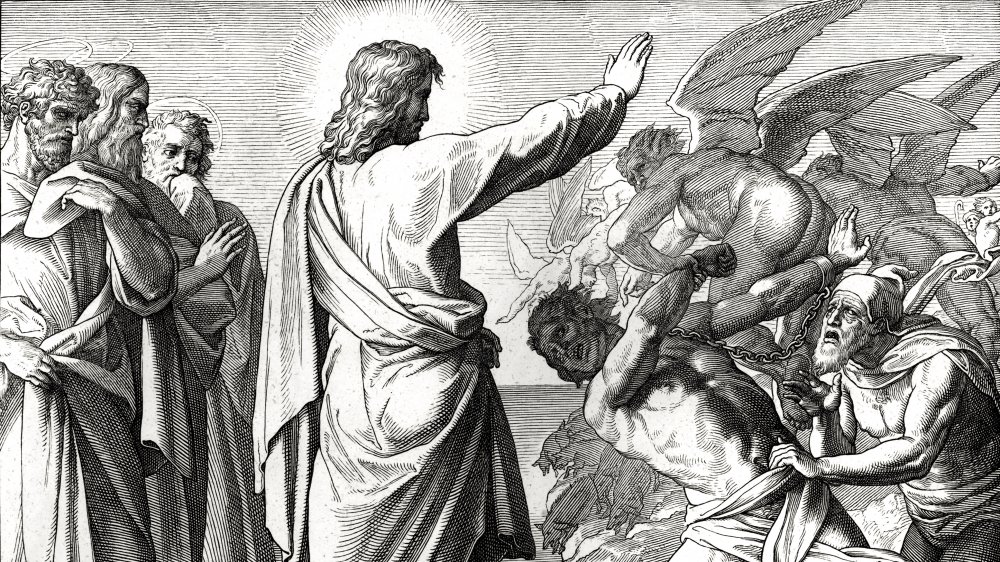
28 And when [Jesus] came to the other side, to the country of the Gadarenes, two demon-possessed men met him, coming out of the tombs, so fierce that no one could pass that way. 29 And behold, they cried out, “What have you to do with us, O Son of God? Have you come here to torment us before the time?” 30 Now a herd of many pigs was feeding at some distance from them. 31 And the demons begged him, saying, “If you cast us out, send us away into the herd of pigs.” 32 And he said to them, “Go.” So they came out and went into the pigs, and behold, the whole herd rushed down the steep bank into the sea and drowned in the waters. (Matt. 8:28-32)

Last week we looked at angels.  This week we’ll look at their counterparts, demons.  Demons are scary for many Christians, so it’s good to get the cards on the table about demons.  Some Christians even believe we can be possessed by demons.  That’s not true as we’ll see. 

But first, what is a demon?   When Satan rebelled (Isa 14:12-15) he apparently took a third of the angels with him  (Rev. 12:4).  The dragon in this passage is Satan (Rev. 12:7-9).  So, we believe demons are fallen angels who joined Satan when he was cast out of heaven.

So, what can demons do?  From the passage above, we see demons can possess people.  Possession means the demon or demons enter a person and can take over that person’s actions even his speech.  Demons recognized Jesus and were afraid of Him.  They are in no way equals but subordinate to Him. 

As a quick side note, notice the demons identify Jesus not by His name but as the Son of God.  In John 5:18 we’re told the term “Son of God” means Jesus is equal to the Father.  These demons had much to be afraid of. 

There was a herd of pigs nearby and Jesus cast the demons into them.  This shows us a person can be possessed by many demons, that Jesus has the power to cast them out of humans, and that He can send them wherever He wants.  They must obey Him.

24 “When the unclean spirit goes out of a man, it passes through waterless places seeking rest, and not finding any, it says, ‘I will return to my house from which I came.’ 25 “And when it comes, it finds it swept and put in order. 26 “Then it goes and takes along seven other spirits more evil than itself, and they go in and live there; and the last state of that man becomes worse than the first.”  Luke 11:24-26)

When a person is possessed by a demon and that demon has been cast out, if that demon may return unless the person becomes a Christian.  Demons cannot possess Christians.  We are filled with the Holy Spirit, and He does not share His home with anyone:

for what partnership have righteousness and lawlessness, or what fellowship has light with darkness? 15 Or what harmony has Christ with Belial, or what has a believer in common with an unbeliever? 16 Or what agreement has the temple of God with idols? For we are the temple of the living God; just as God said, “I will dwell in them and walk among them; And I will be their God, and they shall be My people.  (2 Cor. 14b-16)

So, if anyone tells you as a Christian you can be possessed by evil spirits, they’re blowing smoke.  They have no idea what their talking about.

Why is this important?

We as Christians need to know our adversaries.

12 For we do not wrestle against flesh and blood, but against the rulers, against the authorities, against the cosmic powers over this present darkness, against the spiritual forces of evil in the heavenly places. (Eph. 6:12)

How we deal with these evil spirit beings is also laid out in Ephesians:

13 Therefore take up the whole armor of God, that you may be able to withstand in the evil day, and having done all, to stand firm. 14 Stand therefore, having fastened on the belt of truth, and having put on the breastplate of righteousness, 15 and, as shoes for your feet, having put on the readiness given by the gospel of peace. 16 In all circumstances take up the shield of faith, with which you can extinguish all the flaming darts of the evil one; 17 and take the helmet of salvation, and the sword of the Spirit, which is the word of God, 18 praying at all times in the Spirit, with all prayer and supplication. To that end, keep alert with all perseverance, making supplication for all the saints, (Eph. 6:13-18)

As a good friend of mine likes to say, we as Christians need to “get up, suit up, and show up.”  That’s a good motto for Christians for we never know when the evil world of the enemy might take notice of us.  Remember, “a sterile Christian is the next best thing to a lost person to Satan.”

To cast a demon out of a person is a very serious matter and should be undertaken by mature believers in a group if possible who are willing to take the abuse, insults, and exposed sins in their own lives for the demon(s) will expose all to get the exorcism to stop.

Angels

The word “angel” simply means “messenger “ in both the Old and New Testaments.  The Hebrew word for “angel” is Malakh, and the Greek word is Anggelos.  

We usually think of angels as these super beings who can conquer evil, overthrow armies, and serve at the pleasure of God.  That’s accurate most of the time, but when the word “angel” appears in Scripture it doesn’t necessarily mean a super being like Gabriel or Michael.  Sometimes, the word just means a messenger, even a human messenger.  We see this in Luke 17:24a:

24 When John’s messengers had gone, Jesus began to speak to the crowds concerning John

The word “messengers” here is aggelos, angels.  So, we shouldn’t be surprised when we see even Jesus called an angel.  In John 8:58, Jesus identifies Himself as the Person in the burning bush of Ex. 3.

 John 8:58 Jesus said to them, “Truly, truly, I say to you, before Abraham was, I am.”

Exodus 3:14  (ESV)  God said to Moses, “I am who I am.” And he said, “Say this to the people of Israel: ‘I am has sent me to you.’ ”

So, “I Am” is the divine name given to Moses and the name Jesus took when speaking to the Jews in John 8.  The reaction of the Jews in John 8:59 helps us understand what was being said by Jesus. They wanted to stone Him:

59 So they picked up stones to throw at him, but Jesus hid himself and went out of the temple.

The Jews saw what Jesus had claimed and believed it as blasphemy. Now look at Acts 7:30:

 “Now when forty years had passed, an angel appeared to him in the wilderness of Mount Sinai, in a flame of fire in a bush.

So, we know the person in the burning bush in Exodus 3 was Jesus.  Exodus tells us He is God.  Acts 7:30 tells us He was an angel.  How do we answer this?

Jesus is submissive to the Father and probably has been at least since creation (Phil. 2:8).  As such, God the Father sent God the Son as a messenger (angel) to speak to Moses.

Many believe the term “Angel of the Lord” in the Old Testament is really Jesus.  No confirmation on that, though.

So, if angels are messengers, what are archangels?  Archangels are chief angels.  They’re the commanders of a body of angels.  We see this in Revelation:

Rev 12:7 (ESV) Now war arose in heaven, Michael and his angels fighting against the dragon. And the dragon and his angels fought back.

When Jesus returns, He’ll be accompanied by at least one archangel.

1 Thess. 4:16 (ESV) For the Lord himself will descend from heaven with a cry of command, with the voice of an archangel, and with the sound of the trumpet of God. And the dead in Christ will rise first.

So, how many archangels are there?  We don’t know for sure.  We know Michael is an archangel (Jude 1:9).  We aren’t told of any other.  In fact, only two other angels are actually mentioned by name: Gabriel (Luke 1:19) and Lucifer (Isa. 14:12).  Lucifer’s name comes from the Latin translation of “Day Star” in Isa. 14:12.  Lucifer, of course, had his name changed to Satan upon his fall from heaven.  We believe Satan was an archangel  because he is in charge of a host of fallen angels. He is the dragon Michael will fight in Rev. 12:7. Satan’s “angels” are fallen as is he.

So, how many archangels?  We know Michael is an archangel according to Jude 9.  Daniel calls both angels and demons “princes.”  So when we look at Daniel, we see Michael fighting against another fallen angel called “the prince of the kingdom of Persia.”  An angel comes to answer Daniel’s prayer and explain why it has taken him so long to arrive.  In this verse we find Michael is just “one of the chief princes.”  So, there are more than one archangel.  We’re just not sure of their names other than Michael’s or how many:

Daniel 10:13 (ESV)   The prince of the kingdom of Persia withstood me twenty-one days, but Michael, one of the chief princes, came to help me, for I was left there with the kings of Persia

Why is this important?

Sometimes we are confused when comparing Scriptures.  When we see Jesus called God then called an angel, we might think there is a problem there.  It’s a simple issue of language, not a problem.

I’ve always wondered if we have guardian angels, personal bodyguards keeping an eye on us.  I haven’t seen any evidence of that, but angels are in our midst:

Heb. 13:2  (ESV) Do not neglect to show hospitality to strangers, for thereby some have entertained angels unawares.

Cults

A cult is basically a group which aligns itself with a world religion but distorts or denies some basic tenants of that world religion. 

Cults are not exclusive to Christianity .  Some friends joined my wife and I to a debate at a mosque in California.  The subject was, “Who is our Messiah: Jesus or Hazrat Mirza Ghulam Ahmad.”  Mr. Ahmad died in 1908, and you can visit his home in Pakistan which is preserved for pilgrims.

This denied the basic belief of Islam that the Messiah is yet to come. It is a cult.

So, not all cults are calling themselves Christians.  We’ll call ours “non-Christian cults.”  Non-Christian cults would be groups which claim the title of Christian but do not adhere to one or more of the basic beliefs of Christianity: the Trinity, the bodily resurrection of Christ, the deity of Christ, and salvation by grace alone.  All major cults have writings besides the Bible which either interpret the Bible to their way of thinking.

The larger non-Christian cults today are Mormons, Jehovah’s Witnesses, and Christian Science.

Mormonism:  Mormonism was founded by Joseph Smith in the late 1820s and 1830s.  It denies the classic doctrine of the trinity.  They teach that the Father, Son, and Holy Spirit are three separate gods.  The Father and Son are physical beings, but the Holy Spirit is a Person of spirit.

Unlike other non-Christian cults, Mormons believe Jesus was raised bodily.  They believe Jesus is divine but was the result of sexual relations of God the Father with the virgin Mary.  Of course, that is not the biblical Jesus, and so they deny the person and deity of Christ.

For Mormons, salvation is not by grace but through baptism and works.  Here is a quote from Mormon.com:

Within Jesus Christ’s teachings we find the plan for our happiness, our redemption, and our salvation—a divine blueprint that includes faith in Christ, repentance, baptism, keeping God’s commandments, receiving the Holy Ghost, and enduring to the end. These are the saving principles taught by Jesus Christ, the bedrock on which His Gospel is built.

The Mormons, of course, have the Book of Mormon, Pearl of Great Price, and Doctrines and Covenants to interpret for the follower what they say the Bible says, and they have a living prophet who heads the organization.

Jehovah’s Witnesses:  The Jehovah’s Witnesses’ organization, the Watchtower Bible and Tract Society, was incorporated in 1884 by Charles Taze Russell.   Jehovah’s Witnesses deny all four major doctrines of the Christian church.  They believe only the Father is God.  The Son was the archangel Michel, became the man Jesus until His death, then was recreated as the archangel Michael and ascended to heaven.  That denies both the trinity and the deity of Christ. They also believe the Holy Spirit is just a force.

Jehovah’s Witnesses believe Jesus was raised as a spirit creature and that His body probably evaporated into gasses.  This of course, denies the bodily resurrection of Christ.

Jehovah’s Witnesses publish a plethora of magazines and books dating from the founding of their organization.  Their major publication is the Watchtower Magazine.   Jehovah’s Witnesses have changed their doctrines a number of times over the years along with making prophecies which did not come to pass.  This results in the need to publish corrections and denials of their doctrinal and prophetic stances.  The updates are called “New Light.”

Christian ScienceThe First Church of Christ Science was founded in 1879 by Mary Baker Eddy who claimed to have discovered the “Science of Metaphysical Healing.”  Christian Science is like Grape Nuts.  It isn’t Christian, and it isn’t science.  Christian Science is a Gnostic faith.  

For the members, God is an impersonal but omnipotent Being.  Jesus is separate from Christ.  Jesus is the human being Who holds the Christ ideal.  They believe matter is an illusion, it isn’t real, so when you see a Christian Science funeral, they are all wearing white rather than black to demonstrate this.  Sickness is not real nor is evil.  So, the Christian Science beliefs are in no way aligned with historic conservative Christian views.

The main text for Christian Science is Mrs. Eddy’s Science and Health with Keys to the Scriptures.

Why is this important?

Understanding a bit about the beliefs of others helps us to better understand the differences and know the terms they use when discussing our faith with them.  Our job is to inform people who do not know Jesus.  In the case of Jehovah’s Witnesses and Mormons, they come right to our door ready to discuss religion.  What could be better?  Sadly many Christians feel too inadequate to face them, and the cultists leave more sure of their faith.

Since they all deny at lest three of the major doctrines of the Church, we can learn one of those doctrines well enough to discuss it with them.

Next time you run into one of these folks, ask them about what they believe and share what you do and why.

Women and Angels at the tomb

Now after the Sabbath, toward the dawn of the first day of the week, Mary Magdalene and the other Mary went to see the tomb. And behold, there was a great earthquake, for an angel of the Lord descended from heaven and came and rolled back the stone and sat on it. (Matt. 28:1-2)

vWhen the Sabbath was past, Mary Magdalene, Mary the mother of James, and Salome bought spices, so that they might go and anoint him. And very early on the first day of the week, when the sun had risen, they went to the tomb. And they were saying to one another, “Who will roll away the stone for us from the entrance of the tomb?” And looking up, they saw that the stone had been rolled back—it was very large. And entering the tomb, they saw a young man sitting on the right side, dressed in a white robe, and they were alarmed. (Mark 16:1-5)

But on the first day of the week, at early dawn, they went to the tomb, taking the spices they had prepared. And they found the stone rolled away from the tomb, but when they went in they did not find the body of the Lord Jesus. While they were perplexed about this, behold, two men stood by them in dazzling apparel.  (Luke 24:1-4)

Now on the first day of the week Mary Magdalene came to the tomb early, while it was still dark, and saw that the stone had been taken away from the tomb. (John 20:1)

11 But Mary stood weeping outside the tomb, and as she wept she stooped to look into the tomb. 12 And she saw two angels in white, sitting where the body of Jesus had lain, one at the head and one at the feet. (John 20:11-12)

The Bible gives four accounts of the resurrection of Christ, more precisely, the visit of the women to the tomb and the angels who greeted them.  If you’ll notice, the accounts are different.  I’d like to address this issue since it is a favorite of critics of the biblical record to say the Bible contradicts itself.

Matthew records the two Marys as going to the tomb.  Mark mentions a third, Salome.  Luke doesn’t tell us how many women came to the tomb, and John mentions only Mary.  There are two quotes of John given because the passage concerning Mary is divided.  After seeing the stone had been rolled away, she ran to tell the others.

So, the question is, “Why are the accounts different?  Aren’t they contradictory?  Actually, no.  They are contrary but not contradictory.  “Contrary” means they seem to be contradictory but really aren’t.  Suppose someone said “I saw Bob at church this morning” but told a friend of yours “I saw Bob and Sue at church this morning.”  You wouldn’t think that was contradictory because Bob was the main character in the first statement and both Bob and Sue were important in the second.  No contradiction here.

It’s the same with the four accounts above.  John thought it was only important to say Mary had gone to the tomb.  She was the central character other than Jesus especially in John 20:11,12.  The prior verses tell us John and Peter had run to the tomb and inspected it.  Verse 10 says the disciples then went home, but not Mary.  She stayed weeping and met Jesus in the garden.  She was very important in the story, so John focused on her.

Matthew mentions one angel sitting inside the tomb in the appearance of a man and one sitting on the stone which had been rolled away.  Luke records two angels appearing as men inside the tomb, yet John mentions none.  So, were there two angles, one, or none?

There appears to have been at least two angels.  One was simply more prominent as the spokesman, so Matthew only mentioned him.  It’s the same story as with the women.  There is no contradiction here.

Why is this important?

Many skeptics have caused some Christians to doubt their faith by bringing up seemingly contradictory passages such as these.  They catch the Christian unaware and make them doubt the reliability of the Bible.  Be careful.  The Bible is God’s Word, but it is also God’s Work.  If there are errors found, it is in the process of copying not in the originals.  Unfortunately, we have only the copies, so we cannot show the originals as the accurate sources they were. 

What we do have is more than 5,000 copies of the New Testament in Greek and more than 24,000 manuscripts overall.  Some are very early manuscripts.  We can compare all these manuscripts to try and come to a consensus of what the original looked like.  Scholars are 99+% certain of the accuracy of modern peer reviewed translations of the Bible.  The passages in question are not doctrinal.  Most mistakes are made from poor copying, misspelled words, etc.

So, stand by the biblical account of the empty tomb.  We have the accounts of eyewitnesses telling us what happened.  Happy Easter to you all.

Does God Change His Mind?

10 When God saw what they did, how they turned from their evil way, God relented of the disaster that he had said he would do to them, and he did not do it. (Jonah 3:10).

Before I dedicated my life to Christ, I attended a home Bible study where this verse from Jonah was used to show God changes His mind.  Even before I knew God, I had problems with this interpretation of the passage. I found several others bothered me too.  Eventually I came across Jeremiah 18:7,8:

If at any time I declare concerning a nation or a kingdom, that I will pluck up and break down and destroy it, and if that nation, concerning which I have spoken, turns from its evil, I will relent of the disaster that I intended to do to it.  (Jer. 18:7,8)

So, one of God’s principles is “If you repent, you will be forgiven.”  God always stands by His principles.  He is the same today, yesterday, and always.  His nature is to forgive those who will repent, no matter what command or promise they have broken.  Noah said “40 days and Nineveh would be overthrown,” but the Ninevites repented.  They were, therefore, forgiven.

Then there’s this problematic passage:

In those days Hezekiah became sick and was at the point of death. And Isaiah the prophet the son of Amoz came to him, and said to him, “Thus says the Lord: Set your house in order, for you shall die, you shall not recover.”  (Isa 38:1)

“Go and say to Hezekiah, Thus says the Lord, the God of David your father: I have heard your prayer; I have seen your tears. Behold, I will add fifteen years to your life. (Isa. 38:5)

This isn’t a nation repenting, it’s a king begging God for a longer life so Jeremiah 18 doesn’t apply.   I’ve really had a problem with this passage over the years.  All I can see here is God showing us what happens if He were to grant our prayer, a prayer which is against His will.

There are some minor arguments for God’s actions in this passage: God didn’t say when Hezekiah would die is the best I’ve found. Therefore there is no contradiction. 2 Kings 5,6 would disagree. It records the same story but adds just enough to demolish that argument:

5 “Turn back, and say to Hezekiah the leader of my people, Thus says the LORD, the God of David your father: I have heard your prayer; I have seen your tears. Behold, I will heal you. On the third day you shall go up to the house of the LORD, 6 and I will add fifteen years to your life. I will deliver you and this city out of the hand of the king of Assyria, and I will defend this city for my own sake and for my servant David’s sake.”

Hezekiah had a son, Manasseh, during the additional 15 years God had granted him.  Manasseh took the throne at age 12 upon Hezekiah’s death and ruled for 59 years. He was the longest ruling king in Judah.  Manasseh was a horrible king. He turned Judah back to idolatry even sacrificing his own son to these gods (2 Kings 21:2-16) causing God to curse both Manasseh and Judah.

So, if Hezekiah had simply died, Manasseh would not have been born, and perhaps Judah would have continued with the example of Hezekiah, a pretty righteous king.  What I get from the story of Hezekiah is not so much that God seemed to change His mind but that our prayers should always end with “Your will be done, Lord.”

Who are we to ask God to change His mind/will.  When you think about it, it’s actually a pretty arrogant and stupid thing to do.  If He did change His mind, would His new view be better or worse than the last?  If God is all powerful and all knowing, He would know what is best and that would be His plan.  If we were to ask for something different, we would be asking for something worse than what God has planned for us.

So, what I get from the story of Hezekiah is a lesson in prayer not a lesson about whether God can change His mind. 

Why is this important?

Some Christians read passages like the two above, and want to change God’s mind for what they perceive is their benefit.  How can anything other than God’s benevolent plan for us be better?

God doesn’t change His mind.  His will is the standard for what is best for us.  Let us never pray against God’s will thinking we have a better idea. Thinking He does change His mind would call His promises into question. God keeps His promises!

There is a rule in Bible study: “When a passage seems to contradict the common message of the Bible, go with the preponderance of passages.  Chances are you’re misunderstanding the passage in question.  The preponderance of passages say God doesn’t change His mind; He is unchanging (Mal. 3:6; Num. 23:19; James 1:17; 1 Sam. 15:29; Ps. 33:11; Heb. 6:18; Isa. 40:8; John 17:17; Ps. 119:89; Heb. 7:21; Titus 1:2; and so on), so I’m going with the preponderance.

God is consistent.  We need not ever fear.  He does not change His mind and will forever keep His promises.  He is our God whom we serve and the only God with Whom we have to do.

Do not be deceived, my beloved brethren.  Every good thing bestowed and every perfect gift is from above, coming down from the Father of lights, with whom there is no variation, or shifting shadow. (James 1:16-17)