Cleansed Lepers

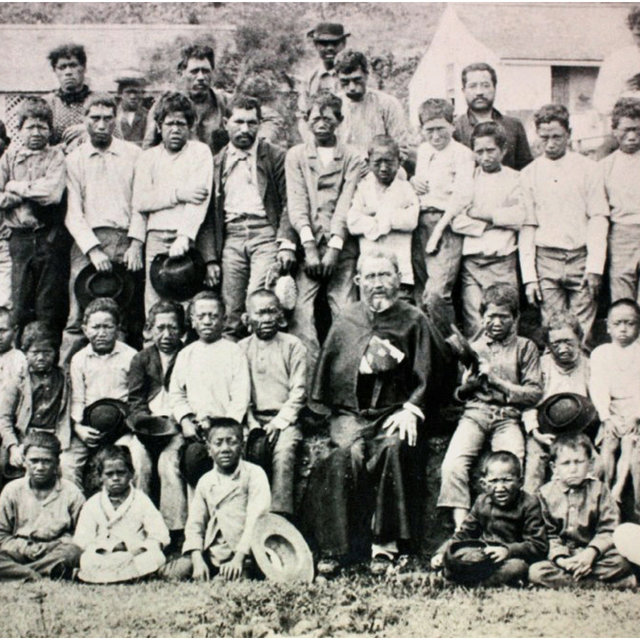
Father Damien at the Molokai Leper Colony (circ. 1865)

Leprosy, also known as Hansen’s Disease, is a horrible affliction.  It can attack the body’s nervous system and cause the victim to no longer feel pain.  Once he cannot feel pain, the victim is unaware of injuries or infections resulting in the loss of limbs.  The body just literally rots away.

Symptoms are characterized by white spots appearing on the skin which penetrate below the surface.  The spot becomes a circle with raw skin at the center.  The hairs of the infected area turn white.  Leviticus chapter 13 is dedicated to recognizing this disease and the procedure for preventing its spread.

In Scripture, when someone was healed of leprosy, the healing was described as a cleansing rather than a healing. That’s appropriate since leprosy is more easily transmitted in unsanitary conditions.  If you and I had close contact with lepers, careful bathing every day would go a long way to prevent contracting the disease. 

Father Damien as an example, headed the leper colony on Molokai, Hawaii for 16 years.  He ate out of the same bowls as the lepers and worked closely with them building homes, schools, and roads.  He bathed regularly and so did not show any symptoms of the disease for 11 years.  Though he did eventually die of the disease in 1889, he showed us close attention to personal hygiene can go a long way in prevention.

In biblical times, leprosy was a long and lingering death sentence.  One needed to be inspected by the priests to confirm the disease (Leviticus 13 deals exclusively with leprosy). Those who had the disease were separated from the community and had to call out “unclean” whenever they were near others.  Imagine the loneliness and isolation for these people.  They could only mingle with other lepers.

We’ve looked at leprosy as such an ultimate example of filth and infection. Now, let’s look at the other extreme, the holiness and purity of God. 

God is free from evil and sin.  He is “without spot.” When man stands before God, he must feel he is nothing but “unclean.”

Isaiah 6:5 (ESV)
And I said: “Woe is me! For I am lost; for I am a man of unclean lips, and I dwell in the midst of a people of unclean lips; for my eyes have seen the King, the LORD of hosts!”

This is why Paul says his greatest achievements are trash compared to Christ:

Philippians 3:7-8 (ESV)
Indeed, I count everything as loss because of the surpassing worth of knowing Christ Jesus my Lord. For his sake I have suffered the loss of all things and count them as rubbish, in order that I may gain Christ

So, we have looked at the contrasts between the clean priests and the unclean lepers; between the holy spotless God and filthy sinful man.  The separations are tremendous. 

When I reach out to God in prayer and feel His presence, I feel as though, Like Isiah, I should shout “UNCLEAN!”  Yet that holy and pure God Who took on human form feels compassion on me as He did 2,000 years ago.  Jesus, as a flesh and blood man Who was not to touch the diseased person reached out to touch the dirtiest human in that society, the leper:

Matthew 8:3 (ESV)
And Jesus stretched out his hand and touched him, saying, “I will; be clean.” And immediately his leprosy was cleansed.

Jesus doesn’t move away from us because we’re unclean but reaches out to us to cleanse us no matter how filthy or diseased we may be by sin.  If He will touch the leper, He will touch us too. If we let Him, we can become “cleansed lepers.”

Why Go to Church?

Many individuals have said over the years they don’t need to go to church.  They pray, they read the Bible, they know Jesus, they feel close to God just walking through His creation. So, why should they need to go to church?

There are several good reasons to be involved in a local church. Let’s look at some of them.

 Fellowship is a good reason.  Christians aren’t meant to be loners.  God is a communal God, He likes interacting with His children, and He’s designed us to be communal creatures.  We find it hard to walk the Christian walk without other Christians around to help us. When adversity strikes, it’s good not to face it alone. We are encouraged by others in our Christian life.

Hebrews 10:24-25 (ESV)
24  And let us consider how to stir up one another to love and good works,
25  not neglecting to meet together, as is the habit of some, but encouraging one another, and all the more as you see the Day drawing near.

Reproof.  In this case, “reproof” can mean to rebuke.  A Christian might no longer realize he’s living with sin.  Normally, the Holy Spirit will convict him of the sin, but repeatedly practicing that sin will harden his heart. He can become jaded to the point he no longer thinks of it as sin.  Sometimes a Christian is aware of his sin but rationalizes it away.  Obedience to God’s reproof is a blessing:

Proverbs 1:23 (ESV)
23  If you turn at my reproof, behold, I will pour out my spirit to you; I will make my words known to you.

Correction is different from reproof.  It’s meant to keep our beliefs straight.  I was supposed to present a Bible study at a rest home a few weeks ago.  I came across a portion of Scripture I didn’t understand which made me dig deeper, and I came up with a pretty odd explanation of the passage.  No commentary addressed what I was thinking, so I called a learned friend of mine who agreed it was a little too spooky to be teaching without a solid basis.  After all, teachers are held to a higher standard (James 3:1).

That’s what I mean by correction.  We watch out for each other and are there for one another.  Proverbs 27:17 says this: “Iron sharpens iron, and one man sharpens another.”   You don’t get sharpened or corrected much by walking around in the woods.

Accountability sort of comes with fellowship but is much more personal.  I meet with a group of Christian guys once a week, and actually all six points of this blog are addressed in that group.  We share what is going on in our lives, the areas we need to work on, our doubts, our understanding of Scripture, and our prayer needs.  We also ask each other how we’re doing with things we’ve shared previously.  We’re held accountable.  Because of our openness and vulnerability, these men have become some of my closest friends.  Accountability is not something a Lone Ranger Christian can do.  We need each other.

Instruction is pretty apparent.  In the local church, we have the opportunity to learn from people who know the Bible better than we do. It’s a place where we can ask questions and hear solid biblical answers. It’s also a place where we hear from people who have been through trials we’re currently facing.  All learning isn’t “book learnin.”  God uses others to speak to us.

Ministry, and this is the hardest lesson for us to learn about the local church.  It seems the majority of Christians see the church solely as a place to be served.  They go there to learn, to see friends, even for financial help, or a listening ear.  Once we’ve been a Christian for a while, we should begin to see the church as a place where we can minister to others as well.  We should also see the local church as a base from which we can reach out to our communities with the love of Christ.  

So, let’s not look at our relationship with Christ as exclusively an individual experience.  We need other Christians around us.  Besides, God tells us not to forsake the fellowship of other believers (Heb. 10:25).  God knows we need each other.  Don’t we all really know that too?

Christianity and Philosophy

Colossians 2:8 (ESV)
8  See to it that no one takes you captive by philosophy and empty deceit, according to human tradition, according to the elemental spirits of the world, and not according to Christ.

Philosophy, like most things, can be used for good or for evil.  You can use philosophy to convince people of absolutely foolish ideas.  Moral relativism is the idea that moral (ethical) standards should be set by either the individual or the culture.  It has cost millions of lives over the past century and damaged even more.  In a marketing class years ago we were discussing business ethics, the instructor said, “what is legal is what is ethical.”  I objected and pointed to 1950s America where it was legal to pay women and minorities less for the same labor.  “Was that ethical?” I asked.  Then I asked if Simone De Bouvier and Martin Luther King should have been expunged from our society for going against culture and saying people should be judged by the content of their character and not their skin color or sex.  She was stunned and said she needed to teach what was in the textbook.  Sad, but the class saw my point.

We see this sort of thing deeply embedded in our culture today.  No one can say what’s right or wrong without someone else being offended.  Moral relativism is at the root of many of our problems.  Accompanying moral relativism is epistemological (factual) relativism: “What’s true for you isn’t necessarily true for me!”  Recognize it?  If there is no objective truth, there can be no standards.

Philosophy can be used for good too, of course.  In previous posts, we’ve looked at the philosophical arguments and evidence for the existence of God.  Using logic (a discipline within philosophy) we’ve looked at many arguments against biblical truth and found them wanting. 

So, how do we tell the difference between godly and evilideas?  As Paul says in Col. 2:8, if we listen to the philosophy of the world we will be taken captive, deceived.  Some lies sound perfectly plausible and even attractive, so we need to be watchful.  We need to be so familiar with the truth lies are easily recognized.  The Bible is the standard for truth and morality not man.

If we follow philosophy according to Christ, if we search for actual truth, if we look for the real answers to the world around us, we end up on solid ground.  A Christian philosopher, Rene’ Descartes, told us that truth can be identified by its consistency.  Lies are inconsistent.  While some lies are complex, and the inconsistencies are well buried, they will eventually be found out.

There is a difference between one’s personal philosophy and philosophy as a discipline.  Your personal philosophy is the filter through which you view the world.  If you’re a Christian, you see the universe as a creation of God.  Because of what an atheist believes, he sees something very different.  That doesn’t mean they’re both true.  In fact, it means at least one is false. 

There is a considerable amount of philosophy in the Bible.  Jesus often reasoned with the Pharisees.  The Sermon on the Mount is very philosophical.  At least seven times in the book of Acts, we are told that Paul “reasoned” with the Jews and with the Greeks.  His argument starting in chapter 17:22 was a demonstration of logical reasoning to convince another of a specific truth.  James tells us wisdom (sophia from which we get philo-sophia, the love of wisdom – philosophy) is open to reason.  That’s a good definition of godly philosophy.

James 3:17-18 (ESV)
17  But the wisdom from above is first pure, then peaceable, gentle, open to reason, full of mercy and good fruits, impartial and sincere.

Christian philosophers over the past century have been making a difference.  They have taken the stance that all truth is God’s truth.  Alvin Plantinga has shown that evil and a loving God can exist at the same time.  William Lane Craig has given mountains of evidence pointing to the resurrection of Jesus as a historical fact.  Francis Beckwith has done amazing work for the pro-life movement, Greg Koukl has been fighting relativism, and the list goes on.

So, next time someone says something derogatory against philosophy, remember, much of what we believe is based in it.  Besides, “Philosophy is foolish,” is a philosophical statement.

Isaiah 1:18a (ESV)
18  “Come now, let us reason together, says the LORD:

What Child is This?

This past week, a few others and I went to a couple of nursing homes to sing Christmas carols.  A very creative friend of mine came up with the idea of arranging 14 of them to tell the Christmas story.  It really worked beautifully.  My role was that of a narrator.

In reading the stories behind some of these carols, it became clear to us what a wonderful, marvelous really, event this was.  Think about it.  A bunch of shepherds are out in the fields at night watching their sheep when an angel appears to tell them of the birth of Christ in nearby Bethlehem.

Angels aren’t an everyday occurrence for most of us, and angels themselves must be very frightening.  After all, one angel killed 185,000 Assyrians in one night (2 Kings 19:35).  So, this angel must have been quite a sight.  In fact, Luke tells us they were very afraid.  You tend to listen to a guy like that.

Then, to make matters even scarier, a whole army of these guys appears shouting, “Glory to God in the highest!”  Since the first angel spoke of the babe born in Bethlehem, the shepherds went to see this child.

What child is this that an army of angels appears to announce His birth?

Matthew tells us soon after some “wise men” came from the east to visit this child, to see this king which was prophecied about more than 500 years earlier (Jer. 30:9).  The wise men or “maji” were astrologers from Babylon and had traveled some 900 miles to see the king.

Remember the Israelites were captured by the Babylonians back around 586 b.c.  During their captivity, Jeremiah had prophecied the coming Messiah, and Babylonian astrologers had been watching for a sign ever since.  Just in case you think this is some sort of endorsement by God of astrology, please note their astrology took them to Herod who wanted to kill the child, not to Bethlehem to worship Him.  That information was found in Scripture for them by one of Herod’s scribes.

Imagine the sight of these Maji, probably more than the three the song tells of, coming to this small town with their entourage.  We live next to a small town called Dewey.  The town is so small, they only have one employee at the post office.  No mail is delivered.  Everyone has a P. O. box.  Dewey is a sort of modern day Bethlehem, a very unimportant, unnoticed, little community.  Yet the King of kings was born in this hick town, Bethlehem, in as lowly a surrounding as could be imagined.  This birth brought both hard working shepherds and very wealthy and influential men to see the miracle of His birth.

What child is this.  The Holy Spirit says it best through Paul:

Philippians 2:5-11 (ESV)
5  Have this mind among yourselves, which is yours in Christ Jesus,
6  who, though he was in the form of God, did not count equality with God a thing to be grasped,
7  but emptied himself, by taking the form of a servant, being born in the likeness of men.
8  And being found in human form, he humbled himself by becoming obedient to the point of death, even death on a cross.
9  Therefore God has highly exalted him and bestowed on him the name that is above every name,
10  so that at the name of Jesus every knee should bow, in heaven and on earth and under the earth,
11  and every tongue confess that Jesus Christ is Lord, to the glory of God the Father.

The Great God of the universe came to earth in the form of a servant, a man, willing to wash their feet, touch the lepers, cure the sick, and die violently, painfully, humiliated for our sakes.

There is a beautiful song written about 25 years ago entitled, “Mary did you know.”  One of the lines of the song goes like this, speaking of Mary, “when you kiss your little baby, you’ve kissed the face of God.”

What Child is this?  He was the Child mankind was waiting for since the fall.  He is the man who forgives our sins and gives us peace.  He is Christ the Lord.

God and Gays

What exactly does God think of gay people, and how should we treat them? 

Certainly, God condemns the practice of homosexuality.  Lev. 18:22 says, “You shall not lie with a male as with a woman; it is an abomination.”  Romans 1:26-27 says “For this reason God gave them up to dishonorable passions. For their women exchanged natural relations for those that are contrary to nature; and the men likewise gave up natural relations with women and were consumed with passion for one another, men committing shameless acts with men and receiving in themselves the due penalty for their error.”  So, we can be pretty sure since both the Old and New Testaments call this a sin, it was sin before Christ and still is.

If homosexuals are sinners, how is the Christian supposed to treat them?  Christians have been more harsh toward the sin of homosexuality than pretty much any other sin.  We will allow an adulterer or a drug addict attend church with us.  After all, they need the Lord and to repent, right?  But, many churches don’t allow homosexuals through their doors.    

We have all sinned, so why do you suppose homosexuality is treated like a mega-sin?  Maybe because many see it is a sin against nature as well as a sin against God, a kind of double sin.  But, is that biblical?  I don’t see gradations of sin in the Scripture, so a homosexual is no more of a sinner than an adulterer. 

Can gay people be changed by God and become straight?  In 1 Cor. 6:9-11, Paul says “Or do you not know that the unrighteous will not inherit the kingdom of God? Do not be deceived: neither the sexually immoral, nor idolaters, nor adulterers, nor men who practice homosexuality, nor thieves, nor the greedy, nor drunkards, nor revilers, nor swindlers will inherit the kingdom of God.  And such were some of you. But you were washed, you were sanctified, you were justified in the name of the Lord Jesus Christ and by the Spirit of our God.

So, we see that some of the men at the church at Corinth were no longer practicing homosexuals.  Either they were changed by God or chose to abstain from the practice.

I was on the church’s elder board a few years ago, and we faced this problem. We wanted homosexuals to come to our church and hear the gospel, but at what point are we condoning the lifestyle? We came to the following decisions: 1. If a homosexual repents and ends their relations with other gays as well as abstaining from homosexual practices, they are welcomed into membership of the church. 2. If they are still seeking God, and we can see a change in their lives, they are encouraged to stay. 3. If they continue to attend, but we see no change after several months of instruction, they may continue to attend but not cause dissention within the body. 4. If they do cause dissent or division, they they would be asked to leave.

That moves us to the next natural question, “Can there be gay Christians?” That’s like asking can there be Christian sinners?  You and I sin and are Christians, so I’m sure the answer is yes.  To be a Christian, though, we are to no longer practice sin.  The test of a true Christian walk is if the Christian practices sin, yet 1 John 1:9, written to Christians, says we Christians need to confess our sins and be forgiven.   So, Christians aren’t sinless no matter how hard we try. Some Christians are addicted to a particular sin: drunkenness, pornography, drugs, and more.  They may need help, and there are plenty of ministries out there offering.  It may be the same with homosexuality.  Legend tell us Michelangelo was gay but abstained his entire life because he knew practicing homosexuality was sin.  I think this is evidence of a Christian life.

Michelangelo’s choice to abstain also addresses the question, “What if I was born like this?”  We hear this pretty often.  Well, even if you were born this way, God says to practice homosexuality will keep you from His kingdom (1 Cor. 6:9-11).  So a homosexual who wishes to become a Christian is just like anyone else, he needs to repent, confess his sin before God, and ask God to take control of his life.  Like adulterers, thieves, addicts, and all the rest of us, they need to give up the practice of sin.  We were all born with the same sin nature.  Even if being born a homosexual is true, it’s not an excuse. 

Christians aren’t innocent.  Withholding God’s love from those we see as unlovable doesn’t excuse us from God’s instruction to love one another.  Jesus didn’t separate out gays as a group not deserving of hearing the gospel. Paul says in Romans 5:18 that Christ died for all men.  Not all men except gays but for all men, gays included.

Remember all the sin in your life?  Remember how God was able to forgive you and save you from hell?  Homosexuals are also people for whom Christ died.  In that sense, they are no different from the rest of us.  Let’s love more and judge less.  It’s God’s way – the best way.

The Measure of a Christian

Ever ask yourself the question, “How am I doing in my Christian walk?”

What we’re talking about here is that big theological word “sanctification” which just means God makes us more and more like Him the more we spend time with Him.  Someone once told me sanctification is like going to the end of the Santa Monica Pier and trying to jump to Catalina Island 26 miles away.  Some will get closer than others, but no one is going to reach it or even come close.  We’ll never reach perfection this side of heaven, but we should see improvement.

We wonder how we’re doing.  We’re human.  God recognizes this desire and gives us “tape measures” to tell us where we are in our Christian walk.  One of these is found in Galatians 5:22-23, 

But the fruit of the Spirit is love, joy, peace, patience, kindness, goodness, faithfulness,  gentleness, self-control; against such things there is no law.”

These fruit of the Spirit shouldn’t be goals in our lives so much as symptoms of a Christian walk.  If we have yielded our lives to God’s Spirit, we should see love, joy, peace, patience, kindness, goodness, faithfulness, gentleness, and self-control increase in us.  The amount of increase of these traits in our lives should give us a good idea of our progress.  Do we see we are more loving, joyful, peaceful, etc. than we were, say, five years ago?  We should be if we are letting God work in us.

Another “measuring tape” is found in 1 Cor. 13: 4-7, “Love is patient and kind; love does not envy or boast; it is not arrogant5 or rude. It does not insist on its own way; it is not irritable or resentful;
 it does not rejoice at wrongdoing, but rejoices with the truth. Love bears all things, believes all things, hopes all things, endures all things.”

To check how you’re doing, replace the word “love” in the passage with your name: “Mike is patient and kind; Mike does not envy or boast….”  You get the picture.  Most of us are embarrassed when we read the text that way, but it’s a good indicator how much we are or aren’t releasing control of our lives to the Holy Spirit.

The natural reaction to all of this is, “I need to be more loving, I need to be more patient to people, I’ll be kinder.  I’ll work on my envy and boasting, etc.” when the real response should be, “I need to spend more time with the Lord and in His Word.”  By building up our relationship with God and letting go of our flesh, these traits will automatically follow.  The more God is revealed in our lives, the less prominent we become.  That’s the Christian goal, isn’t it, the world seeing more of God and less of us?

True, God gives us commands such as at the end of James chapter 1 where He says, “This is pure and undefiled religion, to visit orphans and widows in their distress….”  These are things Christians should be doing.  Since God’s Word reveals His nature to us, obeying His commands joyfully indicates a change of mind and heart in us.  The more we let God take control of us, the more we understand God, and the more of us we want to give up to Him.

Augustine said we must believe in order to understand anything about God.  That sounds like a cop-out for Christians.  It sounds like our beliefs are based on blind faith, but they aren’t.  Augustine was brought to Christ through intense questioning of some passing evangelists and accepting the rational arguments they presented.  What Augustine meant was that the more we believe in God, the closer we walk with Him and the better we will understand His ways.

To summarize, we can measure how we’re doing in our walk with Christ by looking at our lives.  We should see fruit and more of it every day.  If we’re letting God work in us, there should be a noticeable change.  If there is no change, maybe we might look at our relationship with God.  Are we talking with Him?  Do we listen for His voice?  Do we read the Bible?  If we’re not seeing fruit in our lives, that’s the fix.

If you have a comment, question, of criticism you would like to see addressed on this blog, please mention it in the comments square or email me at AnswersAZ@gmail.com

Common Wonders

When I was a kid, I heard that God gave us rainbows as reminders of His promise never to destroy the earth by flood again.  Being the nerdy kid I was, I wondered if we would expect rainbows if they weren’t given to us.  In other words, I wondered how many things that should be known aren’t because we don’t have a concept of them.

Then there was the day in 7th grade science class when our teacher told us bumblebees shouldn’t be able to fly.  There was no understanding of aeronautics at the time that would allow for small wings to support flight of such a chubby insect.  That didn’t stop God from designing such a creature.   Apparently now they have discovered the math that allows for bumblebee flight.  Maybe God created that math when He created the bumblebee just to add to the wonder we have for our world.

Woodworking has been a hobby of mine most of my life.  As I worked around the shop over the years, I began to think of how God has set up this universe so that man could progress from fairly primitive cultures like the pre-flood guys up to today.  To build quality furniture, for instance, you need to be able find an absolutely vertical line and a line perfectly perpendicular to that vertical line and carry those lines to the work piece.  In other words, you would need to be able to construct a perfect carpenter’s square.  This is needed in building all sorts of things from pyramids to picture frames to Noah’s ark.

God has supplied the laws and conditions of this universe so even the simplest culture can arrive at a square if they think about it.  We can create a perfectly vertical line by suspending a rock from a thread.  We can create a perpendicular line to that vertical line by putting water into a beaker.  Water seeks its own level, so the surface of the water is absolutely perpendicular to the vertical line produced by gravity acting on the rock suspended on a thread.  There you have it, the basics of a carpenter’s square.

Now to check the square once you’ve built it is also provided by God.  First you need a board with a straight side.  A straight line, of course, can be created by tightly stretching a thread between two points.  Viola’, you have a perfectly straight line and can check the board to see if it’s straight.  If it is, you can lay one arm of the square you’ve built against the side of the board.  To check its perpendicular arm, draw a line along the edge of that arm then flip the square over and see if the arm aligns with the line you just drew.  If it does, you have made a perfect square.  I use this method whenever I buy a new square.  You can spot a cheap square that is perfectly aligned by using this method.

Making a circle is just as simple.  Put a peg in a whole in a board, tie a string to it, tie a marking device of some sort to the other end of the string, and drawing a circle using the radius.

In cabinetmaking there is something called a “story rod.”  It is a tool used to find the distance between two walls, for instance.  A story rod is actually two rods.  The end of one rod is placed against a wall, and the other rod is placed against the other wall.  The two rods are held together in a straight line and level.  Where the two rods overlap, the installer can put a pencil mark and take that measurement back to the shop.  It is a precise method for measuring the new cabinet in order to fit the space perfectly.  The reason it is called a “story rod” is because in ancient times, illiterate cultures like the early Israelites would keep their family history on a rod like similar to Aaron’s rod.  Each generation’s patriarch would carve something on a rod like Aaron’s so they would be remembered by future generations.  Patriarchs would sit with their children in the evening and recite the family story as they were reminded by the chronological carvings on the rod.  When someone like Aaron wanted to measure a space, he could take his story rod along with a plain rod and overlap then pushing the ends to touch each end of the space.  Where the rods overlapped, say at Uncle Benjamin’s carved spot, they knew how large the space was.  They used the stories represented by carvings on the rod to remember a dimension.  No inches or fractions needed.  God gave us a way to measure something long before the tape measure came about.  By the way, the story rod is still used today by some cabinetmakers because it’s easier and more accurate than a tape measure.

Now with vertical lines, level gauges, circles, measuring devices, and squares we can build most of the important structures up until just a few centuries ago from chairs to houses.

Then there’s the light we see.  You know the color we “see” doesn’t really exist.  The green leaves of a tree aren’t really green but reflect a specific frequency of sunlight and absorb all other frequencies.  That specific frequency of light strikes the cones of our eyes which convert the frequency to an electrical impulse. The impulse then travels up our optic nerve.  It is our minds which interpret that electrical impulse as the color we think we see.  In this way, God has provided a much more interesting universe filled with colors of every shade and intensity.  It is also an added way for us to distinguish various items from one another.

Then there’s water. There are very few substances on earth that expand when frozen (only 3 last I heard). Water is one of them. That’s why ice floats. Since ice floats, ponds and lakes freeze on top insulating the rest of the water from the freezing temps. If Ice didn’t float, it would sink to the bottom freezing the lake from the bottom up. Eventually the lake would freeze solid killing all the fish. So, God designed water to expand when frozen in order to maintain fresh water fish on earth. Pretty neat.

I’m sure there are lots of other things we’re not aware of that God has created just as they are just for us, but these are just a few as examples of His ultimate wisdom and preparation of the world for our use and enjoyment.  What a wonderful and creative God we serve!

If you have any topic or questions you would like to see addressed in this blog, please enter them in the comments section or email them to AnswersAZ@gmail.com

Bible Study Questions?

What do we do if we have questions about a passage we’re studying?  Back when I started this blog nearly two and a half years ago, I gave several Bible study methods the Bible student can use to better understand God’s Word.  There were the word study, character study, ABCD study, and the topical study methods.  But, even with these methods we’ll run across portions of Scripture that puzzle us.  How do we check those passages to better understand them?  Here are some of the methods I use.

  • Pray: Always pray first and listen for the answer.  God will often open my eyes on the spot when I ask Him.  After all, we have access to the Author of the Book.  Why not use it?
  • Read the context:  First and foremost, we need to read the surrounding verses, the verses before and after the passage in question, to get the feel and better understand the topic being covered in the passage.
  • Who was the book written to, what was the purpose, etc?  Even if the salutations of Paul’s letters identify the recipient, we still need to know more about the occasion of the book, why it was written and if there are problems the book is addressing.  You can get this information from at least four sources.
    • Study Bibles.  A good study Bible normally contains an outline to each book as well as an introduction to that book.  A study Bible will also have notes that address particular passages, so if your passage is puzzling, sometimes the footnotes will clear up the confusion.
    • Bible dictionary.  Bible dictionaries are books that are written to explain topics and events in the Bible.  You’ll usually get book outlines for every book of the Bible.  You’ll get information on characters and geographic locations mentioned in the Bible.  So, if you need info on a specific book, a Bible dictionary is the place to start.
    • Bible encyclopedia.  Bible encyclopedias contain the same information Bible dictionaries offer plus more.  You can look up theological terms, heresies, and all sorts of things you won’t normally find in a Bible dictionary although Bible dictionaries are becoming broader in the scope.  Still, a good Bible encyclopedia goes more in depth on the subjects it contains than does a Bible dictionary.
    • Commentaries:  Commentaries will give you a considerable amount of information about a Bible book and particular passages within that book.  More on how I use commentaries later.
  • What type of book is it?  The Bible contains a number of book types.  In fact, the books are ordered by their type.  We have the five books of Moses, historical books, the writings (poetic writings), then prophetic books.  In the New Testament we have the biographies (gospels), historical book, writings (epistles), and prophetic (Revelation).  Each type of book has it’s own style of writing.  We need to understand the type of book before we judge a passage that confuses us.  A prophetic book will read very differently from a poetic book.

When I have a problem that these resources don’t handle, I turn to commentaries.  I don’t like using commentaries during my study because I believe Bible study is personal.  God wants to speak to the student as directly as possible, so I try to keep my study as pure as possible.  Commentaries are what someone else sees in the passage.  True, they are much better educated in the Bible than I am, but still I have God’s phone number, and He has mine.  He can talk with me.  Normally, I use commentaries at the end of my study to check what I’ve already decided the passage says.  A few times I’ve looked in a commentary and found something like, “some people think this means ‘X’, but that would be a major mistake because ‘Y’.”  I’ve found myself way out of line.  Good thing I checked before I wrote or taught what I had initially found.  We need to be careful with what we teach and accept as true.

I also use some language helps.  I don’t understand Greek or Hebrew, so I look to someone who does.  Because I don’t speak these languages, I can get into trouble here if I’m not extremely careful.  Greek and Hebrew are very different from each other and from English, so anything I think I understand should be checked if it doesn’t align with what I already know the Bible says.

If I still haven’t found help and am unsure of my conclusion about the passage, I’ll check with a more knowledgeable Christian friend.  I have a few pastors I can talk with comfortably about these questions, and I do.  Make friends with your pastor.  He wants to be a resource for your study and will almost always be glad you checked on a passage you’re unsure of.

If I still haven’t arrived at a satisfactory answer to the puzzling passage, and I think it’s extremely important, I’ll go to an expert.  I go to a seminary I trust, look up their faculty list, and I will usually find email addresses for the various professors.  If I have a theological question, I’ll send an email to a professor of theology.  If my question is a language question, then I send an email to the language department or a specific professor in that department.  If I can’t find email addresses, I’ll call the school and ask for the department I need information from.  They will usually direct me to someone who can help.

Lastly, once in a while there just is no answer this side of heaven.  We need to accept it and move on.

Speaking of questions, I’d like to initiate a new policy and open this blog up to your questions.  You might inspire a blog post, and that would be great!  No names will be mentioned.  You can comment here or email me at answersaz@gmail.com

Christians and Alcohol

You’re over at a friend’s home and they offer you some wine with dinner.  You’re a Christian.  What do you do?

Surprisingly, the Bible has quite a bit to say about this sort of situation.

First, let’s look at the issue of whether Christians can drink alcohol at all.  Eph. 5:18 calls drunkenness debauchery, so we can be sure we shouldn’t get drunk.  But, can we drink at all?  Of course, if you’re an alcoholic, the answer is a definite “NO!”  That’s just common sense, but what about the rest of us?

There are plenty of examples of saints drinking wine in Scripture, but some say drinking wine was necessary because the sanitary conditions were so bad they couldn’t drink the water.  “Today,” they say, “is different.  Sanitation is of a much higher quality, so we don’t need to drink wine and shouldn’t for fear of possible drunkenness.” 

I really don’t think that argument holds water.  Luke 7:33-34 says John the Baptist didn’t drink wine, but the same passage indicates almost certainly that Jesus did.  We can get two points from this short passage.  First, if John didn’t drink wine, wine wasn’t all there was to drink.  We also see that Jesus almost certainly drank wine.

Some deny the examples of New Testament Saints and Jesus Himself drinking wine.  They say it was really grape juice.  I don’t think Luke 1:15; 5:39 and several other passages could be interpreted as grape juice.   So, that argument is unsupported by Scripture.

At the wedding at Cana (John chapter 2), Jesus turned water into wine.  Was it real wine?  The master of the feast certainly thought so and so do most commentators.  So, we have to ask ourselves if drinking wine was sinful, why would Jesus provide it? The next question is should we?

Romans 14:21-23 (NLT2)
21  It is better not to eat meat or drink wine or do anything else if it might cause another believer to stumble. 22  You may believe there’s nothing wrong with what you are doing, but keep it between yourself and God. Blessed are those who don’t feel guilty for doing something they have decided is right.
23  But if you have doubts about whether or not you should eat something, you are sinning if you go ahead and do it. For you are not following your convictions. If you do anything you believe is not right, you are sinning.

A lot of Christians believe drinking alcohol is sinful behavior.  For them, then, according to this passage, drinking is truly wrong.  God would see it as sinful if they drank alcohol.

Based on some passages I’ve mentioned, though, many Christians believe God is fine with our having a glass of wine in the evening to relax or with dinner, a beer with friends or on a hot day.  The Bible allows for that.  However, the Bible doesn’t allow for stumbling a brother or sister who thinks drinking is wrong.  The Christian who is drinking is the one responsible for the decision and result not the brother or sister who is stumbled. Scripture doesn’t seem to make an allowance for the stumbled brother’s interpretation of biblical teaching.  I believe it also doesn’t allow us in principal to drink in front of an unbeliever who thinks Christians are hypocrites if they drink.  They might be standing in the way of that person’s decision to accept Christ.

 “So, am I supposed to be a closet drinker?” you might ask.  That’s up to you.  I have a beer on a hot day or once in a while in the evening.  I’ll have a glass of wine from time to time.  Personally, though, I almost never drink in public.  Though a beer might go well with a steak or wine with fish, it isn’t worth taking the chance someone who knows I’m a Christian might see me and stumble in their faith or on their path to Christ.  I had a Christian friend who believed drinking was allowed biblically but refused to drink. His reason? He thought he might hurt his witness to another believer.  After all, just how important is that drink?

To summarize, let me give my opinion on what we’ve looked at here.  The Bible allows for drinking in moderation.  Once you feel the intoxicating effects of alcohol, you’ve gone too far.  It also tells us not to drink in front of a brother who might be stumbled by it.

So, this is the gist of the arguments for and against Christians drinking.  Please decide for yourself.  Don’t play the “Holy Ghost Police” and criticize those with a different view. Do your own research and pray about it. 

Thinking of Leaving the Church?

Ephesians 4:11-12 (ESV)
11  And he gave the apostles, the prophets, the evangelists, the shepherds and teachers, 12  to equip the saints for the work of ministry, for building up the body of Christ,

People leave local churches all the time for lots of reasons.  Many have very little to do with their spiritual life.  Maybe the music is too loud or too soft.  Maybe it’s too modern or “those old hymns.”  Maybe the pastor said something, and an individual felt slighted or there was some personal conflict with others in the church.  People have even left churches because they didn’t like the color of the new carpet, the paint used in the sanctuary, even what the pastor and the worship team wears  Very seldom, though, do Christians leave a church because of something scandalous or doctrinal, and even then, I’m not sure there is a reason to leave.  The purpose of the church is to equip the saints for the work of the ministry.  If your church is doing that, there is most likely no reason to leave.

I was a member of a church where an associate pastor denied the trinity on two different occasions.  After the first denial, I talked with him after service to see if it was a mistake or if he really meant it.  He assured me it was a mistake.  When he did it a second time, I went to the board of elders asking them to correct him.  He ended up leaving.  My point isn’t that there are poor teachers in the pulpit but that we often need to stay where God has placed us and be part of the solution, not create more problems.  I’m sure people left over this “heresy” from the pulpit and didn’t give it a second thought, but leaving shouldn’t be our first response.   We are the body of Christ.  We are supposed to seek unity.

More important, I think, isn’t that people leave.  Christians will normally end up at another church where God can use them and where they will be fed.  What is more important is how they leave.

The new Christian might leave, and few notice.  This is especially and unfortunately true in larger churches where the loss of one-in-a-thousand or so new or infrequent attendees might go unnoticed.  This is actually a pretty major problem for the local church.  Keeping track of new attendees is difficult.

The mature Christian, however, is more problematic.  They are often looked up to and admired by many in the congregation.  When such a Christian leaves, there is a temporary hole left.  People want to know why she left or what she found distasteful or in error.  “Certainly a mature Christian wouldn’t leave over some of the reasons listed in the second paragraph of this blog!” you might say.  You would be surprised.  The old axiom, “The church isn’t a hotel for saints but a hospital for sinners” is true in so many ways.  The people in the church are not perfect and sometimes don’t act perfectly, even the experienced Christians.

Those of us who have been in churches for years have seen the letters that are sent out explaining some imagined doctrinal error.  We’ve heard the gossip of how poorly some Christian hero in the church was treated by leadership.  We’ve been in the Bible studies where a self-righteous prayer for the church’s obvious insensitivity has caused broken hearts.  Some of these are sincere.  Some are striking back at a church someone felt had let them down.  They are a source of division within the body of Christ.

Sure the more experienced Christian will shrug off the vicious ones and count them as attempts at division.  The church will often seek some sort of understanding and restoration of the unhappy congregant.  Some of these stories are so vitriolic, though, they are viewed with anger and disgust.  It’s the newer or weaker Christians who are often stumbled by this sort of gossip or parting statement.  That’s the saddest consequence.  The young Christians hear someone they looked up to left the church over some doctrinal difference when she was actually asked to leave because she was casting demons out of paintings in the church café (actual event), and the young Christians, too, leave the church or even the faith not having heard the whole story or having been misled by the offender.  The original Christian who left never understands the damage she left in her wake.

To summarize, if you’re planning to leave the church, ask yourself why.  I had a chief in the Navy who used to respond to every complaint with a pat answer: “Sounds like a personal problem to me.”  If the chief is speaking to you, maybe you should ask yourself a few questions:

  1.  Am I being ministered to at this church?
  2. Am I ministering to others?
  3. Is the Gospel being preached and the Bible taught?

I had wanted to leave a church years ago and mentioned it to a pastor friend of mine.  He was alarmed and asked me if I was called to another church or just wanted to leave this one.  I said I was just unhappy and wanted to leave.  I have held his response as one of the spiritual maxims of my life:  “You don’t leave a church unless you are clearly called elsewhere.”

I know the readers of this blog are mostly happy with the churches they attend.  Just sock this away in case you later become disillusioned with your church.  It might clear up a lot of confusion and help you decide the path to follow. Compare your reason for leaving with the purpose of the church.