What About Women?

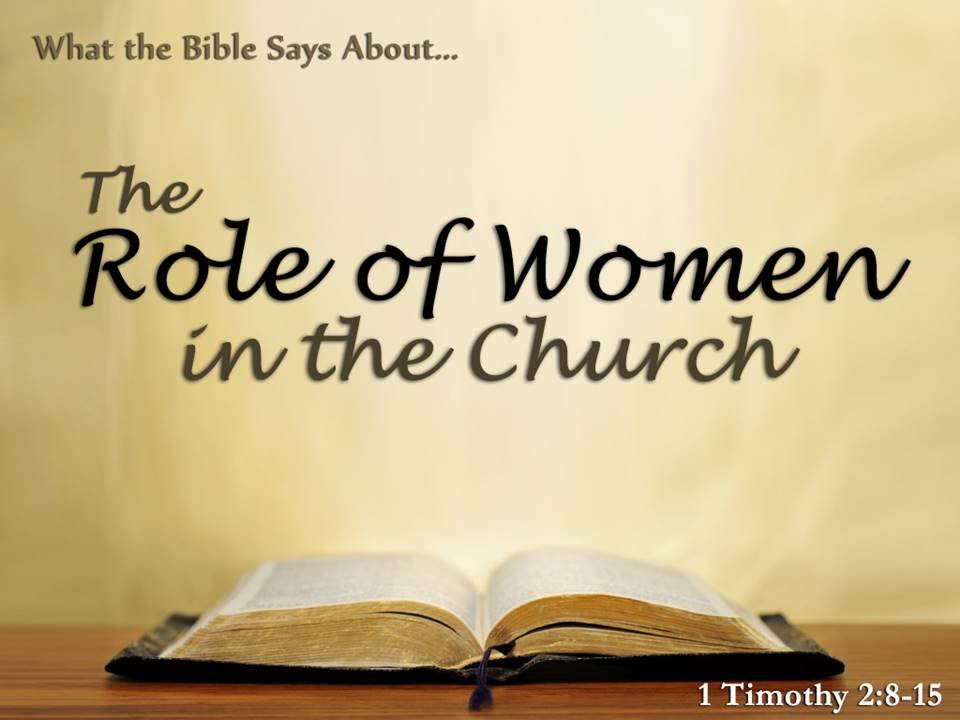
The role of women in the church has been a heated discussion for years.  The arguments cover a broad spectrum of teachings.  So, I thought I’d throw my two cents into the pot, just to muddy the waters a bit more.

Some churches won’t let women do almost anything but teach the children.  Others have no limitations at all.  The rub comes when women feel slighted. They’re told men can do things they can’t.  They’re told to be submissive, subject to the rule of men.

The ill feelings come from different sources.  Many men lord this submission over the women. Some pastors beat it to death. Even biblical commentators and some study Bibles come down heavily on this.

But, what does the Bible actually say about the role of women?  For one thing, it says men and women are seen as equals and fellow laborers:

Philippians 4:3 (ESV) Yes, I ask you also, true companion, help these women, who have labored side by side with me in the gospel together with Clement and the rest of my fellow workers, whose names are in the book of life.

Galatians 3:28 (ESV) 28  There is neither Jew nor Greek, there is neither slave nor free, there is no male and female, for you are all one in Christ Jesus.

No inferiority here.  The dispute really comes with leadership positions.  Just where does a woman’s role fall in the leadership of the church?  Women can be ushers, greeters, women can serve communion, and baptize.  There is nothing in Scripture that teaches against this.

There is good biblical support that women can also be deacons.  In 1 Tim. 3, we are given the qualifications for deacons and elders.  Elders must be the husband of one wife.  That would exclude women as elders.  Pastors are teaching elders, so women would also be excluded from the pastorate. 

Under the qualifications for deacon, however, is the phrase ““Their wives likewise must be dignified, not slanderers, but sober-minded, faithful in all things.” (1 Tim. 3:11) 

You might think this would exclude women from being deacons as well, but the language here is interesting.  The New American Standard translates the passage this way: “Women must likewise be dignified, not malicious gossips, but temperate, faithful in all things.”  This is because the word often translated “wives” as in 1 Tim. 3:11, is more often translated “women” in the Bible than “wives” although it can be translated as either. 

In Romans 16:1, we read, “I commend to you our sister Phoebe, a servant of the church at Cenchreae,”

The word translated servant here in the ESV is, “diakonos,” the word from which we get our word, “deacon.”  The New Living Translation actually translates it as “deacon.”  So, many churches allow for women deacons including the conservative church I attend.  One more point on the role of women in the church is authority.  Paul says that women are not to teach or have authority over men: 

1 Timothy 2:12 (ESV) 12  I do not permit a woman to teach or to exercise authority over a man; rather, she is to remain quiet.

Deacons are seen in Scripture as servants rather than an authoritative role, by the way.

So, to summarize, women are equal to men in every way.  It is the leadership positions available to men and women which differ.  Many women cringe at the thought of being told to be submissive to men.  They believe that is God saying that women are inferior.  It isn’t. Submission is to be voluntary.

Luke tells us Jesus, the very Son of God, was submissive to Mary and Joseph:

Luke 2:51 (ESV) 51  And he went down with them and came to Nazareth and was submissive to them. And his mother treasured up all these things in her heart.

Paul tells us Jesus is submissive to God the Father

Philippians 2:8 (ESV) 8  And being found in human form, he humbled himself by becoming obedient to the point of death, even death on a cross.

So, even though Jesus was greater than Mary and Joseph, and He is equal to the Father, He voluntarily became submissive to them all.  The points being that “submissive” doesn’t equal “inferior,” and submission is not to be forced.

God has seen fit to put men in the leadership roles of the church and the home.  Society isn’t the standard of truth.  We aren’t the standard for truth.  God is, and we must leave it at that.

The next question, of course, is what is your role in the church?  Find where God has planted you and let Him use you there.

Standing on the Promises

Russell Kelso Carter, a pastor and later a medical doctor, wrote that old familiar hymn,  “Standing on the Promises of God.” It was first published in 1886.  Carter spoke in his hymn of the certainty of God’s promises.  So, humming the melody, I began to think about what promises are.

Promises, of course, are a sort of contract, a commitment.  Sometimes they’re unconditional.   God promised never to destroy the earth with a flood in Genesis 9:11.  Sometimes they are conditional.  In 2 Chronicles, God promises, “If my people who are called by my name will humble themselves, and pray, and seek my face, and turn from their wicked ways, then I will hear from Heaven and will forgive their sin, and will heal their land.”

There are warning promises (Ps. 9:17), saving promises (Rom. 10:13), motivating promises (2 Cor. 7:1), There are guiding promises (Ps. 32:8), Comforting promises (Ps. 55:22), uplifting promises (2 Cor. 12:9), and hopeful promises (Rom. 8:28).  All in all, there are well over 3500 promises in the Bible.  There are so many, people have filled books with just some of God’s promises.

“These are all great, but how do we claim all these promises,” you might ask?  We claim them through faith:  “But without faith, it is impossible to please him, for he who comes to God must believe that he is, and that he is a rewarder of those who diligently seek him” (Heb. 11:6).

And where does this faith come from?  “So then faith comes by hearing and hearing by the word of God” (Rom. 10:17).

The hardest thing about God’s promises is sometimes they take time to fulfill.  Patience is not a common trait among humans.  We don’t like waiting for our rewards.  When I was a kid, I’d order those toys off the back of cereal boxes and expect them to arrive in the next day’s mail.  The anticipation grew, but patience dwindled.  I was so excited when the toy actually arrived, though.

I don’t know if you’ve ever asked God for patience.  I have, and it was murder.  Nothing arrived on time, God was trying to teach me to be patient, but I didn’t learn much except to never again pray for patience.

God fulfills His promises.  I’ve waited sometimes for years to see people come to Christ, but they came.  I’ve seen people healed, money appear suddenly just in time for someone in desperate need, jobs found, couples married, children born.  I suppose then that “wait upon the Lord” is a good idea. (Ps. 27:14)

Some of my favorite promises are these:

Jer. 33:3 “Call to me and I will answer you and tell you great and mighty things which you do not know.”

John 1:12 “But to as many as received Him, to them He gave the right to become the children of God, to those who believe in His name.

My wife’s favorite is Matt 28:20b “….. and ‘lo I am with you always, even to the end of the age.”

The central verse of the entire Bible is a promise, John 3:16:

John 3:16 (NKJV)
16  For God so loved the world that He gave His only begotten Son, that whoever believes in Him should not perish but have everlasting life.

The Bible is filled with literally thousands of promises God has made to us.  What’s your favorite?

Church Government

A friend and I were discussing how our church is governed.  Like just about everything in the church, disagreement on this issue can range from friendly differences to people leaving the church or even to church splits.  The latter should never be.

So, why do some churches govern differently from others?  For some, it’s tradition.  With others, it’s just a matter of efficiency.  Some see a command in Scripture.  But, what does the Bible teach about church government?  We’ll look at that, but first let’s look at three major forms of church government today.  There are variations, but these are the three major general forms:

Congregational

First is the congregational form.  This is sometimes called the “Lynch Mob” form of church government, the congregation as a whole votes on just about everything that goes on in the church from the type of carpet to times of service.  I’ve been in congregational meetings where discussion of how many flowers should be on the alter dragged on and on. 

The pros and cons for this form are that: everyone is involved.  Since all decide, everyone has skin in the game.  Everyone, or at least the majority, wants the church programs to succeed and will work to make It so.  This can draw church members closer together and create more of a family atmosphere especially in smaller churches.  The drawback is also that everyone is involved, so it often takes a long period of time to get things done as well as major decisions like paying to repair a copier is often run by the congregation.  Even with all this, the pastor normally makes the everyday decisions.  The pastor is responsible to the congregation in this form.

Presbyterian

Secondly, we have the Presbyterian form.  “Presbyter” simply means “elder,” and these churches are run by a board of elders making pretty much all decisions regarding the church.  The pastor is regarded as a teaching elder and seldom has any more say on board decisions than any other board member. 

The congregation has little or nothing to say about how the church is run other than, perhaps, the election of these elders.  In some churches, the pastor appoints the elders.  The budget may be voted on by the congregation as well.  The pros of this are that major decisions do not require a congregational vote, smaller things are handled immediately, and ideally these decisions are made by spirit-filled and spiritually mature men.  The pastor has less pressure and is able to accomplish more.  Among the drawbacks are the fact the pastor has no direct “skin in the game” at various ministries within the church.  Since the entire board makes the decisions, the board responsibilities rest on the board and are often divided up among individual elders to oversee specific portions of the church ministries.  The senior pastor is responsible to the board of elders unless he is to be removed.  Then it normally goes to a congregational vote, but not always.

Episcopal

The third form is the pastor-run church, often called the “Moses” model.  In this form, all ministries are run past the senior pastor for his approval.  He makes the final decisions on pretty much all major issues facing the church.  While he may seek counsel in his decisions, the final responsibility falls on him.

The pros and cons are that the pastor has “skin in the game” for everything that goes on in the church.  He knows how every ministry is run and who is running it.  New ministries are promoted by the pastor since it is he who is responsible for the success or failure of that ministry.

The pastor, as you can see, carries a heavy load with this form of government.  Also, the pastor must be a fine man, mature in the faith and spirit led.  Otherwise the church can fall into error.  The pastor must be open and transparent to others in the congregation who can guard against error.

With all three forms, there is often a hierarchy above the local church that keeps tabs on it.  Many, like most Sothern Baptist churches, however are autonomous.  To protect themselves against error, they belong voluntarily to local associations of So. Baptist churches who keep an eye on each other.  That association has no real authority, but if a church is removed from the association, it doesn’t help that church’s reputation in the community.

I said I would give you scriptural evidence for the biblical model for church government.  Well, actually, all three I’ve mentioned appear in Scripture.  The church came together to vote for the office of elders in Acts 6:1-4 (Congregational).  The church at Jerusalem formed a council of elders and apostles to decide how to deal with Gentile believers in Acts 15:6 (Presbyterian).  In Titus 1:5, Paul directs Titus, the senior pastor at the church in Crete, to appoint elders.  This indicates Titus and Titus alone, was in authority over the church there (Episcopal).

So, all three forms of church government can be seen in Scripture.  These examples in Scripture are just that – examples.  A specific command is not given to form a particular type of government in Scripture.  It is left to the local congregation. 

So, don’t get yourself in a snit because you don’t like the form of government your church holds to.  So long as the pure Word is taught, people are ministered to, and error is addressed, you are in good hands.  After all, as a wise man once asked me, “Who’s church is it, Mike?”  The answer, of course, is Christ’s church.

Read and Study

The Bible is a wonderful Book.  Most Christians know how to read it.  But, reading isn’t all we’re commended to do with the Bible.  We’re commanded to read it, sure, but we’re also commanded to study and maybe even to memorize it.

2 Timothy 2:15 (ESV)
15  Do your best to present yourself to God as one approved, a worker who has no need to be ashamed, rightly handling the word of truth.

Psalm 119:11-12 (ESV)
11  I have stored up your word in my heart, that I might not sin against you.
12  Blessed are you, O LORD; teach me your statutes!

The act of memorizing the Bible is actually a very excellent form of Bible study.  The process of memorization requires you to think more deeply about that passage and what it means.  You become aware of every word and how it relates to others in that portion of Scripture.

So, how are we to do this?  Well, it’s pretty much up to you and how you learn best.  I do best just reading and repeating.  Some of us learn best by listening to someone else recite a passage and repeating it, some like flash cards.  There are other methods, too.  The Navigators are pretty good  and you might check Youtube.com for some more methods.  I do suggest you memorize by topic: salvation, for instance.  That helps you share with other if that is your purpose for memorizing Scripture.

How about studying rather than just reading?  “Just reading” is important.  God likes us to sit and read His Word to learn the stories, lessons, doctrines, etc. as we read.  It’s a good way to commune with God and have Him speak with us.

Studying involves a more deliberate approach.  One of the simplest way to dig a little deeper into Scripture is to paraphrase a verse or two, put that passage in your own words.  That way, it makes you look more closely at the passage and analyze it.  You are forced to understand the idea better in order to write it down in another form.

Another simple study method is called the ABC Method.  You can use this method for a paragraph or chapter, even a book of the Bible if you’re ambitious.  It goes like this:

You need to find A title for the passage.  That’s the “A”.

Then you need to decide on a Basic verse for the passage.  That’s the “B”

And, the “C” is for commitment.  What commitment has this passage made on your life?

Some students of the Bible add a “D” for “difficulty” to the study.  So, if there is something they don’t understand about the passage, they can research it a little later using more advanced study tools to better understand what is puzzling them.

Memorizing and Bible study go hand in hand.  The passages I’ve memorized keep coming to mind when I’m studying Scripture.  Maybe I’m reading a portion of Acts where the disciples are in trouble.  James chapter one comes to mind about trials, what they mean to us and how we are to respond to them.  Sometimes I even compare one passage I’ve memorized with another I’ve memorized or one I’ve heard on the radio program with one I’ve memorized and the Holy Spirit gives me insight through whose two passages being put side by side.

And, that’s it.  There’s nothing miraculous about better understanding the Bible.  It just takes some time and dedication.

Just as We Are

The great old hymn Just As I Am has blessed millions over the years.  Billy Graham used it for decades to close his crusades.  There is a dramatic and inspiring story behind this wonderful hymn.

Charlotte Elliot was from an upper middle class and pious family.  Both her grandfathers were pastors as were her two brothers.  Charlotte received a college education at a time when few women did.  After college, she fell in with a somewhat worldly crowd and drifted away from her religious upbringing.

In 1821, Charlotte suffered a “severe illness.”  No one at the time knew what it was, but it left her an invalid the rest of her life.  Early in her illness, she befriended Belgian pastor Rev. Dr. Malan.  Rev Malan asked her if she had made peace with God.  Her response was that she wanted to clean up her life first.  Malan’s response was, “Come just as you are.”  She did, and from this came the hymn Just As I Am.

Spending most of her life in bed didn’t get Charlotte down.  She wrote 150 hymns, edited the Invalid’s Hymn Book including 115 of her own hymns, and edited an annual publication called The Christian Remembrance Pocket Book for some 25 years.

Her Hymn, Just As I Am, describes her attitude perfectly.  She did not let her condition prevent her from serving.

The other day, a couple of buddies and I talked about this very thing to a group of seniors, how we can’t allow our condition of life prevent us from serving.  I referred to a list I’d found on the internet to illustrate those who were unworthy or unable to serve, but did it anyway.  Moses was 80 before he was fully used by God. David had an affair, Mary Magdalene was likely a hooker, Gideon was a coward, and the list goes on.  My favorite on the list, though, was Lazarus.  He was dead, and God still used him.  With that in mind, what excuse can we really provide that would qualify us to sidestep service to God?

One of the women in this group of seniors said she couldn’t serve because she didn’t have a car.  Another in the group told her she was the finest Christian woman in the community.  She was an example to the others there, both believers and non-believers, of what it means to be a Christian.  Her ministry was to those in the seniors’ community there.

Philippians 1:6 says, “And I am sure of this, that he who began a good work in you will bring it to completion at the day of Jesus Christ.”  In other words, if we’re still alive, God hasn’t finished with us.  Our ministry is not complete until the day of Christ whether when He comes or we go to Him.

So, what can unqualified people do?  Well, there’s an old saying, “God doesn’t call the equipped, He equips the called.”  If God is telling us to do something, we need to do it.

When I took Economics in school, the instructor told us if we wanted to be successful entrepreneurs, we needed to do at least one thing each day to promote or advance the business.  It didn’t matter if it was just a phone call, answering a letter, or closing that big deal.  All were important.

If God is calling us to serve in an area, and we’re not quite sure precisely where He wants us but we have a general direction, we should take a step in that general direction.  God will guide us.

Two years ago I had no opportunities to teach.  Since this is my drive, my spiritual gift, I needed to find an outlet.  Teaching was the general need.  I needed to find a step that would lead me in that direction.  One result of the small steps I’ve taken is this blog.  In the two years it’s been in existence, it has reached 22 countries including places like Estonia and even Communist China.  It has had nearly 3350 views, and only God has promoted it.

A few months after I started the blog, I formed a website for Jehovah’s Witnesses.  It has been viewed over 1,000 times with little promotion.  The site has been visited from 20 countries worldwide including Senegal, South Africa, and the Ukraine.  These two sites, the blog and the website, cost me less than $100 a year, and I am not a tech person.  It’s just one way, one way a teacher, a shut-in, or a shy person can reach out and maybe make a difference for Christ.

I’ve learned if you’re uncertain about what steps to take but know what your direction should be, just step out in that direction.  If it’s of God, We’ll know it and need to take another step.  We may not be qualified or “spiritual” enough.  But, if God has called us, he’ll equip us.

Does a Fish Know He’s Wet?

Acts 17:28a (ESV)
28  for “‘In him we live and move and have our being’….”

When I attended philosophy classes in school, I was presented with questions, earth shaking questions, questions only the greatest trained minds could possibly ponder: Why don’t sheep shrink when it rains, why isn’t phonetics spelled phonetically, and does a fish know he’s wet?

The other day, I was discussing the latter with a friend and wondered if we might be like the fish.  Maybe Acts 17:28 means we’re immersed in God.  His presence is everywhere, right?  He’s all around us, yet most people don’t recognize He’s here because they’ve known nothing else.  Like the fish who has never been anything but wet, we’ve never been anything but immersed in the presence of God.

If we’ve been immersed in His presence since time began how would we understand that to be the case? It would seem to be the “normal” state of affairs.  The terrifying part for the fish is when he is removed from the water, gasps for water to breathe, and eventually suffocates.  He didn’t know he was wet or that there was an alternative state.

We humans are all going along in our happy lives.  Many deny the very God in which we are immersed.  Like the fish, we don’t know God surrounds us because we’ve never known a time when He hasn’t.

With that in mind, we know that God is love (1 John 4:16).  Maybe no love exists without God being present.  We love because we are saturated in the presence of God.  Our love for our friends, our spouses, our siblings, our parents, all may be drawn from the love that surrounds us in God’s presence.

Now let’s consider what sort of world it would be and what sort of lives we would lead without God surrounding us and without His love to draw on.  It would be a lonely unloving, and – since fear is the opposite of love – a terrifying existence.  There might be others around us but without love or any desire to commune together, help one another, or encourage one another, it would be a place of sadness, fear, and pain.  It would be a terrifying place, a very dark and empty existence.  It would be very much like what Jesus describes in Matthew 25:30:

Matthew 25:30 (ESV)
30  And cast the worthless servant into the outer darkness. In that place there will be weeping and gnashing of teeth.

Life wouldn’t end in that place, but love would.  If standing in the presence of God is light, then being cast away from His presence would be outer darkness.

God will not remove His light from those who reject Him while they are still here.  Surely they can love and have compassion for others because the love of God is still present, still around them filling them and protecting them.  They believe the love they express comes from them alone, not from God.  They have an inner darkness, though, a personal darkness.  The light in them comes only from being made in God’s image.  But, there will be a day when they will be asked to account for the light they were given, for what they have done with it.  If they have refused that light, rejected the love of God which surrounds them, if they refuse to believe they are “wet,” they will be cast into outer darkness, a place where there is no light, no love, no presence of God; only darkness and fear.

What was comfortable and natural for them when they were alive will now be foreign to them.  Now their natural state will be dark, empty, and alone.

The solution to this terrible tragedy is simple.  We are the light of the world.  We are the city on a hill.  We alone know we are immersed in God’s love.  We alone are the fish who know we’re wet.  Our job is to splash a little water around on fish who are drying.

Prayer

I’ve done at least one blog on prayer before, but I heard a new (new to me) concept of prayer and thought I’d share it here with you.

When our children are young, try to include them in things we do.  One example might be when I asked my son if he would like to build a headboard for our bed.  I could have done it myself, of course, and it might have looked pretty much the same.  It might even have taken less time, but the idea was to include my son in something I was doing, to teach him a useful skill, and to give him self-esteem through achievement.  That’s how we’re to build self-esteem, by the way, not praising our children for everything and anything they do.  But, I digress.

Let me take this opportunity to throw a little philosophy and theology your way.  God chooses to exist in three divine Persons: Father, Son, and Holy Spirit.  The standard philosophical definition of God is, “that of which nothing can be greater.” I think that is a good definition.   If you can think of something greater than your concept of God, then your concept is incorrect and God exists in that greater form.

The Bible tells us God is triune, so existing in three divine Persons must be the perfect and greatest way for God to exist.  Since that is true, then God is a communal being and seeks interaction with others.  Otherwise, He would just exist as one Person. 

Back to the topic at hand: prayer.  I’ve actually always had a bit of a problem with prayer, it’s purpose, that is.  I’ve always seen prayer as fellowship with God.  God is a communal Being.  Therefore, I concluded prayer to be God’s desire to interact with His children, and I think that’s pretty much true.  But our Pastor put a new spin on it I hadn’t considered before.

In his concept of prayer sees it as more than just fellowship.  He thinks God wants to include us in His work.  I agree.

Like when my son and I worked together to create that headboard, God has a task He wants done.  Also like working with my son, God wants to include us, so He impresses on us the desire to pray for a particular thing: the healing of a friend, the loss a widow experiences, the financial needs of a child.  We pray for that healing or sadness, or need, and God grants that prayer.  He could have done it without us, of course, but He didn’t want to. 

Again, like the example of my son and I, God wanted to show His child how things work, how He does things, what is possible.  He may also want to improve His child’s skills.  For instance, when we pray for someone in the hospital, His answer is often, “Go visit them.”  After we’ve visited the sick in the hospital enough times, we don’t pray so much about it but just do it.  We feel more comfortable doing it, too, because God has taught us the skills of what to say, what not to say, some of the stories to tell, etc.  God had built in us a more Christ-like spirit.  We just know what He wants.

Sometimes, we’re not sure how to pray about something, but there are lots of things we can be certain are in God’s will.  We know God wants everyone saved, so we know that is how to pray.  James says we are to visit orphans and widows (James 1:27) and so on.  The more we know God’s Word, the more certain we can be on how to pray and act on those prayers.

I have a different view of prayer now, a more exciting view, even a more precious view.  I now realize some of my prayer life involves God tapping me on the shoulder to say, “Let’s do something together.”

A Broad Spectrum of Beliefs

Person With Red Arrows Shows Many Choices of Paths

Matthew 7:13-14 (ESV)
13  “Enter by the narrow gate. For the gate is wide and the way is easy that leads to destruction, and those who enter by it are many.
14  For the gate is narrow and the way is hard that leads to life, and those who find it are few.

Most of us know what Jesus meant here.  There are many paths out there to take. He supports the idea in John 14:6 where He says He is the only way to God.  Christianity is the narrow way.  That’s because Christianity is the Truth.  There can be an assortment of lies but only one truth.

French philosopher, Rene’ Descartes, said that truth is consistent.  It does not contradict itself.  So one way to tell if something is true is to look into the opposing views searching for contradictions.

Detectives use this line of reasoning all the time.  “Where were you at 7:00 Friday night?”  “I was at the baseball game, Angel’s Stadium, watching the game.”  “But 20 people saw you enter the Disneyland Hotel with a blonde woman at 7:00.” 

The truth doesn’t contradict itself.  Truth is a reflection of reality.  If something doesn’t correspond with what actually happened, then it is a lie.

We have the Truth in Christ.  Anything which comes against it is a lie and must have contradictions.  There are lots of good stories, complex stories with so many facets it’s hard to weed out the contradictions.  But, if they do not correspond with the truth, they are wrong and contradictions are contained within the set of beliefs.

Unfortunately, since lies can be plentiful and truth can only have one position, lies pervade our world spiritually.  From Buddhism, Hinduism, Islam, Sikhism, Mormonism, Jehovah’s Witnesses, Wicca, Druids, to Satanism, lots and lots of lies.

The way banks train tellers to recognize counterfeit money is not to have them inspect the counterfeits but to recognize the features of the original, the genuine article.  God has told us to do the same with our “Genuine Article,” the Bible.

2 Timothy 2:15 (NKJV)
15  Be diligent to present yourself approved to God, a worker who does not need to be ashamed, rightly dividing the word of truth.

So, while there are lots of paths out there we can take, only one is true.  Only one corresponds to reality.  Let’s study our Bibles, talk about what we learn with other believers, and test ourselves to see if we are still on the true path.

2 Corinthians 13:5a (ESV)
5  Examine yourselves, to see whether you are in the faith. Test yourselves. Or do you not realize this about yourselves, that Jesus Christ is in you?

Imitations of Christ

Thomas A’ Kempis (1380-1471) wrote a remarkable book, Imitation of Christ.   It’s a devotional outlining the qualities Christians should find in their lives.  We should all be imitators of Christ.  But, of course, there is another meaning to “imitation.”  “To imitate” can also mean it is not the genuine article.  It is that type of imitation I’d like to look at today.

There are imitations of Christ, fake Christs which look much like the original but are not really the same.  Many people will say they believe in Jesus and begin to list many facts about Him.  The Jehovah’s Witness, for instance, will tell you that Jesus was born in Bethlehem, escaped to Egypt, returned and lived in Nazareth, and did the majority of His ministry in Galilee.  They will also seem to agree with us doctrinally saying Jesus is divine, the only son of God, that He died on Calvary, rose from the dead, ascended into heaven where He sits at the right hand of God, and He is coming back to judge the world. 

That sounds like the Jesus you and I know, doesn’t it?  So, why then do we call them a cult?  It’s the definition of terms where we differ.  The Jehovah’s Witnesses believe Jesus’ being the Son of God means only that He was the first and greatest creation of God.  Being divine means only that Jesus is a heavenly creature, specifically the Archangel Michael.  When they say He rose from the dead, they don’t mean He rose bodily but as a spirit.  So, you see, the Jesus of Jehovah’s Witnesses is an imitation of the Biblical Jesus.

The Mormons tell us Jesus is also the Son of God, that He is the second Person of the Trinity, they will say Jesus has existed from all eternity and will exist for all eternity, yet is the Mormon Jesus the Jesus of the Bible?  Well, when a Mormon says Jesus is the Son of God, he means that Mary was sexually impregnated by God the Father, a physical being, and Jesus is their son on earth.  Now they believe Jesus pre-existed from all eternity as they believe all of us have existed from all eternity as intelligences.  Then Elohim, God the Father, had spirit children in heaven among which were Lucifer and Jesus.  Lucifer and Jesus each presented a plan for man’s salvation to the Father, and Jesus’ plan was chosen.  Lucifer got ticked off and is now the devil.  However, don’t miss the fact the Mormon Jesus is the brother of Lucifer.

When a Mormon tells us Jesus is the Second Person of the Trinity, his definition of the Trinity is three separate gods (actually among a pantheon of gods), the Father, Jesus the Son, and the Holy Spirit a spirit creature.

Muslims believe in a Jesus as well.  They will tell you that Jesus is the Messiah and will return one day, that He was virgin born.  He did miracles

What Muslims do not believe is that Jesus died on the cross (or anywhere else).  They believe Allah made someone else look like Jesus, and that man was crucified in His place.  They don’t believe Jesus is God the Son, Second Person of the Trinity.  For them, God is only one person and never had a son.  They believe Jesus did not rise from the dead since He didn’t die.  Jesus was taken up into heaven by Allah.

So, there are many imitations of Christ out there.  We must be careful.

2 Corinthians 11:3-4 (ESV)
3  But I am afraid that as the serpent deceived Eve by his cunning, your thoughts will be led astray from a sincere and pure devotion to Christ.
4  For if someone comes and proclaims another Jesus than the one we proclaimed, or if you receive a different spirit from the one you received, or if you accept a different gospel from the one you accepted, you put up with it readily enough.

Memory

Memory is an awesome thing.  I memorized a couple of chapters of Scripture years ago, and they still come to mind when I need them.  Because I memorized them, they can teach me, reproof me, correct me, and instruct me still today without needing a Bible at hand.

John Newton, the writer of Amazing Grace was standing on the deck of his slave ship when he remembered a verse from childhood.  He turned his life over to Christ because of that one verse.

When my children were young, I was working on a memory verse collection.  We were driving to church, and they asked if they could memorize some too.  Together we memorized Proverbs 7:1, “My son keep my words and treasure my commandments within you.”  My children are in their 40s now.  Last year my son sent me a Fathers’ Day card.  At the bottom, he wrote Proverbs 7:1.  How wonderful that my son still remembers that verse and our time together memorizing it.  

In the very early church, the congregation engaged in responsive reading.  The leader would recite a portion of Scripture and the congregation would recite the next portion from memory.  In this way, the illiterate people in the congregation and those who could not afford the very expensive scrolls of Scripture learned important passages for Christian living and for understanding teachings of the faith.

Before new converts could be baptized, they would need to study the faith for up to three years.  They would then be tested and often would be required to recite a creed or doxology they had memorized before the congregation to show they knew what they believed.  These creeds are still around.  Most of us are familiar with the Apostles Creed and Nicene Creed, but there are others. These would still be beneficial to memorize today.

Much of what Jesus taught was recorded in a form that was easily memorized so it could be kept close to the hearts of those hearing it.  The Beatitudes, for instance, are laid out like this. 

Then there are doxologies like “Praise God for Whom all blessings flow, praise Him all creatures here below. . . .”  But, did you know there are doxologies in the Bible, portions of Scripture which were meant to be memorized and/or presented publicly to praise God?  Phil. 2:5-11 is one.

At the end of Jude, there’s another: “Now to Him Who is able to keep you from stumbling and to present you faultless before the presence of His glory with exceeding joy.  To God our Savior Who alone is wise be glory and majesty, dominion and power both now and forever.  Amen.”

There are dozens of doxologies and benedictions in Scripture.  Google them for yourself. Deut. 6:22-26 is a well-known benediction: “The Lord bless  you and keep you; the Lord make his face shine on you and be gracious to you; the Lord turn his face toward you and give you peace.”  These were there for instruction and for comfort, for reproof and for correction.  They were also memorized by the congregation.

Memorizing Scripture is a good practice.  David said, “I have stored up your word in my heart, that I might not sin against you.”  Memorizing Scripture also helps us to resist sin.  So, to put God’s word into your heart and mind helps us to stand firmly against the devil as we have the Sword of the Spirit sharp and shiny and ready for battle.

God’s Word is both an offensive and defensive weapon.  Even if we don’t have the written Word of God in our hands, If we carry it in our hearts and minds, we are prepared . . . ready for battle.

Memorization has many uses from creeds, doxologies (praises) and benedictions, to defenses and personal instruction.  It is a powerful tool to help us stay on the straight and narrow, to draw us closer to our Lord, and to better understand what He has for us.

Many say they can’t memorize Scripture.  If you’re one, I suggest you start with John 11:35: “Jesus Wept” or 1 Thess. 5:16, “Rejoice always.”  You’ll begin on a path that will bless you the rest of your life.

This past week I learned that God had healed a couple of friends of mine and has put it on my heart to pray for another who has an ailing heart.  While preparing this blog, I came across the doxology in Romans 11:33-36.  I think I’m going to memorize it and keep it close.  I want to remember what He has done and can do, and I want to better praise Him for it.

Romans 11:33-36 (ESV)
33  Oh, the depth of the riches and wisdom and knowledge of God! How unsearchable are his judgments and how inscrutable his ways!
34  “For who has known the mind of the Lord, or who has been his counselor?”
35  “Or who has given a gift to him that he might be repaid?”
36  For from him and through him and to him are all things. To him be glory forever. Amen.