Christians/Politics

Phil. 2:1-4 (ESV)  So if there is any encouragement in Christ, any comfort from love, any participation in the Spirit, any affection and sympathy, complete my joy by being of the same mind, having the same love, being in full accord and of one mind. Do nothing from selfish ambition or conceit, but in humility count others more significant than yourselves. Let each of you look not only to his own interests, but also to the interests of others.

We’re having an election in a couple of days in the United State, and some tempers are running a bit high.  How we as Christians present ourselves to others reflects on our Lord.  While we may disagree on important topics, we need to remember people are why Jesus came, people are why Jesus died, people are now our mission field not politics.  Shouting matches burn bridges that may never be rebuilt.

“Love your neighbor as yourself” still stands as the second commandment Jesus gave us and is equal to loving our Lord.  In fact, I think how we love our neighbors tells others how much we love the Lord.

God is in control of our elections, of government, of the people in charge.  Some governments are put in place as a consequence of that  nation’s attitude toward God. No matter the government, our job is the same:

Titus 3:1-3 (ESV)  Remind them to be submissive to rulers and authorities, to be obedient, to be ready for every good work, to speak evil of no one, to avoid quarreling, to be gentle, and to show perfect courtesy toward all people. For we ourselves were once foolish, disobedient, led astray, slaves to various passions and pleasures, passing our days in malice and envy, hated by others and hating one another.

The other day, I watched a video by Greg Laurie about elections.  He is concerned so many Christians are deciding not to participate in our electoral process.  He can see no biblical reason. 

Some don’t realize Separation of Church and State isn’t in the Bible but in a letter Thomas Jefferson wrote to the Danbury Baptists telling them there is a wall of separation but by government from the church not the other way around.  Christians in America are not taking advantage of the power God has given them to bring safety and justice to all Americans through the ballot box.

There are no perfect politicians just as there are no perfect plumbers, architects, or bloggers for that matter.  We as Christians can only do what God has offered us to do and vote for those who would further the kingdom of God or, at least slow the descent into a less godly nation.  It is up to Christians often to exercise this power to change.

Why is this important?

A lot of Christians see participation in the electoral process as a sort of endorsement of a corrupt system and, thus, refuse to vote or have anything to do at all with politics.  They see the world as separate, that “we should be in the world but not of it.”

Looking at nations where Christians have taken this step back from influencing their government, we can see countries where great cathedrals lay empty, where Christianity is seldom mentioned except in history books or it is taken as a sort of club where the Vicar is an occupation much like the village sweep  or city councilman.  Faith has been replaced by religion.

Many of the barriers Christians face in society are the result of poor Christian influence in government.  Our schools now teach things diametrically opposed to the Bible’s teachings.  Abortion is seen as a normal and permissible act, evolution is taught as fact, premarital sex has become just a stop along the path of coming of age.  All this may be traced to the Christian failing to seek public offices such as school board members, city council, and even Christians in teaching roles.  Our desertion of these positions has had grave effect.

I believe much of the blame comes from the church giving up its role in the community and turning over such duties as charity to the government.  Churches often become fortresses where individuals never meet with community members outside in a faith productive environment.

The local churches in America used to be the centers of local social life.  They are now passed by by most people on their way to Sunday morning breakfast, soccer, football, or just home for the game.

Unless the Christians take a more active role in our local communities, a generation or so from now, our churches will become museums and art galleries as are the great churches of Europe.  The next best thing to a lost soul is an inactive and sterile Christian. Vote!

Merely Jesus?

John 8:21 (ESV)  So he said to them again, “I am going away, and you will seek me, and you will die in your sin. Where I am going, you cannot come.”

This is an interesting passage because I thought a central truth of the gospel was Jesus would save us from our sins if we seek Him.  This seems to say the exact opposite.

I now understand it to mean this: The Jewish leaders were looking for a very different Messiah than Jesus seemed to be.  He was a teacher, a philosopher, a Rabbi, a sage.  The Jews of Jesus’ day expected a Messiah like David as Jeremiah prophesied:

“Behold, the days are coming, declares the Lord, when I will raise up for David a righteous Branch, and he shall reign as king and deal wisely, and shall execute justice and righteousness in the land.” (Jeremiah 23:5, ESV).

He wasn’t the Messiah they were expecting.  Because they had an incorrect view of Jesus, they were mistaken in their search.  So, I think Jesus was saying if they were seeking the Messiah, and He wasn’t a conquering King, then He was not the one they were looking for.  Looking for the wrong Messiah, the wrong Jesus, meant they would die in their sins.

We can have a wrong view of Jesus and be lost.  We can have a simple view of Him and be saved.  There are lots of people who have a fully incorrect view of Jesus.  Some think He is the Archangel Michael, some think He is the spirit brother of Lucifer, some think He was just a great moral teacher, and some think He was a false prophet.  A belief in any of these would be as mistaken as the belief of the Pharisees.

2 Cor. 11:4 (ESV)  For if someone comes and proclaims another Jesus than the one we proclaimed, or if you receive a different spirit from the one you received, or if you accept a different gospel from the one you accepted, you put up with it readily enough.

There are other Jesus’, other spirits, and other gospels.  The Pharisees in our text had a wrong Jesus, the wrong Messiah.

Through the rest of the chapter, Jesus tries to convince the Pharisees that He is indeed the Messiah but that the Messiah is not who they think.  He is God incarnate, God in flesh (John 1:14).  He has been trying to explain this to the Jewish leaders since the first, and they understood what He was saying, but just wouldn’t accept it as true.  In fact, they saw it as heresy:

John 10:33 (ESV)  The Jews answered him, “It is not for a good work that we are going to stone you but for blasphemy, because you, being a man, make yourself God.”

They were right.  Jesus is God.  In Exodus 3:14, as we saw a few weeks ago, the God of the burning bush identifies Himself by the name “I AM.”  In  Genesis chapters 18 and 19, we see three “men” who visited Abraham.  Two of these were angels.  As Abraham and this third man walk together, the writer, Moses, identifies the third man as God Himself.

God then destroys Sodom:  Gen. 19:24 (ESV)  Then the Lord rained on Sodom and Gomorrah sulfur and fire from the Lord out of heaven.

Jesus said this in answering the Pharisees:

John 8:56-58 (ESV)  Your father Abraham rejoiced that he would see my day. He saw it and was glad.” 57 So the Jews said to him, “You are not yet fifty years old, and have you seen Abraham?” 58 Jesus said to them, “Truly, truly, I say to you, before Abraham was, I am.”

Here, Jesus points to Himself as the I AM in Exodus 3:14 and the God who destroyed Sodom in Genesis 19:24.  The Jews understood exactly what He was claiming and took up stones to kill Him for blasphemy.

Why is this important?

I was convicted by this passage in John.  Is my Jesus merely Jesus?  Is He merely the man who died on the cross to pay for my sins?  We can fall into this idea so easily when we read the gospels.  So much of the New Testament is about the man, Jesus and not God the Son, yet they are the same Person. 

While Jesus is not the only Person of the trinity, He is the God of the burning bush, the God who called down fire from heaven to destroy Sodom.  I think we are influenced to see Him as less than this due to our readings of the gospels.  We see Jesus so much as a man who has the power given Him by the Father that we lose the majesty of His omnipotence, His omniscience, His greatness.  We get lost in His omnibenovelance and forget the rest of Who and What He is.  In other words, our Jesus is too small.  To us He may well be merely Jesus.

Who is our Jesus then?  Is He merely Jesus: just a man empowered by His Father, or is He the God who met Abraham on the plains of Mamre?  Is He the God of the burning bush? 

The great eleventh century theologian and philosopher, Anselm, said “God is a being than which none greater can be imagined.” That is Jesus, God the Son, second Person of the Trinity. Is that our Jesus?

To Be Fully Human

To be “fully human.”   What does that mean?  We can be merely human, we fit all the criteria of being human: we’re self-aware, we were born to other humans, and even have human offspring; but does that make us human?

To have the basic traits of humans keeps us in the category of “Human.”  Maybe we’re just merely human.  Maybe we have the minimum qualifications needed to be classified as human beings and not much else. Could there be more?  We know humans can be filled with the Holy Spirit, for instance.

I don’t think even Adam was fully human.  There seems to be more to him than to us, though.  He may have had a full head of hair and a thinner waist.  The Bible tells us God gave him dominion over the fish of the seas, the birds of the air, and everything that walks the face of the earth.  That seems more than you and I have.  He came up with names for all the animals, so he must have had a pretty sharp mind.  He walked with God and talked with Him face-to-face.  After the Fall, the penalty for that was death, so there may have been privileges attached.

Gen. 2:8-10  (ESV)  And they heard the sound of the Lord God walking in the garden in the cool of the day, and the man and his wife hid themselves from the presence of the Lord God among the trees of the garden. But the Lord God called to the man and said to him, “Where are you?” 10 And he said, “I heard the sound of you in the garden, and I was afraid, because I was naked, and I hid myself.

God told Moses seeing His face would end in his death:

Ex. 33:20 (ESV)  But,” he said, “you cannot see my face, for man shall not see me and live.”

So, there was something special about Adam’s possibly perfect, human body.  Now how about Jesus? 

Was Jesus fully human?  Theologians say He was and is.  He is still a man, after all, and as both God and man serves as the perfect Mediator between us and God:

1 Tim. 2:5-6 (ESV)  For there is one God, and there is one mediator between God and men, the man Christ Jesus, who gave himself as a ransom for all, which is the testimony given at the proper time.

What might we expect if we become fully human on Christ’s return? Paul tells us quite a bit about our bodies and what they will be like in heaven:

1 Cor. 15:42-49 (ESV)  So is it with the resurrection of the dead. What is sown is perishable; what is raised is imperishable. 43 It is sown in dishonor; it is raised in glory. It is sown in weakness; it is raised in power. 44 It is sown a natural body; it is raised a spiritual body. If there is a natural body, there is also a spiritual body. 45 Thus it is written, “The first man Adam became a living being”; the last Adam became a life-giving spirit. 46 But it is not the spiritual that is first but the natural, and then the spiritual. 47 The first man was from the earth, a man of dust; the second man is from heaven. 48 As was the man of dust, so also are those who are of the dust, and as is the man of heaven, so also are those who are of heaven. 49 Just as we have borne the image of the man of dust, we shall also bear the image of the man of heaven.

Notice how many times “man” is mentioned in the passage: 8 times, implying we will be humans throughout all eternity.

Why is this important?

Looks like there is a lot more to this “Human” thing than we are experiencing now.  Currently we are merely human, but when we go to be with the Lord whether through death or His return, we will become fully human: imperishable, raised in glory and power, a body with spiritual abilities.  I wonder what all that means.  I really don’t know, but I’m sure looking forward to finding out what it will be to be fully human.

Regrets/Wisdom

Psalm 25:7 (ESV)  Remember not the sins of my youth or my transgressions; according to your steadfast love remember me, for the sake of your goodness, O Lord!

In a group of men I know and love, we were discussing regrets: are they good or are they bad?  We all have them.  They help make us who we are today.  As a friend said, “The reason we regret these things is because we’re not like that anymore.”  We’re closer to where God would have us.

Sometimes our regrets drive us back to God:

Jeremiah 3:22-25 (ESV)  “Return, O faithless sons; I will heal your faithlessness. ”Behold, we come to you, for you are the Lord our God. 23Truly the hills are a delusion, the orgies on the mountains. Truly in the Lord our God is the salvation of Israel. 24 “But from our youth the shameful thing has devoured all for which our fathers labored, their flocks and their herds, their sons and their daughters. 25 Let us lie down in our shame, and let our dishonor cover us. For we have sinned against the Lord our God, we and our fathers, from our youth even to this day, and we have not obeyed the voice of the Lord our God.”

I’m an old man now.  I’ve passed three quarters of a century.  Billy Graham was asked near the end of his life what surprised him most about life.  He said “Its brevity.”  That holds so true for those of us who are older. It seems like just the other day our children were young, life was a challenge we were anxious to face together, and our love was new.

I’m happy to say God has a special place in His heart for the old, and much of our usefulness comes from the things we now regret.  I saw a tee shirt a while back that said “The reason I’m old and wise is because God protected me when I was young and stupid.”  There is a lot of truth in that shirt.  The foolish things we did that we now regret are things we can use today to help others younger than we who are facing the same sorts of problems and temptations.

Job 12:12 (ESV)  Wisdom is with the aged, and understanding in length of days.

Prov. 16:31 (ESV)  Gray hair is a crown of glory; it is gained in a righteous life.

So, now that we’ve received wisdom from our regrets and faith from God’s deliverance from the  foolish acts that cause our regrets, what’s next?

With that in mind, I was especially struck by Joshua 19:49-50 where our pastor spoke of the land divisions of the promised land to the tribes of Israel:

When they had finished distributing the several territories of the land as inheritances, the people of Israel gave an inheritance among them to Joshua the son of Nun. 50 By command of the Lord they gave him the city that he asked, Timnath-serah in the hill country of Ephraim. And he rebuilt the city and settled in it.

Why is this important?

Joshua was almost 90 when he “retired” and began to rebuild Timnath-serah (translated: “A double portion”) and died at age 110.

Joshua 24:29-31 (ESV)  After these things Joshua the son of Nun, the servant of the Lord, died, being 110 years old. 30 And they buried him in his own inheritance at Timnath-serah, which is in the hill country of Ephraim, north of the mountain of Gaash.

31 Israel served the Lord all the days of Joshua, and all the days of the elders who outlived Joshua and had known all the work that the Lord did for Israel.

Note that Joshua didn’t really retire.  His life reflecting his Lord inspired the people to follow God during his leadership and even impressed those who carried the torch thereafter.

People are self-involved. We go to church to be fed. We go to prayer gatherings to thank God for what he has done in our lives. Joshua wasn’t an example of that as much as he was an example of reaching out to others.

Years ago I had a pastor tell me I had been a Christian for some time and should see church as first a place to minister and only second as a place to be fed.

May the regrets in our lives build the character in our old age to inspire others to see God’s grace and urge us on to continue the work God has begun in us.

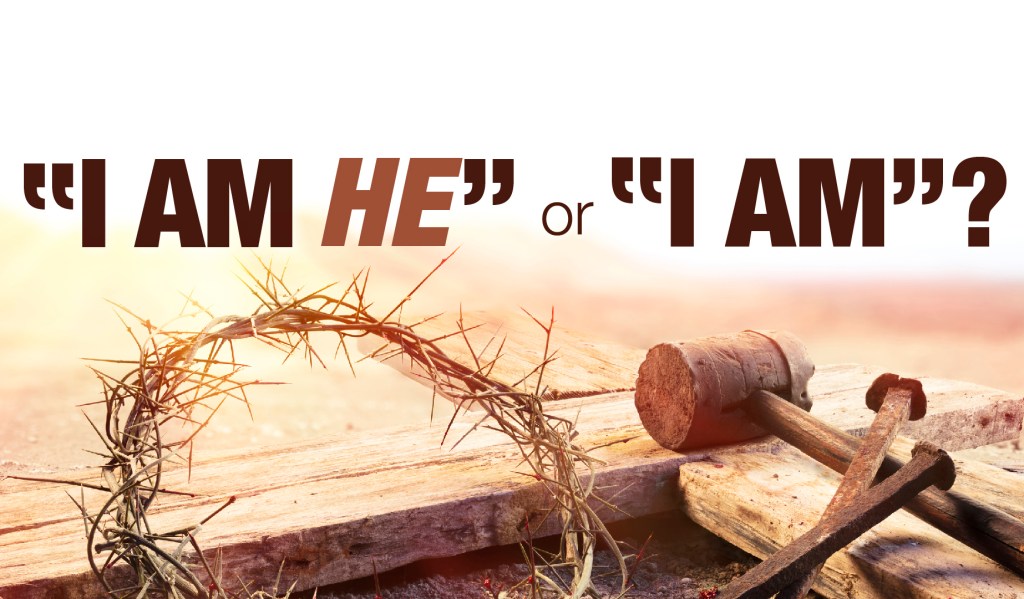
Jesus the I Am

The phrase or title “I am” appears only 18 times in Scripture as a title or complete sentence, at least in the ESV.  In Exodus 3:14-15 the term is asserted as God’s name and would only identify the one true God “throughout all generations”:

14 God said to Moses, “I am who I am.” And he said, “Say this to the people of Israel: ‘I am has sent me to you.’ ” 15 God also said to Moses, “Say this to the people of Israel: ‘The Lord, the God of your fathers, the God of Abraham, the God of Isaac, and the God of Jacob, has sent me to you.’ This is my name forever, and thus I am to be remembered throughout all generations.

I also searched the New Testament alone, and the times Jesus uses the phrase “I am he,” the Greek word for “he” never appears.  The translators apparently inserted it to make the passages “flow better.” So, Jesus is simply using God’s name, “I am,” and applying it to Himself.  There is one verse, of course, where the “he” is not inserted by the translators:  

John 8:58-59 (ESV)  Jesus said to them, “Truly, truly, I say to you, before Abraham was, I am.” 59 So they picked up stones to throw at him, but Jesus hid himself and went out of the temple.

Here the Jews recognized Jesus was claiming the divine name as his own and sought to stone Him for blasphemy.

The term “I am” as part of a phrase such as “I am the Christ, I am able to destroy,” etc.  appears over 300 times in the New Testament and is usually said in passing by most New Testament characters: the centurion, John the Baptist, Peter, and, of course, Jesus as well.  So, this is not an uncommon phrase when a part of a longer phrase.  It is very uncommon as a complete sentence, however and as I said, is only spoken by Jesus in the New Testament.

The most interesting “I am” passage, I think, is in John 18:4-8 where the Temple Guards come to arrest Jesus. Let’s look at it without the “hes” inserted: “Then Jesus, knowing all that would happen to him, came forward and said to them, ‘“Whom do you seek?’” They answered him, “’Jesus of Nazareth.’” Jesus said to them, “’I am.’” Judas, who betrayed him, was standing with them. When Jesus said to them, “’I am,’” they drew back and fell to the ground. So he asked them again, “’Whom do you seek?’” And they said, “’Jesus of Nazareth.’” Jesus answered, “’I told you that I am. So, if you seek me, let these men go.’”

These guards were devout Jews, Temple Guards.  Did you ever wonder why
they drew back and fell to the ground?”  Jesus was using the divine name just as He had with the Pharisees throughout John chapter 8 – 8:24, 28, 58.  It’s no wonder the Jews took up stones to stone Him.  He continually claimed equality with God the Father:

John 5:18 This was why the Jews were seeking all the more to kill him, because not only was he breaking the Sabbath, but he was even calling God his own Father, making himself equal with God.

And:

John 10:33 33 The Jews answered him, “It is not for a good work that we are going to stone you but for blasphemy, because you, being a man, make yourself God.

I’ve done some more research; this time to see where in the book of John the Jewish leaders might have knowingly lied.  They don’t.  The things they said are from a Pharisaic or Mosaic point of view.  Claiming to be the Son of God is claiming equality with God.  Both John and the Jewish leaders recognized this.  The book of John is written to both Jews and Gentiles. That’s why John tells us what it meant.  That is when the Jews began to want to kill Jesus.  He was claiming equality with the Father.

Why is this important?

Having a better understanding of just Who Jesus is and what the Bible says about Him improves our relationship with Him.  Think of your friends or your spouse.  The more you know about them the better you understand them and closer you draw to them.

It’s All True

Prov. 7:1 (ESV)  My son, keep my words and treasure up my commandments with you;

Lately, in classes I teach, I’ve noticed myself repeating the phrase “It’s all true!” The more I study, the more real it becomes personally. I’ve known Jesus for nearly 50 years now, and I’ve known He’s real and the things He said in His Word are true, but it’s been becoming more real to me lately how it is all true, not just the things said in Scripture but the reasoning behind it and the consequences of the life it encourages for its followers.

This verse in the Book of Proverbs leads the reader into warnings against fleshly desires.  So, why should we be careful of these?  Well, giving in to fleshly desires becomes problematic.  Let’s take sex, for instance.  Sex outside of marriage leads to children without a father, venereal disease, attachments to strangers or to people we don’t know well but just feel attracted to, etc.  Saving sex until marriage by both partners leads to none of these.  Here’s the important part: God seems to know what He’s doing giving us guidelines to happier households and reducing the chances of single parent families.

Let’s look at the first of the Ten Commandments, “You shall have no other gods before (or beside) me.”  The worship of other gods had convinced just a little fewer than 1 million Hindus in India to live a vegetarian lifestyle.  Due to this Hindu teaching, about a third of the Indian population lives near starvation.  I wrote a paper in college promoting the Christian evangelization of India as a solution to the starvation in that nation.  My professor was convinced enough to send contributions to Christian organizations working to evangelize India.  The important part is neither my school nor my professor were Christian.  The Christian worldview worked best for the welfare of the Indian population.

The Old Testament had a welfare system.  Gleaning was allowed where the farmers were not to harvest all of their crops but leave some for the poor to collect (glean) enough for their own needs.  They would have to work just as hard as the farm workers for their grain, grapes, and fruit, but they could exist.  The Important part?  This assured the able bodied poor still had to work in order to provide for their families encouraging a good work ethic and self image without having to beg.

If a man still wasn’t able to provide for his family, he could become an indentured servant, with the agreement his master would provide for his family in exchange for their work.  It was a sort of employment where the servant could be freed after a period of time unless that servant wanted to stay on.

Widows unable to fend for themselves could also glean in the fields.  There were also several festivals each year where the widows were to be included.  This helped them to supplement their diets. The important part in all of this is few are uncared for unless they choose to be.

All this got me thinking about how many other things God instructs us in that are true whether one can point to Scripture or not.  Many of the people I speak with are not Christian or “Bible believing” cultists.  I speak with atheists, agnostics, and with some who have no opinion of God and don’t care.  How do we reach them if we can’t use the Bible truth?  We reach them by pointing to things they already believe to be true then point to the Bible to show God said it first.

Let’s take the Big Bang for instance. It was less than 100 years ago that the Big Bang Theory became popular through cosmological observations by Hubble showing the galaxies are moving away from each other.  3500 years ago, Moses said petty much the same thing, that the universe sprang into existence through the effort of an all powerful God.  The cosmologists have no cause for the Big Bang except they know the laws of physics as we know them did not cause it.  In fact those laws didn’t exist prior to the Big Bang. In other words, this universe did not create itself but came from a separate cause.  The Kalam Cosmological Argument would indicate this cause had to be greater than the universe it created, had to be an agent (Person) Who decided to create it, and had to be super intelligent (omniscient) to know how to create this.  The importance: all this points to the God of the Bible.

Why is this important?

What we read in the Bible is true.  The commands and “rules” are there for a reason, for our own good.  If we follow them we will have a happier life, a more fulfilled life, a more peaceful life than those who choose to disregard those guidelines.

Besides that, what we are told in Scripture is not just true in that it “works” (pragmatically true), but it is true because it corresponds to reality (correspondently true).  God knows what He is doing.  He made this universe and gave us a manual to understand how it works and how to live happily within it.  Follow the manual, and things will work generally well for you.  Decide to ignore the manual, and things will work generally poor for you.

Sure Christians face trials, and some are not of their own making, but those trials are meant to make us more like our Lord.  They are teaching devices.  The Christian’s life isn’t always easy, and for some it is almost never easy, but it is easier, it is less of a struggle since we have the peace of the God who created the cosmos and the rule book that came with it.

What the Church has Created

Matt. 19:12-22 (ESV)  Jesus said to him, “If you would be perfect, go, sell what you possess and give to the poor, and you will have treasure in heaven; and come, follow me.” 22 When the young man heard this he went away sorrowful, for he had great possessions.

Somehow over the past few hundred years since the founding of the United States, we have taken Jesus’ words above and have given this responsibility over to government.  We have taken biblical instructions given to us as individual Christians and have applied those concepts to government.  This was a foolish and dangerous move on the part of the American church and the church as a whole.

When government takes money from one individual who has worked for that money and gives it freely to those who have not earned that money even if they are in need, expectations arise that those people in need are entitled to the money of those who work.  This builds resentment in the hearts of the workers whose money is taken (taxed) and given to those who are perhaps able bodied but unwilling to work.  Government is lazy and careless with other people’s money.  So, government taking the place of the individual Christian creates anger, resentment, and waste for both the worker and the recipient.

Biblically, however, an individual who watches his neighbor and helps provide for that neighbor’s needs is seen as a person of fine character who pursues a Christian way of life.  The person receiving the help doesn’t see the Christian as a source for a monthly check but as a person helping in a particular situation.  Often the gift of food or clothing is much more helpful than that of cash.  The recipient feels humble gratitude, a Christian emotion.  The giver feels humbled and blessed to have been able to help his fellow man, another Christian emotion and motivation.

There is no expectation the person receiving the help need not work to provide for themselves if they can.  They are simply being helped through a tough time.  With this method, the biblical method, we see people trying to get themselves out of their struggle and rise to provide for themselves and later even for others. 

With Government providing for those in need, we see family generations living on governmental assistance.  Much of the tax money going to help those in need is also spent to provide the governmental structure needed to provide to millions.  The one-on-one system God has provided in His Word has no waste.  All the money goes to those in need.  It also builds a very strong sense of community.

Why is this important?

The human condition is such that we are happy to have “someone else do it.”  We have given up our responsibility as Christians to lend a hand to those who need one and have let government take over that responsibility. 

One result of this mistake is that people look to government rather than God for help.  A nation becomes more godless, Government becomes the Provider and takes the place of God’s people in the lives of millions.  Churches become fortresses uninvolved in the community, a group of strangers unfamiliar to the local population because Christians are not working to make lives better for all.  That’s now government’s job we believe.

On a large scale, Christians have given up God’s instructions to help the poor – Gal. 2:10  Only, they asked us to remember the poor, the very thing I was eager to do.

Much of the nation’s opposition to “organized religion” is the fault of the Christian falling down on the job of helping others.

The United States last year spent $1.1 Trillion on welfare, nearly one fifth of the federal budget.  This money was spent to help 42 million people.  This amounts to a total cost of $23,809.52 for each man, woman, and child on welfare in the U.S.  Since there were 144 million taxpayers in the U.S. last year, this averages out at just shy of $7,000 per taxpayer.  Imagine what could be done had the Christian community continued to help those in need with that sort of available money.

Christians in America have fallen down on the job and allowed government to take over the job God has given to us.

Temptations

James 1:13-15 (ESV)  Let no one say when he is tempted, “I am being tempted by God,” for God cannot be tempted with evil, and he himself tempts no one. 14 But each person is tempted when he is lured and enticed by his own desire. 15 Then desire when it has conceived gives birth to sin, and sin when it is fully grown brings forth death.

Temptations are a common issue for us as Christians.  We’re tempted to eat what we shouldn’t, smoke, keep something we’ve found rather than look for the owner.  These are all temptations, but are they sins and what are some of the ways we can deal with these?

First let’s look at what James has said.  He is not calling temptation a sin but hanging onto that temptation and turning into a lust or desire that is sin.  Jesus was tempted in all ways as we are but without sin:

Heb. 4:15 (ESV)  For we do not have a high priest who is unable to sympathize with our weaknesses, but one who in every respect has been tempted as we are, yet without sin.

So, if Jesus was tempted yet didn’t sin, we are capable to resist the temptations we face all the time and not sin, but how.

I’m no perfect example, only Jesus is, so I can just tell you the methods I try and which help but don’t always succeed:

Memorize Scripture:  I have memorized a couple of passages of Scripture I can recite – when I have the presence of mind to do so.  One is the passage from James posted above.  Another is 1 Corinthians 10:13 (ESV)  No temptation has overtaken you that is not common to man. God is faithful, and he will not let you be tempted beyond your ability, but with the temptation he will also provide the way of escape, that you may be able to endure it.

The nice thing about these passages is they are fairly long.  By the time I finish reciting one, the temptation has passed or at least softened, and it has moved my mind from that doughnut or cigarette to our Lord and His Word.  This usually helps.

A second method I use is to go cold turkey.  I smoked for 16 years and “quit” several times during that period.  Problem was, I would keep a pack of cigarettes in my glove box just in case I fell.  This is called provision for sin.  I set up myself to fail.  It wasn’t until I coughed all the way to work one morning that I was angry enough with myself to throw five packs of cigarettes and a lighter into a dumpster.  By the way, this man of steel went back the very next day to retrieve them, but the dumpster was empty.  Then I was really disgusted with myself and was able to quit.

About two years ago I decided my addiction to carbohydrates was not doing me any favors.  I’m six foot and weighed 276 lbs.  My doctor said if I ever reached 200 lbs, he’d kiss me full on the lips.  Not being of that ilk, I sought other medical advice but I did reach 200 lbs after 10 months of a very restrictive low carbohydrate diet.  I have frequented convenience stores regularly for years, and I love sugar and baked goods.  To me, convenience stores are nothing more than a framed building surrounding a full variety of temptations.  They were how I got that large, but they also are where I get the copious amounts of diet cola I consume even today.  If I was going to lose the weight and still collect my diet soda, I would have to face temptations head on.  What I did was convince myself I just don’t eat that stuff anymore.  Sure I see it, but before the temptation turned into consumption, I would “Just say no.”  For some of us and for some categories of temptation, that will work.

Ask a friend to hold you accountable.  Sometimes it is necessary to confess your sin to a friend and have him/her hold you accountable for your commitment.  I’ve had friends ask me to hold them accountable for lots of temptations they wouldn’t tell anyone else.  In the case of pornography, there are sites where men can pay a monthly fee to have their computer use monitored and reported to their wives, friends, pastors, etc.  Covenanteyes.com is one of these, but the man needs to be serious.  The friend or wife will get a full account of where they have been online.  These sites are very effective.  Every Man’s Battle, the book by Steven Arterburn, is helpful as well.

Why is this important?

It’s not our temptations that separate us from God but what we do with them.  We need to have tools that help keep us from taking the next step into sin.  The other day, I was in a, you guessed it – a convenience store – and got talking with the young man in front of me.  He was buying cigarettes.  I mentioned the high price compared to the sixty five cents a pack I paid for my last one.  He smiled and told me he had shaken his addiction to heroine and was working on his cigarette habit.  He was smoking to handle the stress he still felt from the addiction to drugs.  I would certainly not fault him for that. Sometimes we need to lean temporarily on a lesser fault to overcome a greater one.

Changing Scripture?

(c)Kevin Eng

Rev. 22:18-19  I warn everyone who hears the words of the prophecy of this book: if anyone adds to them, God will add to him the plagues described in this book, and if anyone takes away from the words of the book of this prophecy, God will take away his share in the tree of life and in the holy city, which are described in this book.

Is anyone who adds to or subtracts from Scripture cursed?  It all depends.  We have lots of ways to interpret this passage:

  1. Are those who add or subtract from the whole Bible cursed?
  2. Are just those who add or subtract from the book of Revelation cursed?
  3. Since translations are not exactly word-for-word the same as the original, are the translators cursed?
  4. There are portions of Scripture which were added accidentally.  Are those who made those additions cursed?

Are those who add or subtract from the whole Bible cursed?  This relates to the second question since Revelation is included in the whole Bible, so I would say, yes.  Now who might this be?  I think it would include translators who have purposely altered a passage to match the beliefs of a person or organization.  The New World Translation would be among these.  The “translators” added words and subtracted words purposely to change the meaning of the original to match the beliefs of their organization.

Are just those who add or subtract from the book of Revelation cursed?  I don’t see how you can get out of this one.  I do believe intent must be present, however.  Can someone accidentally change the book of Revelation and be held accountable.  I would say no.  God looks at our hearts.  If we were not to accept accidental errors or misunderstandings as what they truly are, we would be in a sorry state.  Ours is a God of grace.

Early on, when copies of Scripture were being made, a Scriptorium might be set up with several copyists  present.  A leader would read the Scripture and copyists would write down what they heard.  Sometimes they might hear “warm” rather than “warn” and write “warm” down when “warn” was the word in the text of Rev. 22:18.  God is gracious about this I’m sure.  As a matter of fact, we have more than 5,000 handmade copies of the New Testament, and none of them is exactly like another.  The reasons include this sort of error, misspellings, missed words, duplicated words, and others. 

Since translations are not exactly word-for-word the same as the original, are the translators cursed?  Since many of the Old Testament quotes in the New Testament are from the Septuagint, the Greed translation of the Old Testament, I would say translations are permissible.  If it was good enough for Jesus, Paul, and others, we should see this as a precedent and follow their lead.  The earliest translation of the New Testament was by Jerome and is dated at the end of the fourth century.  This was a translation from Greek into Latin and was done for the Western Church, later known as the Catholic Church. 

Before Jerome’s translation, the Christian world spoke Greek, so a translation wasn’t really needed.  As the Romans became more and more present, their common language, Latin, was widely understood.

There are portions of Scripture which were added accidentally.  Are those who made those additions cursed?  There are portions of the New Testament we are pretty sure were not in the original.  A good example would be Mark 16:9-20.  We believe someone may have added this to their personal copy of Mark very early on and generations of copies made from that manuscript. 

There are many who believe this passage was is included in the original, so don’t take my opinion as certain.  Many respected scholars have taken the conservative approach to include this passage until it is absolutely proven otherwise.

With that said, those who believe it was not in the original manuscript of Mark have a few strong arguments:

  1.  Verse 12 states that Jesus appeared in another form when on the road to Emaus: After that he appeared in another form unto two of them, as they walked, and went into the country. It is central to Christian theology that Jesus rose in the same form as died on the cross.
  2. Verse 16 links baptism with salvation.
  3. Verse 18 says believers can drink poison and pick up deadly snakes and not be harmed.  This verse has caused the lives of many snake handlers in the Christian community.

The earliest and best New Testament manuscripts do not include this passage.

Why is this important?

We need to understand legalism, or more accurately letterism, can keep us from God’s teachings and expressing His mercy.  Yes there have been those in the past who have added to Scripture and taken away from it.  Those who did it for their own devices to profit personally or for their group will be held powerfully accountable, but those who have made innocent mistakes will, no doubt, not be accountable for those mistakes.

In many ways, our God does seem like a very literal God.  But, our God is also a God of grace and forgiveness.  Even those who have willingly perverted Scripture for their own benefit can still be forgiven if only they take the single step toward their Savior.

Covert Ops?

Covert Ops Faith

Acts 17:22-28 (ESV)  So Paul, standing in the midst of the Areopagus, said: “Men of Athens, I perceive that in every way you are very religious. 23 For as I passed along and observed the objects of your worship, I found also an altar with this inscription: ‘To the unknown god.’ What therefore you worship as unknown, this I proclaim to you. 24 The God who made the world and everything in it, being Lord of heaven and earth, does not live in temples made by man, 25 nor is he served by human hands, as though he needed anything, since he himself gives to all mankind life and breath and everything. 26 And he made from one man every nation of mankind to live on all the face of the earth, having determined allotted periods and the boundaries of their dwelling place, 27 that they should seek God, and perhaps feel their way toward him and find him. Yet he is actually not far from each one of us, 28 for “ ‘In him we live and move and have our being’; as even some of your own poets have said, “ ‘For we are indeed his offspring.’

Sometimes we’re faced with an audience with whom we’d like to share our faith who are unfamiliar with the Bible or reject it altogether as reliable.  Yet, they seem ready to learn about the faith we hold dear.  How can we present our faith.

A friend, Jacob, and I teach a witnessing class at our church, and in that class we tell the students they should not just learn the material but should know it well enough to explain it to others.  I think this is a good test of whether we really know what we believe overall: can we explain it to someone who has no understanding at all of what we believe?

In the passage above, Paul is just sort of waiting around for his fellow workers and decides to fearlessly “shoot the breeze” with some of the great Athenian rulers and philosophers of his time.  After all, when you have the truth, what is there to fear from those who do not?

Rather than quote Scripture to them, though, he gave the story of faith: who God is and what He has done for us all.  Among the converts by the way was Dionysius who we believe became the first bishop of Athens.

When we encounter people who have no idea of our faith or what it entails, can we explain our faith as well as Paul did?  Do we know more than just the Scriptures of the Romans Road or the Four Spiritual Laws?  Do we understand our faith so completely we can explain it freely in common language, in common circumstances, using common illustrations?  If not, I think we’ll be caught off guard more often than we would like.

Don’t get me wrong, Scripture is the foremost tool in witnessing.  Having John 3:16 and the Romans Road memorized will always lead to a good discussion and possible conversion.  But can we direct the conversation well enough with explanation alone if necessary as Paul did?

Maybe we have family members who have said they don’t want to hear any more Bible verses or the conversation will end.  I had that happen with my brother and had to wait forty years before I could talk with him seriously about the Lord again.  They know the gospel.  Usually we’ve explained it so often they are sick of hearing about Jesus.  So, what can we say?  Paraphrasing Scripture can be a good direction to take.  God’s Word does not return to Him empty.  “You know God just loves us so much,” or “Do you think people should be punished for their crimes?  God feels that way too and holds us responsible for our crimes against Him, but He offers a pardon.” Sometimes only your example of a Christian life well lived will be the gospel they see.

Why is this important?

In combative situations or situations where the person we are speaking with has no concept of God’s love for them, we can still make a dent, “put a pebble in their shoe,” as Greg Koukl likes to say.  The Holy Spirit can use these efforts to remind them of how much He loves them.

We should seek to explain what we believe clearly and plainly.  We can share Scripture without telling others where it came from.  These are effective ways to begin to plant and water the Gospel in the lives of others.

When the person is ready to hear the direct path to God the Father through Jesus Christ, they will be more receptive to direct Scripture.

This is situational, of course.  When we speak with cultists who turn to the Bible for guidance, we can guide them to the passages of Scripture which directly apply.  They will accept those.  When we speak with atheists, though, we often need to be a little more covert.