
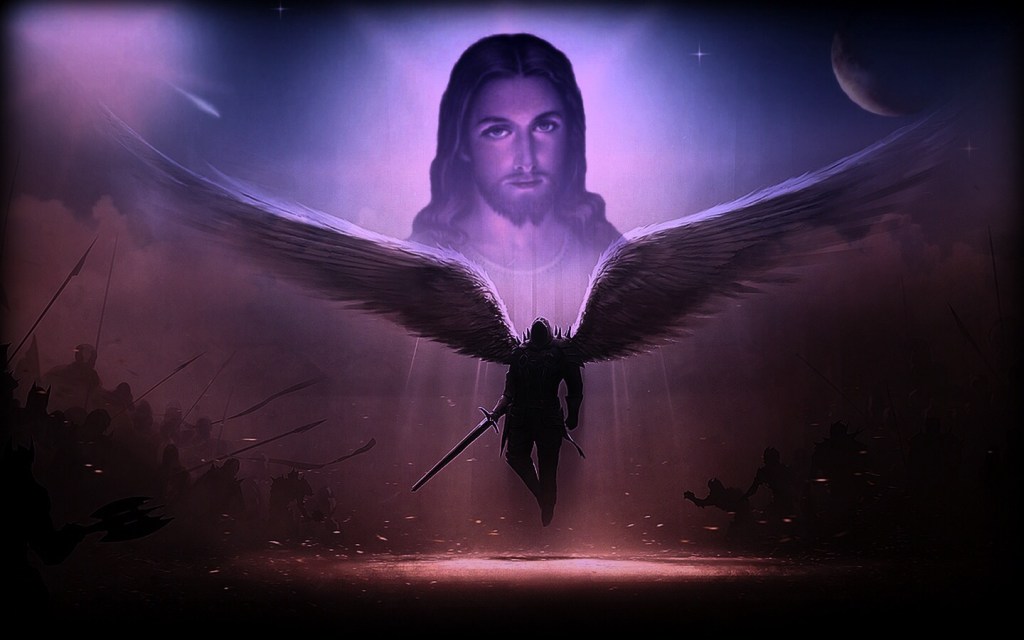
Today, many people believe the word angel means only one thing: the beings we see once in a while in Scripture who appeared at Jesus’ tomb (Matt. 28:2-7) or the angels who visited Abraham (Genesis chapters 18-19). But the mistake is often made that this is the only type of angel mentioned in Scripture.
It turns out the word angel means messenger in both Hebrew and Greek. The beings we know as angels are messengers of God created to perform the tasks God calls upon them to do. In the Old Testament (ESV), the Hebrew word for angel (malak) is translated in 110 verses as angel, 98 verses as messenger, four times as envoy, and once as ambassador. In the New Testament (ESV), the Greek word for angel (angelos) is translated 168 times as angel and 7 times as messenger.
So, neither the Hebrew nor the Greek word translated as angel always means the creature we call an angel. Sometimes the original language is describing an envoy, messenger, or even an ambassador. It is a logical fallacy known as the equivocation fallacy which confuses many people. The equivocation fallacy is switching the meaning of a key term mid-argument to make the logic seem valid when it isn’t.
Here’s a really silly but accurate example:
“Feathers are light.
What is light cannot be dark.
Therefore, feathers cannot be dark.”
With that understood, let’s move on to the original question, “Is Jesus an Angel?”
Most conservative theologians believe Jesus appeared in the Old Testament and was called The Angel of the Lord (not an angel of the Lord, by the way). This term appears in Gen. 16:7 where He speaks with Hagar, in Genesis 22:11-12 when the Angel of the Lord speaks to Abraham and identifies Himself as YHWH: “But the angel of the Lord called to him from heaven and said, ‘“‘Abraham, Abraham!” And he said, “Here I am.” 12 He said, “Do not lay your hand on the boy or do anything to him, for now I know that you fear God, seeing you have not withheld your son, your only son, from me.” Abraham was not sacrificing to a created angel.
Most obviously, the Angel of the Lord is God Himself. This is clear in Exodus 3:2-6 2 And the angel of the Lord appeared to him in a flame of fire out of the midst of a bush. He looked, and behold, the bush was burning, yet it was not consumed. 3 And Moses said, “I will turn aside to see this great sight, why the bush is not burned.” 4 When the Lord saw that he turned aside to see, God called to him out of the bush, “Moses, Moses!” And he said, “Here I am.” 5 Then he said, “Do not come near; take your sandals off your feet, for the place on which you are standing is holy ground.” 6 And he said, “I am the God of your father, the God of Abraham, the God of Isaac, and the God of Jacob.” And Moses hid his face, for he was afraid to look at God.
We looked at a few weeks ago at how the equivocation fallacy confuses some to believe that claiming someone to be God is claiming they are the Father. No, this is just pointing to the deity of the person and that His nature is equal with the Father but not the Father.
Now that we’ve seen The Angel of the Lord is God Himself, we need to identify The Angel of the Lord. Who is exactly He? The Angel of the Lord (YHWY) identifies Himself as the I AM in Exodus 3:14-15. That is His name:
14 God said to Moses, “I am who I am.” And he said, “Say this to the people of Israel: ‘I am has sent me to you.’ ” 15 God also said to Moses, “Say this to the people of Israel: ‘The Lord, the God of your fathers, the God of Abraham, the God of Isaac, and the God of Jacob, has sent me to you.’ This is my name forever, and thus I am to be remembered throughout all generations.
Then in John 8:58-59 Jesus says He is that Person, and the Jews wanted to kill Him for what they saw as blasphemy:
58 Jesus said to them, “Truly, truly, I say to you, before Abraham was, I am.” 59 So they picked up stones to throw at him, but Jesus hid himself and went out of the temple.
Jesus identified Himself as the same person who appeared to Moses in the burning bush. Have you ever wondered why the temple guards who came to arrest Jesus in the Garden fell back when He identified Himself:
John 18:4-6 (ESV) Then Jesus, knowing all that would happen to him, came forward and said to them, “Whom do you seek?” 5 They answered him, “Jesus of Nazareth.” Jesus said to them, “I am he.” Judas, who betrayed him, was standing with them. 6 When Jesus said to them, “I am he,” they drew back and fell to the ground.
The temple guards fell back because Jesus did not say “I am he” but “I AM.” The “he” is not there in the Greek. The guards fell back at the use of the divine name. Jesus identified Himself as God by nature, the same God who spoke to Moses.
Why is this important?
The Son (Jesus) voluntarily became obedient to the Father (Phil. 2:5-8). He is equal to the Father in nature and all other ways but took a submissive role to accomplish God’s plan. Jesus is greater than all the angels (Heb. 1:4-8)
To be confused concerning just who Jesus is to be wrong enough to spend eternity without God. The Bible warns us to beware of this:
2 Cor. 11:3-4 (ESV) 3 But I am afraid that as the serpent deceived Eve by his cunning, your thoughts will be led astray from a sincere and pure devotion to Christ. 4 For if someone comes and proclaims another Jesus than the one we proclaimed, or if you receive a different spirit from the one you received, or if you accept a different gospel from the one you accepted, you put up with it readily enough.
A created angel you call Jesus is not the Jesus of the Bible. To ask that angel for salvation will do nothing but result in you praying to another God than the God of the Bible. Beware.
 Believers Armed and Dangerous