
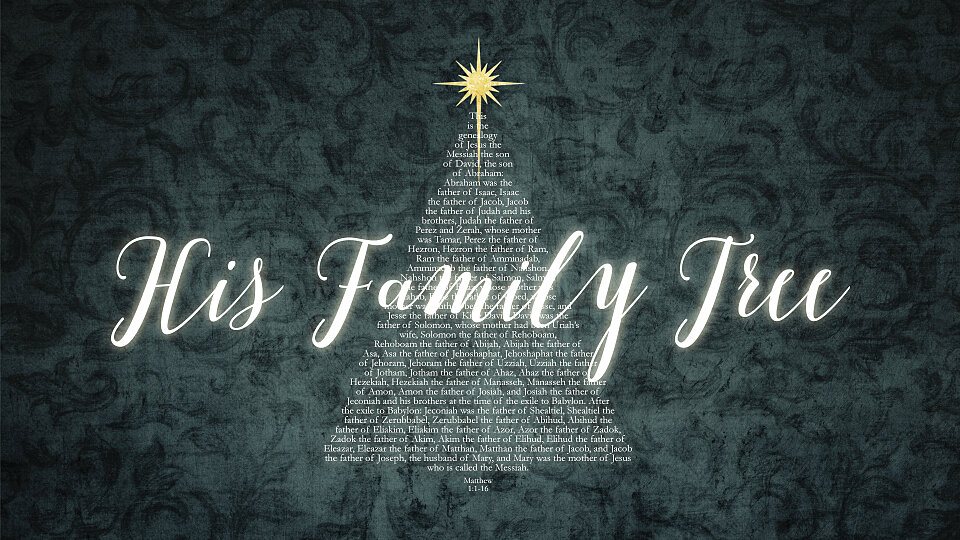
Sometimes we look at the genealogies in Scripture and just see a long list of names (Jesus’ genealogy in Luke has 77 names listed) and think it would be boring to read all those names. But we do read them because God says all Scripture is inspired and beneficial. The genealogies we are given of Jesus may be among the ones we are tempted to skip, but maybe after reading this, we won’t be so tempted.
There are two genealogies for Jesus presented in the Gospels. The genealogy in Matthew runs through Joseph’s line and shows Jesus is the rightful king of the Jews. It begins with Abraham, the father of the Jewish nation, emphasizes David’s kingship, and traces His genealogy through Solomon and the royal line. There are also at least fifteen kings listed in the genealogy of Jesus in Matthew.
Interestingly, there are also five women mentioned in Matthew’s genealogy as well:
Tamar (Genesis 38) is the first woman mentioned. She played the harlot with her ex-father-in-law, Judah, because he withheld his youngest son from her, which was his legal duty. The Mosaic Law, which condemns this, had not yet been written, and Tamar is not condemned for this.
Rahab (Josh. 2) is the next woman mentioned. She really was a harlot by profession and a Gentile from Canaan. She helped the Israelite spies when they came to Jericho and is the only one of the five women explicitly listed in the “Hall of Faith” (Heb. Chapter 11).
Ruth (Ruth 1:1-22) is the third woman mentioned. She was a Gentile, as well, from the land of Moab, but she adopted the Israelite way of life as her own and married Boaz, thereby entering into the line of David.
“The wife of Uriah” (Bathsheba – 2 Samuel 11:2-27) who committed adultery with King David. There are several speculations over why Bathsheba is not directly named: 1. It draws attention to David’s responsibility in Uriah’s death, 2. God’s plan works through flawed human history, 3. It centers the event on David’s moral failure, 4. It shows God’s inclusiveness and providence.
Mary (Matt. 1:18) was a young Jewish woman chosen by God for the greatest mission given to a woman of faith: the virgin birth of our Savior.
Matthew’s record of Jesus’ genealogy tells us there is redemption for all, from an adulterous king to a fallen patriarch, to Gentiles, sinners, shepherds, to the virgin mother of our Savior; no one is left out.
Luke’s genealogy of Jesus is a bit different. While Matthew’s genealogy begins at Abraham, the father of the Jewish people, Luke’s counts back to Adam, the father of man. David is the only king mentioned, as this is Jesus’ genealogy through Mary, and since it was written to Gentiles, the kingly line held no significance for them. Here, Jesus’ line from David comes through his son, Nathan. Luke’s is also reversed from Matthew’s, going from Jesus back through Adam to God. Matthew starts with Abraham and goes forward. And Luke gives 77 generations as compared to 42 for Matthew.
Why is this important?
There are a number of reasons these genealogies are important to the believer:
Matthew shows Jesus legal right to the throne of David, the Son of David. Luke connects Jesus to all of humanity, He is the Son of Man and the Savior for both Jews and Gentiles.
Matthew shows us salvation is offered to all levels of social strata, Luke shows us faithful obedience of ordinary people is rewarded.
Jesus is connected to the covenants of Scripture: the Abrahamic (Matt. 1:1), Davidic (Matt. 1:6), and brings the Adamic connection (Luke 3:38)
Most importantly, the genealogies confirm Jesus as the Messiah in fulfillment of Old Testament prophecies about David and Abraham. They show God works through imperfect people to accomplish redemption, and it supports the doctrine of the incarnation: Jesus is fully biologically human as the Son of Man and fully divine as the Son of God.
 Believers Armed and Dangerous