
The New World Translation

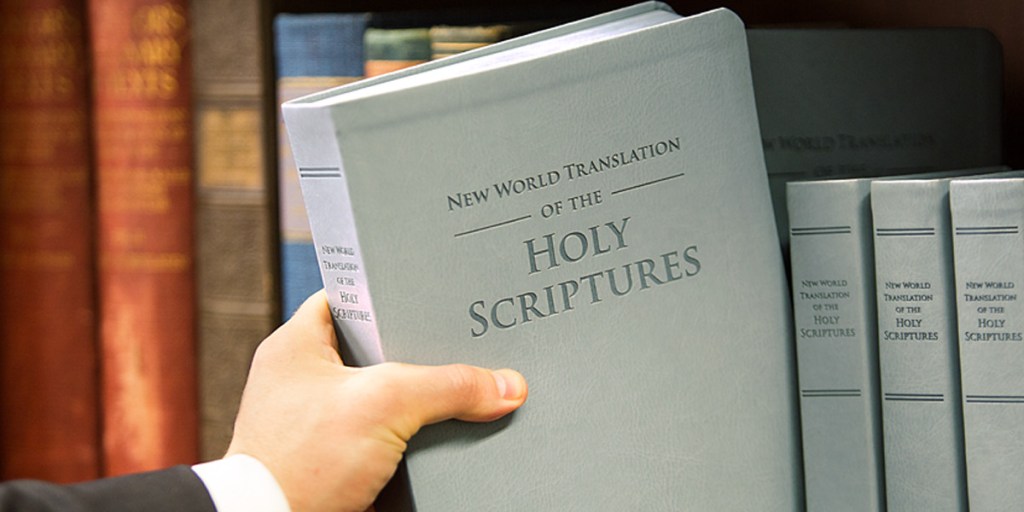
A couple of weeks ago, the post on this blog was about translations, their types, styles, and purposes.  This week, I thought I’d give you a sense of what can be done to a translation that will mislead the reader into believing things the Bible just doesn’t teach.  I will be using the New World Translation (NWT, henceforth) published by the Watchtower Bible and Tract Society (Jehovah’s Witnesses).  It falls into the category of “Confessional/Theologically Guided Translations: Doctrine influences this translation type and so may adjust wording to align with theology.”

I will call this a translation only for convenience.  Raymond Franz, a member of the Governing Body of Jehovah’s Witnesses from 1971 until he resigned in 1980, tells us the  following about the translation committee in his book, Crisis of Conscience:

“The New World Translation bears no translator’s name and is presented as the anonymous work of the ‘New World Translation Committee.’ Other members of that committee were Nathan Knorr, Albert Schroeder and George Gangas. Fred Franz, however, was the only one with sufficient knowledge of the Bible languages to attempt translation of this kind. He had studied Greek for two years at the University of Cincinnati but was only self-taught in Hebrew.” (p. 94)

According to Mr. Franz, the NWT is not a work produced by scholars, but by those seeking a Bible that would support their views without the usual explanations of why other translations do not.  Let me give a couple of examples. 

Jehovah’s Witnesses believe the Holy Spirit is not the third Person of the Trinity but only God’s active force.  Hence, their translation of Genesis 1:2 is as follows:

Gen. 1:2 (NWT)  Now the earth was formless and desolate, and there was darkness upon the surface of the watery deep, and God’s active force was moving about over the surface of the waters.

Sound unfamiliar?  If it does to most Bible readers because a modern, word-for-word, peer-reviewed translation like the English Standard Version (ESV henceforth) translates the same passage like this:

Gen. 1:2 (ESV)  The earth was without form and void, and darkness was over the face of the deep. And the Spirit of God was hovering over the face of the waters.

You can see what the NWT translation committee has done here: they have inserted their doctrine into the passage so their followers might more readily accept it.  But this is not how you translate the Bible honestly.  The Hebrew word is ruh and is universally translated as spirit except in the NWT.  So the Watchtower organization wants the reader to think God’s spirit is a force like electricity or a laser beam.

You might ask, “But have they ever influenced important doctrines this way?”  Funny you should ask.  They’ve done just that in Colossians:

Col. 1:16-18 (NWT)  because by means of him all other things were created in the heavens and on the earth, the things visible and the things invisible, whether they are thrones or lordships or governments or authorities. All other things have been created through him and for him. Also, he is before all other things, and by means of him all other things were made to exist, and he is the head of the body, the congregation. He is the beginning, the firstborn from the dead, so that he might become the one who is first in all things;

Now look at the same passage in the ESV:  For by him were all things created, that are in heaven, and that are in earth, visible and invisible, whether they be thrones, or dominions, or principalities, or powers: all things were created by him, and for him: 17 And he is before all things, and by him all things consist. 18 And he is the head of the body, the church: who is the beginning, the firstborn from the dead; that in all things he might have the preeminence.

Do you notice the difference between the two?  The NWT has inserted the word other into their translation four times in these three verses.  The word other is not there in the Greek.  It was inserted on purpose to make their readers believe Jesus was one of the things created rather than the almighty Creator.  This is a push to try and influence those who know no better that Jesus is not God the Son.

Why is this important?

Today’s culture has worked hard to give truth a very low priority, and translators such as those of the NWT have joined in that crusade.  “Truth is different for you than it is for me,” or “my opinion is just as valid as your facts” are statements that are more and more acceptable.  To keep from being fooled, we need to look at original sources, not what others say the original source says.

The NWT and others like it are a plea for Christians to do their homework, to check things, to look at respected translations and scholars and not just one or two but dozens.  The Bible commands us to test ALL things, and that means even the Bible in which that command appears.  It is God’s command, and He honors it.

1 Thess 5:21 (ESV)  but test everything; hold fast what is good.

The Two Minds Theory

In past blog posts, I’ve discussed both simple and complex things.  Some ideas are easy to grasp, others are harder.  I came across this theory, The Two Minds Theory, last year while reading Thomas Morris’s book The Logic of God Incarnate (1986), although “tastes” of the concept – that Jesus acted as man at times and as God at others – are almost as old as the church.

I think an explanation of the Two Minds Theory is more easily explained if I start with the problems it solves.  The Church has historically taught that Jesus is fully God and fully man.  While most theologians see this in Scripture, they have problems with Jesus not knowing the time of His return (Mark 13:32), being tempted (Heb. 4:15), and growing in wisdom (Luke 2:52).  The problems are how could God be omniscient and not know when He would return, how could a holy God be tempted to sin, and how could God grow in wisdom?  These are human frailties.

One answer to this is that Jesus turned over the use of His attributes as God to the Father when He took on human form.  This would mean He was not all-knowing, didn’t know He couldn’t sin, and so could be tempted, and grew in wisdom as any other human.

Morris’s book makes a distinction between being merely human and fully human, between being merely God and fully God.  What he means by these terms is that we are probably merely human.  We believe we will become something greater: 1 Cor. 15:51-52 (ESV)  Behold! I tell you a mystery. We shall not all sleep, but we shall all be changed, 52 in a moment, in the twinkling of an eye, at the last trumpet. For the trumpet will sound, and the dead will be raised imperishable, and we shall be changed. At that time, says Morris, we shall be fully human.  So, we currently don’t have the full set of attributes or don’t have the attributes fully that someone who is fully human has.

Being merely God and fully God is similar, according to Morris.  If Jesus turned over the use of His attributes to the Father, and no longer acted as God, was He merely God?  Did He qualify as God by nature, but was not the ruler of the universe for those 33 years He walked the earth?  Historic Christianity says “no.”  Jesus is fully human and fully God.

With that in mind, Morris asks how Jesus could be fully God (exercising all the attributes and powers that qualifies a being to qualify as fully God) yet could be tempted, not know when He would return, and grow in wisdom.

Humans have finite minds. If Jesus is fully human, He would need to have a finite mind to go with that.  If He is fully God, He would need an infinite mind to go with that.  These seem contradictory.  Morris again says “no.”  As the omnipotent God (the Son), Jesus could reserve a finite mind within the infinite mind of God and give His human nature access to it.

Sometimes when we dream, we know we are sleeping and can even affect the way the dream goes.  Our mind is in two places: we are aware we are asleep in bed, but there is also a portion of our mind that is aware of our dream.  Morris says this is how the two minds could work.  God the Son would be fully aware of all that is usual for His being fully God and allow for a finite portion of His mind to be aware to His human nature.

There is a heresy known as Nestorianism which states Jesus was two persons: a human person and a divine person.  This is not that.  Morris is saying Jesus and God the Son are the same Person.  In philosophy we say they are numerically identical.

Why is this important?

The Two Minds Theory seems to solve a lot of incarnation problems faced by theologians over the centuries.  Jesus’ human nature had a finite mind and so could be tempted, not knowing He couldn’t sin, grow in wisdom, and not know when He would return.  At the same time, the same Person, God the Son, would be fully God and rule the universe as usual. Morris is attempting to solve that.

There isn’t a lot written on this.  Morris’s book as well as Davis and Yang’s book An Introduction to Christian Philosophical Theology are the only books I’ve seen on the topic. 

Theories like this need peer review and criticism. I haven’t found that yet. So, take this with a grain of salt. Some theologian may find an issue, pull on it, and the entire house of cards collapse. I just thought it would be interesting enough that the theologians among you would like to consider the theory.

Bible Translation Types and Why

I thought it might be good to look at the types of English Bible translations available, along with their various focus, strengths, and limitations.  Some of you may be wondering what translation would best suit you and why some translations seem so different from others.  I thought this might be helpful. 

We will look at them from the most accurate to the original text to the least:

  •  Interlinear or Ultra-Literal: This is the most transparent to the original text.  It shows direct word alignment with original languages along with morphology and word order.

Its strength is maximum transparency and is ideal for textual and linguistic analysis.

Its major limitations are that you can’t read the thing.  It pretty much requires a knowledge of the original languages.

Examples: Greek-English Interlinear or a Hebrew-English Interlinear.

  • Formal Equivalence (Word-for-Word):  This is the highest quality readable translation type.  It preserves as much grammar, syntax, and terminology as possible.

Its strengths are that it provides the best balance of accuracy and usability with minimal theological interpretation.

Its major limitations are that it can sound awkward and the figures of speech may be unclear.

Examples: NASB (1995, 2020), ESV, NRSV, KJV

  • Optimal/Mediating Equivalence: This form leans toward formal but smooths where the English requires it.

Its strengths are that it is generally faithful while readable.  As a result, it is often used in both academic and church settings.

Its major limitation is that it may include interpretation to make it more readable.

Examples: CSB, REB, TNIV

  • Dynamic Equivalence (Thought-for-Thought): This prioritizes meaning over form.  It translates ideas rather than exact wording.

Its strengths are that it is clear, accessible, and communicates the sense of the passage to the modern reader.

It is limited in the sense it loses verbal precision and includes more translator interpretation.

Examples: NIV, NLT, GNT (Good News Translation)

  • Functional/Reader-Response Equivalence: This type attempts to focus on how the original audience would have felt or understood the text.

The strength here is strong cultural clarity.

Its limitation is that we are starting to creep further from the original wording and relying more on the translator’s interpretation.

Examples: CEB (Common English Bible), CEV (Contemporary English Version)

  • Expanded/Amplified Translations:  These insert additional possible meanings into the text itself.

The strength here is that it is helpful for word studies.

The limitations are that it blurs translation to provide commentary and is less reliable as a stand alone text.

Example: AMP (Amplified Bible)

  • Confessional/Theologically Guided Translations: Doctrine influences this translation type and so may adjust wording to align with theology.

The strength is that it is internally consistent, though it may not be consistent with the text.

The limitation, of course, is the risk of doctrinal bias overriding the linguistic evidence.

Examples: NWT (New World Translation), Orthodox Study Bible, New Jerusalem Bible

  • Paraphrase: This is the least reliable for conveying the original text as it rewrites Scripture in a modern form.

The strength is that it is readable and is often used as a devotional Bible.

The limitations are that it is not a translation in the technical sense but reflects the author’s interpretation more than the original wording.

Examples: MSG (The Message), TLB (The Living Bible)

Why is this important?

Translation types and styles are very important and provide a variety of sources for the Christian.  If we are looking for a relaxing devotional time, we might reach for a paraphrase to get the overall meaning of a passage.  If we wanted to do an in-depth study of that passage, though, we would be much better served by picking up a Formal Equivalence translation, which will give us a much more accurate picture of the words and order of the words the original writer wanted to convey.

Also be aware that there are Bibles out there that are extremely doctrinal such as a theologically guided translation, which can heavily interpret a passage to match what the denomination (NJB-Catholic) or cult (NWT-Jehovah’s Witnesses) teaches.

Or, maybe you might want something less wooden yet close to the text.  The Mediating Equivalence form might be more to your liking.

Whatever your needs or tastes, know what you’re getting when you buy a Bible.  Remember, the original documents are inspired, not the translations.  The farther we move away from a translation from the originals, the more interpretation slips in.

What is God?

Deut. 4:15-19 (ESV)  “Therefore watch yourselves very carefully. Since you saw no form on the day that the Lord spoke to you at Horeb out of the midst of the fire, 16 beware lest you act corruptly by making a carved image for yourselves, in the form of any figure, the likeness of male or female, 17 the likeness of any animal that is on the earth, the likeness of any winged bird that flies in the air, 18 the likeness of anything that creeps on the ground, the likeness of any fish that is in the water under the earth. 19 And beware lest you raise your eyes to heaven, and when you see the sun and the moon and the stars, all the host of heaven, you be drawn away and bow down to them and serve them, things that the Lord your God has allotted to all the peoples under the whole heaven.”

This passage speaks of God’s address to the people of Israel at Horeb (the area of Sinai where Moses received the Law – Ex. 19:7-9).  Notice God speaks of not having a physical form for God is spirit (John 4:24).  Spirits do not have physical forms.

This could well be one reason God does not want us to produce any images of Him.  After all, how do you produce an image of something which has no physical form?  So if God has no physical form but we give Him one, we have changed what God is.  It’s a little like the argument against God changing His mind:  If God were to change His mind, would He change it for the better or for the worse?  Since He is omnibenevolent (infinitely good), He has “made up His mind” to do what is best.  There can be nothing better.  For the same reason, He cannot choose something worse.  By nature He wants what is best.

The same logic applies here.  Since God is the greatest of all possible beings, making an image of Him would lessen what He is by limiting Him to a physical form or representation.

An Obvious Problem:

Then what do we do with all those who say they saw God: Abraham, Moses, Jacob, Isaiah, Ezekiel, elders of Israel, and of course those who saw Jesus?

In Genesis Chapters 18 and 19, Abraham speaks with a man identified as YHWH: Gen. 18:1-2 (ESV)  And the Lord appeared to him by the oaks of Mamre, as he sat at the door of his tent in the heat of the day. He lifted up his eyes and looked, and behold, three men were standing in front of him. When he saw them, he ran from the tent door to meet them and bowed himself to the earth

In Genesis 32:24-28 Jacob also saw God in the form of a man: 24 And Jacob was left alone. And a man wrestled with him until the breaking of the day. 25 When the man saw that he did not prevail against Jacob, he touched his hip socket, and Jacob’s hip was put out of joint as he wrestled with him. 26 Then he said, “Let me go, for the day has broken.” But Jacob said, “I will not let you go unless you bless me.” 27 And he said to him, “What is your name?” And he said, “Jacob.” 28 Then he said, “Your name shall no longer be called Jacob, but Israel, for you have striven with God and with men, and have prevailed.”

Then, of course, Jesus appeared in the likeness of men (Phil. 2:5-7).  This passage also says Jesus was not always “in the likeness of men” but was originally in the form of God (vs. 6).  The word form in both verses 6 and 7 is the same, morphe, and in the same context, so if Jesus was a man while He walked the earth, then He was also just as assuredly God.

I get from this that God can take the form of man at will just as the two angels did in Luke 24:4 (ESV)  While they were perplexed about this, behold, two men stood by them in dazzling apparel.  These two are identified as angels by John: John 20:12 (ESV)  And she saw two angels in white, sitting where the body of Jesus had lain, one at the head and one at the feet.

What Isaiah (6:1-5), Ezekiel (10:20), and Amos (9:1) saw were visions.  They did not see God directly.  Moses saw God’s glory or goodness, but not God Himself (Ex. 33:18-23).

Why is this important?

We can make God into something He’s not if we’re not careful.  He’s not our servant, not our idol, not a photograph on the wall, a cross in our bedroom, nor a limited Being.  There are gods created every day.  Some put make up on their god or shave his face every morning.  These are only gods because people have made them so, but there is only one God by nature:

1 Cor. 8:5-6 (ESV)  For although there may be so-called gods in heaven or on earth—as indeed there are many “gods” and many “lords”— yet for us there is one God, the Father, from whom are all things and for whom we exist, and one Lord, Jesus Christ, through whom are all things and through whom we exist.

God is Worthy

I’ve been reading through the books of Moses lately and was stuck by the detail God requires in the building of the tabernacle and its accessories.  The Menorah, for instance, takes ten verses (243 words) alone to describe.  God has very specific requirements for His house.  He covers every detail He wants, every carving, every curtain, the fabric, the design, everything.  Assignments like these would be difficult to impossible for even the most skilled craftspeople, but God has made arrangements for that issue as well:

Exodus 31:1-11 (ESV)  The Lord said to Moses, “See, I have called by name Bezalel the son of Uri, son of Hur, of the tribe of Judah, and I have filled him with the Spirit of God, with ability and intelligence, with knowledge and all craftsmanship, to devise artistic designs, to work in gold, silver, and bronze, in cutting stones for setting, and in carving wood, to work in every craft.  And behold, I have appointed with him Oholiab, the son of Ahisamach, of the tribe of Dan. And I have given to all able men ability, that they may make all that I have commanded you: the tent of meeting, and the ark of the testimony, and the mercy seat that is on it, and all the furnishings of the tent, the table and its utensils, and the pure lampstand with all its utensils, and the altar of incense, and the altar of burnt offering with all its utensils, and the basin and its stand, 10 and the finely worked garments, the holy garments for Aaron the priest and the garments of his sons, for their service as priests, 11 and the anointing oil and the fragrant incense for the Holy Place. According to all that I have commanded you, they shall do.”

So, God has extreme requirements for His Tabernacle, requirements so great He needed to supernaturally gift already talented craftsmen to complete the tasks.

While thinking about this, I began to think “God isn’t showy.  He doesn’t present Himself as a prideful God.  After all, He stepped down from the grandest throne, the throne of heaven, to be born in a stable as a human, wash the feet of men, allow lowly men to torture Him, then carried a cross Himself – the symbol of His greatest humility – to the place where He allowed humans to execute His human form.  On top of that, He calls us fellow workers, friends, and brothers. That is not a prideful God.”

“Why, then, does He feel the need for such splendor in His Tabernacle,” I wondered.  Then it came to me.  It was not pride that required such beauty but worthiness.  God is worthy of such majestic a structure.  As the old saying goes: “It ain’t bragging if you can do it.”  Well, with God, it isn’t bragging if it’s who you are.

There’s a respect that comes with who someone is and/or what they’ve done.  Veterans, for instance, often hear “Thank you for your service” because they are worthy of such a statement.  We stand when a judge enters the courtroom to show due respect for their office.  For the same reasons, God is worthy of the best and finest not because He is prideful, but because He is due such respect and adornment.

Because of God’s character, nature, actions, and relationship with humanity, He is worthy of our worship, trust, and obedience.   But, it isn’t that that makes Him worthy.  He is worthy by His nature alone.  He is omnipotent, omniscient, omnipresent, immutable, holy, and omnibenevolent. 

Anselm of Canterbury said God is “That than which nothing greater can be conceived.”  It is understood, then, that if we could imagine anything greater, that would be God.  Such a God is worthy of all He asks.

Why is this important?

It’s difficult to wrap our minds around the concept of God’s nature, What God is rather than Who He is.  I hope this has helped a little, but I’m only human like you.  Certainly I don’t have all the answers or even many of them.  I just know the God we serve is worthy of all we and the hosts of heaven can give Him and then some.

If God had a business card, what more could it say than just “God?”  I think that’s why, when Moses asked His name in Exodus 3:14, God just said “I am that I am.”  What more is there?

When Did the Church Begin?

Christmas will be here in less than two weeks, and some of us will be sitting around the table with assorted family and friends who think Christianity is some sort of fairy tale, a fraud perpetrated on simple, illiterate, and naïve followers two thousand years ago.  So, maybe it would be good to brush up on some of the facts to present to these skeptics. 

Did Jesus exist, and did He rise from the dead?  While some are educated well enough to know there was a historical figure named Jesus who walked the earth back around 30 or 40 a.d., some will deny He even existed at all.  Well, Jesus is mentioned by such early historians as these:

Flavius Josephesus (37-100 a.d.) who mentions Jesus as a teacher and even speaks of His brother, James. 

Tacitus (56-120 a.d.) who speaks of Jesus’ execution. 

Pliny the Younger (61-113 a.d.) who confirms the worship of Jesus as a common Christian practice.

These three are especially important since they are non-Christian historians and wrote within the lives of the apostles or their followers and could have been checked and denied if incorrect.

Then there is a near-consensus of well-known and respected modern secular Greek New Testament scholars as well who believe at least seven of  Paul’s letters are genuine.  Here are ten:

  1. Bart D. Ehrman (agnostic / atheist-leaning, Greek textual critic)
  2. Gerd Lüdemann (atheist, German Greek scholar)
  3. Paula Fredriksen (Jewish historian, secular)
  4. E. P. Sanders (secular historical scholar)
  5. James D. G. Dunn (critical scholar; widely used in secular universities)
  6. Maurice Casey (atheist, Aramaic & Greek specialist)
  7. Raymond E. Brown (critical scholar, non-evangelical)
  8. Dale C. Allison Jr. (critical historian)
  9. Martin Hengel (critical historian, Greek philologist)
  10. Larry Hurtado (critical scholar of early Christianity)

“Genuine” here means: written in the 1st century, substantially authentic texts (what Paul actually wrote and not medieval forgeries), and—where applicable—authored by the traditionally named author (Paul).  It does not mean inspired, miraculous, or theologically true.  These are the seven books:

  • Romans
  • 1 Corinthians
  • 2 Corinthians
  • Galatians
  • Philippians
  • 1 Thessalonians
  • Philemon

The book of Galatians is of particular importance in that it speaks of Paul going to Jerusalem three years after his conversion to compare notes with Peter for a couple of weeks (Gal. 1:18).  Then Paul began his missionary journeys.  In the same book, Paul tells us he returned 14 years later to compare what he was teaching to make sure it was still consistent with the gospel Jesus had taught (Gal. 2:1-2).  Paul recorded in another of his books, which is considered genuine, exactly what he was teaching during those 14 years:

1 Cor. 15:3-8 (ESV)  For I delivered to you as of first importance what I also received: that Christ died for our sins in accordance with the Scriptures, that he was buried, that he was raised on the third day in accordance with the Scriptures, and that he appeared to Cephas, then to the twelve. Then he appeared to more than five hundred brothers at one time, most of whom are still alive, though some have fallen asleep. Then he appeared to James, then to all the apostles. Last of all, as to one untimely born, he appeared also to me.

Most historians believe Paul was converted about three years after the crucifixion of Jesus.  Since he waited three years in personal study and preaching before meeting with Peter, that would make his first visit just six years after the crucifixion, not enough time for a legend to develop.  There were too many people still living who were aware of the truth, and the teaching of Peter was being done in the very city where Jesus was crucified.

Consider this: It’s 1969, and you’re in Houston, Texas, and someone comes to you and says he is starting the Church of the Risen John F. Kennedy.  You would laugh him to scorn because the whole idea was silly.  We saw JFK die and buried.  We can go to the tomb and show you he’s still there.  The whole city knows this.

Now, it’s 39 a.d., and you’re in Jerusalem.  One of Jesus’ followers comes to you and says Jesus of Nazareth was crucified.  This isn’t news.  The whole city was aware of this.  But then the man takes you to the empty tomb and introduces you to over 500 men who saw Him risen from the dead many of whom saw Him do miracles while He walked the earth.  Maybe you could even meet Lazarus and his family and listen to their story.  That’s how the church started, but it started even earlier than that (Acts chapter 2).

I’d like to make one more point.  We’ve pretty much settled that Paul met with Peter in Jerusalem only about six years after the crucifixion of Jesus.  Look at Galatians again and what had happened during the six years:

21 Then I went into the regions of Syria and Cilicia. 22 And I was still unknown in person to the churches of Judea that are in Christ. 23 They only were hearing it said, “He who used to persecute us is now preaching the faith he once tried to destroy.” 24 And they glorified God because of me.

Within those six years, there were already churches outside of Jerusalem in Judea. 

So, here is some evidence which can be presented to the skeptics at your Christmas dinner – or anywhere, for that matter.  The Church began at Pentecost, and Peter and Paul taught Jesus rose from the dead. God has not left us with a blind faith but with a faith founded on fact.

Remember the Promises

Remember on the Promises

Genesis 15:18-21 (ESV)  On that day the Lord made a covenant with Abram, saying, “To your offspring I give this land, from the river of Egypt to the great river, the river Euphrates, 19 the land of the Kenites, the Kenizzites, the Kadmonites, 20 the Hittites, the Perizzites, the Rephaim, 21 the Amorites, the Canaanites, the Girgashites and the Jebusites.”

Genesis 49:11-12 (ESV)  Then Joseph settled his father [Jacob] and his brothers and gave them a possession in the land of Egypt, in the best of the land, in the land of Rameses, as Pharaoh had commanded. 12 And Joseph provided his father, his brothers, and all his father’s household with food, according to the number of their dependents.

Sometimes we look at the riches available in life just as Jacob and His family saw the luxury available in Egypt. Jacob was the father and family of the number two man in all the land.  But he had forgotten the promise God had given to Abraham, his grandfather, that they were given the land of Canaan, not Egypt.

I can see Jacob now, entering the house of Joseph, which was most probably a palace, and settling into Joseph’s favorite recliner, putting his feet up, leaning back with his hands behind his head ready for a cushy retirement.  Jacob had it made.  His son was the second most powerful man in Egypt, second only to Pharaoh, wealthy beyond measure, and life was good.  “God has blessed me,” I’m sure he thought.  But is that what God had promised to the family of Abraham?

Jacob started by doing the right thing. He was providing for his family by buying food from Egypt.  He had sent his boys down to do that, but when the family saw the possibilities of wealth and comfort, they decided to stay.

I’m thinking we are a lot like Jacob.  We sometimes find ourselves in favorable situations and think it’s God’s blessing on our lives.  And maybe we even believe we deserve it.  But what if it’s just a test to see if we will follow what God has promised rather than a path to our own comfort? Maybe it is something that will keep us from what we should be doing.

There are times when we read God incorrectly.  Throughout Scripture, Egypt is used as a type of sin.  It’s seen as a place of bondage (Ex. 20:2), as a return to the old life (Deut. 17:16), and as representing a trust in the world system rather than God (Isa. 31:1).

Jacob and his family fell into the trap like rats who see the cheese but never ask why it’s free.  We see that while Joseph asked for his bones to be returned to the Promised Land, he had Jacob’s body embalmed (Gen. 50:2), an Egyptian practice that took 40 days. The Israelite practice was to bury the dead the day they died. Then Joseph buried him in the land of Canaan.  Joseph was also embalmed (Gen. 50:26).  I believe this shows to what degree Jacob’s family had slid into the practices of the Egyptians, even when only the first generation of Israelites in Egypt was present. 

Their willingness to dwell in Egypt rather than the land God had given them resulted in 400 years of slavery there.

Why is this important?

This is reminiscent of the story of Lot when he separated from Abraham, how he looked longingly at Sodom (Gen. 13:10), then he settled as far as Sodom (Gen. 13:12), then he was dwelling in Sodom (Gen. 14:12) and finally he was sitting at the gate of Sodom – a place of city leadership (Gen. 19:1).

We can so easily be distracted from God’s promises by power, wealth, and position.  We need to step carefully to make sure we aren’t headed in the wrong direction.

Let’s not go back to Egypt just because it looks more attractive.

1 Cor. 10:1-6 (ESV) For I do not want you to be unaware, brothers, that our fathers were all under the cloud, and all passed through the sea, and all were baptized into Moses in the cloud and in the sea, and all ate the same spiritual food, and all drank the same spiritual drink. For they drank from the spiritual Rock that followed them, and the Rock was Christ. Nevertheless, with most of them God was not pleased, for they were overthrown in the wilderness.

Now these things took place as examples for us, that we might not desire evil as they did.

The Law Before the Law

Rom. 5:13 (ESV)  for sin indeed was in the world before the law was given, but sin is not counted where there is no law.

The Bible talks a lot about The Law, and mostly the law it is referring to is the Mosaic Law, but were there laws given before that?  Did God give laws concerning life prior to the laws He gave Moses?  It seems He did.

Let me define a law as opposed to an instruction.  I think a law is a long-term command covering generations.  It must not apply to just one person but to a large group.  So, let’s take a look at some that are suggested.

Gen. 9:5-6 (ESV)  “And for your lifeblood I will require a reckoning: from every beast I will require it and from man. From his fellow man I will require a reckoning for the life of man.  “Whoever sheds the blood of man, by man shall his blood be shed, for God made man in his own image.”

Genesis 9:5-6 is a good start.  It was a law given to Noah after the flood.  Interesting that we are told to kill even an animal that takes the life of a human.  This law is very direct and is a principle of life, not just a guide for Noah to tend the earth.  If you kill someone, you will be killed.  This doesn’t qualify how someone kills another without meaning to, and if that should bring a lesser charge, if a charge at all.  That does come with the introduction of the Mosaic Law, though, with the introduction of Cities of Refuge (Num. 35:6) where a man who kills another can plead his case and be protected if judged innocent.

Gen. 26:4-5 (ESV)  I will multiply your offspring as the stars of heaven and will give to your offspring all these lands. And in your offspring all the nations of the earth shall be blessed, because Abraham obeyed my voice and kept my charge, my commandments, my statutes, and my laws.”

So, laws were given to Abraham.  The Bible doesn’t tell us about how Abraham received those laws, but we do see some consistency with some of the laws of Moses.  For instance, when Abraham fought with the kings in Genesis chapter 14 in order to save Lot, he very much followed the instructions later laid down in the instruction to the Israelites in Deut. 20. 

We see the laws against homosexuality enforced in Genesis chapter 19 with the destruction of Sodom and Gomorrah.  Some more “progressive” pastors say this was the lack of hospitality, but Jude tells it straight:

Jude 7 (ESV)  just as Sodom and Gomorrah and the surrounding cities, which likewise indulged in sexual immorality and pursued unnatural desire, serve as an example by undergoing a punishment of eternal fire.

Back to Genesis chapter 14, we see Abram tithing to Melchizedek, the priest of the God Most High – verse 18 – as king of Salem, whom some believe was the preincarnate Christ. So, tithing seems to have been understood prior to Moses.

Why is this important?

Some theologians believe Christ’s freeing us from the Law only applies to the Mosaic Law and that laws initiated prior to Moses are still in effect. I’ll leave that up to you to wrestle with.

There are other laws implied before Moses and many which were followed, indicating some of the Mosaic Law was at least understood before the Exodus.  We just don’t have them listed or really mentioned.  Perhaps the principle and promise of Jeremiah 31:33 was active even before the Law:

Jeremiah 31:33 (ESV)  For this is the covenant that I will make with the house of Israel after those days, declares the Lord: I will put my law within them, and I will write it on their hearts. And I will be their God, and they shall be my people.

Even after the Law was given through Moses, there was more work God wanted to do in us.  His promise was to the Israelites and to us.  May God circumcise our hearts.  May this be our prayer today:

Deut. 30:6 (ESV)  And the Lord your God will circumcise your heart and the heart of your offspring, so that you will love the Lord your God with all your heart and with all your soul, that you may live.

The Holiness of God

The Bible says God is holy. Just what exactly does it mean to be holy?  Let’s look at some of the ways God is holy:

  •   He is set apart, distinct, unlike any other.  He is not just better than creation, He is other than creation.  He is absolutely unique:
    Ex. 15:11 (ESV)  “Who is like you, O Lord, among the gods? Who is like you, majestic in holiness, awesome in glorious deeds, doing wonders?”

God is above and beyond all created things.

  • He is morally perfect in that He is pure, undefiled, and without sin. 

1 John 1:5 (ESV)   This is the message we have heard from him and proclaim to you, that God is light, and in him is no darkness at all.

God’s character is unblemished; His moral purity is absolute.

  • God’s essential nature is holy.  It is not just one of His many attributes.  It is the beauty of all His attributes combined:

            Isa. 6:3 (ESV)  And one called to another and said: “Holy, holy, holy is the Lord of hosts; the whole earth is full of his glory!”

In Hebrew, repeating a word three times expresses perfection and infinite intensity.  God is not just holy, He is perfectly and infinitely holy.

  • God is separate from all evil, He is perfectly opposed to sin.

                Habakkuk 1:13a (ESV)  You who are of purer eyes than to see evil and cannot look at wrong,

God is morally incapable of tolerating or participating in evil.

Now that we’ve looked at how holy God is, let’s look at the holiness connected with the things and people of God.

  •  Objects, people, and places that are set apart for God’s use are called holy

Lev. 20:26 (ESV)  You shall be holy to me, for I the Lord am holy and have separated you from the peoples, that you should be mine.

1 Peter 2:9 (ESV)  But you are a chosen race, a royal priesthood, a holy nation, a people for his own possession, that you may proclaim the excellencies of him who called you out of darkness into his marvelous light.

Holy here means to be set apart for God’s purpose.  We are not perfect, but we should practice moral purity, obedience to God, separation from sin, and devotion to Him.  In short, we need to grow in Christlikeness through the Spirit.  Yes, we never truly can reach this holiness on our own, but only in a life transformed by grace.

  •  Lastly, but certainly not least important, is the holiness of God’s covenant with us:

Heb. 10:10 (ESV)  And by that will we have been sanctified through the offering of the body of Jesus Christ once for all.

                We are holy and set apart, sanctified, through the sacrifice of Jesus Christ forevermore.

Why is this important?

This is important to us as Christians because we need to better know the God with whom we share a personal relationship.  Just as we can learn more about our spouses, children, friends, and even enemies, to understand them and thus relate to them better, we can know the one true God in a very personal.  This is true with God. 

Understanding His holiness gives us insight into how to worship Him more fully.

Christian Unity

Psalm 133 (ESV) 

Behold, how good and pleasant it is

when brothers dwell in unity!

      It is like the precious oil on the head,

running down on the beard,

       on the beard of Aaron,

running down on the collar of his robes!

      It is like the dew of Hermon,

which falls on the mountains of Zion!

       For there the Lord has commanded the blessing,

life forevermore.

Christian unity is a blessing both for the Christian and for our Lord.  Verse 2 tells us we are anointed in that unity.  I attend two men’s groups each week: one is a prayer group of maybe 50 men.  The other is a discussion group of about 40.  Each group is obviously anointed by God to bring out truth, mutual concerns, and personal issues needing prayer.  I think we all realize these are the benefits of such groups, but verse 3 tells us that such groups are also pleasing to our God.  They are as refreshing to both him and to us as the dew of Hermon which falls on the mountains of Zion

A guest speaker at our church once told us one reason our church is so vibrant and successful is the Men’s Prayer Group that meets on Saturday mornings.  It brings blessings and anointing to the entire church, which otherwise might be missed.

These benefits can also be experienced in worship services, of course, but not as much interaction between individuals takes place.

A historical event came to mind when I was preparing this, so I thought I’d share it.  It is the Forty Soldiers of Christ and took place in a.d. 320.

The Roman Twelfth Legion was stationed near the city of Sebaste in the northern portion of Armenia, which is now modern-day Turkey.  The Roman governor for Armenia, Agricola, ordered all Roman soldiers to sacrifice to the emperor.  There were forty members of the Twelfth Legion who were Christians and refused to perform the sacrifice.  “We belong to Christ, and Him we serve,” they said.

Though their commander tried earnestly to persuade them to relent, they stood firm.  So, the commander put them under guard and sent a messenger to Argicola asking what discipline should be handed out.  The sentenced was to be death.

The commander then had the forty men stripped to the skin and marched out onto a nearby frozen lake to die.  He also erected a shrine where the men could come at any time.  Should they change their minds, they could sacrifice there, and a hot bath was also waiting.  All would be forgiven, and they could return to their ranks.

During the night, the men encouraged each other with Scripture and prayers for strength.  At one point a single man left the group and ran to the shrine to sacrifice, but the extreme temperature change from the freezing cold to the hot bath was too much and killed him.

From the group, it could be heard, “Now there are 39.”  At that moment, the jailer who had kept them in custody while the men awaited sentence, tore off his clothing and ran to join the group still on the ice.  He was heard to shout “No.  There are 40 Christians.”

In the morning, those still living were executed except one, a young man who had been recruited from the village.  His mother was asked if she could nurse him back to health.  She flew into a rage.  “How could I deprive my son the honor of standing before his Savior together with his fallen comrades to receive their crowns.  Let him have the privilege of dying with them.”

Why is this important?

Christians in unity can provide strength and courage to one another.  God will provide the anointing offered in Psalm 133 and loves those who stand for Him both in life and in death.

Matt. 10:32-33 (ESV)  So everyone who acknowledges me before men, I also will acknowledge before my Father who is in heaven, but whoever denies me before men, I also will deny before my Father who is in heaven.