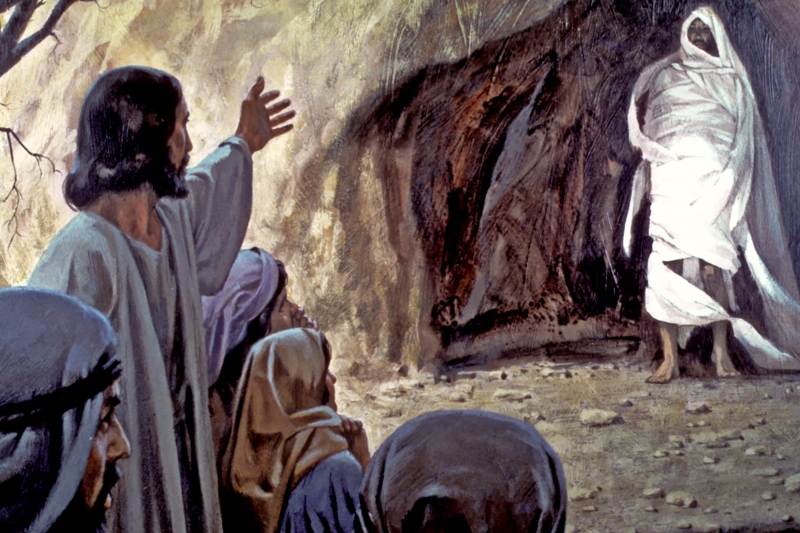
A Lazarus Apologetic

When most of us think of Christian Apologetics, we might think of a man standing before a crowd or an individual sharing the truths and defenses of the Christian faith.  We seldom look at a passage of Scripture and see the writer giving obvious evidence for the truth of a particular situation.  These apologetics in Scripture do exist, though, and one is in John chapter 11: the story of Jesus raising Lazarus from the dead.

First we have statements by John, Jesus, Martha and Mary – Lazarus’ sisters – that Lazarus was indeed dead:

Vs. 14: 14 So then [Jesus] told them plainly, “Lazarus is dead,

Vs. 21: 21 “Lord,” Martha said to Jesus, “if you had been here, my brother would not have died.”

 Vs. 32: 32 When Mary reached the place where Jesus was and saw him, she fell at his feet and said, “Lord, if you had been here, my brother would not have died.”

Vs. 44:  44 The dead man came out, his hands and feet wrapped with strips of linen, and a cloth around his face.

So, we can be sure Lazarus was dead.  Also, the people there saw him die and his sisters were eyewitnesses as well.

Could this be a trick?  Well, Jesus alone as the center figure in the drama at the home of Lazarus, Martha, and Mary had the idea Lazarus would rise from the dead.  He alone called for Lazarus using the power only God could provide, the reanimation of the dead.  Satan is not interested in raising people from the dead and does not have power to do so if he were.

Now Lazarus was alive.  The people who saw him die were there to see him alive.  He had been in the tomb for four days (vs 39).  This would eliminate the chance of a trick since four days without water would certainly result in one’s death from thirst.

Jesus was outside of town, not even nearby when Lazarus was put in the tomb (vs. 30), another proof of no tricks.  The sisters of Lazarus saw him both dead and alive and could testify to the facts.  Of course Jesus saw him alive as well.  Many who were there believed in Jesus because they saw Lazarus alive. 

Even those who were eyewitnesses but didn’t believe Jesus was the Son of God took the story to the chief priests and Pharisees (vs.47).  And even they didn’t doubt that Lazarus was now alive since they plotted to kill him as well as Jesus (vss 12:9-10).  The Pharisees couldn’t afford to have Lazarus, a living testimony to God’s power through His Son, walking around for all the world to see. They would lose their jobs (11:48).

Why is this important?

I think this is important for a couple of reasons.  First, Jesus had been accused of working the devil’s work and that He was not from God (Luke 11:14-15).  But raising someone from the dead is God’s work, not Satan’s.

Secondly, I think Jesus was still trying to completely convince His disciples He was God, and there was no limit to His power.  They needed to understand He could even raise Himself from the dead.

Like us, His disciples believed God could do some things, but they thought raising someone from the dead was too much to ask even though they had seen Him raise Jairus’ daughter (Luke 8:54) and the son of the widow at Nain (Luke 7:15).

You and I see God do something in our lives that we doubted He could or would do.  We’re limited creatures.  I remember a fairly famous pastor say once he had seen God heal many he had prayed for, but he didn’t have the faith to pray for a missing limb to be restored.  He believed God could do it, but didn’t have the faith to ask God to do it. He had never seen God do it.

Our understanding of God is so limited do to His vastness and our smallness.  I’m not sure we will ever overcome it this side of heaven.  Like the event with Lazarus, though, God has given us times in our lives when we have seen Him work, and those experiences increase our faith in praying for miraculous acts of God.  If we remember the times God has pulled our irons out of the fire, our faith grows so we’ll be more ready to believe next time. 

God proved His power at the raising of Lazarus.  After that event, the faith of Martha and Mary and certainly Lazarus was increased.  They had seen God act and began to see His limitless power.

Does Jesus Really Change Lives?

Luke 19:1-10 (ESV) [Jesus] entered Jericho and was passing through. And behold, there was a man named Zacchaeus. He was a chief tax collector and was rich. And he was seeking to see who Jesus was, but on account of the crowd he could not, because he was small in stature. So he ran on ahead and climbed up into a sycamore tree to see him, for he was about to pass that way. And when Jesus came to the place, he looked up and said to him, “Zacchaeus, hurry and come down, for I must stay at your house today.” So he hurried and came down and received him joyfully. And when they saw it, they all grumbled, “He has gone in to be the guest of a man who is a sinner.” And Zacchaeus stood and said to the Lord, “Behold, Lord, the half of my goods I give to the poor. And if I have defrauded anyone of anything, I restore it fourfold.” And Jesus said to him, “Today salvation has come to this house, since he also is a son of Abraham. 10 For the Son of Man came to seek and to save the lost.”

I’ve been reading this for the past couple of weeks in preparation for a devotional I gave today.  A few things hit me about Zacchaeus.  The first, was that Zacchaeus “received him joyfully.”  Zacchaeus was almost certainly a crook.  Tax collectors made most of their money by overcharging the people.  Zacchaeus was both the chief tax collector and rich.  This would imply he had not only overcharged the people but also those tax collectors under his authority.  In addition, he was a pretty shrewd investor as he was able not to just return the money he had gotten through defrauding the people but four times that amount and to give half his wealth to the poor.

Jesus brought a drastic change in this man.  As I thought about this, I looked through Scripture to see how many times the word changed appears concerning a person Jesus had effected.  There are none.  However there are a couple of verses which say when we are in Christ, we are a new creation (2 Cor. 5:17; Gal. 6:15)

This week I spent some time with a couple of friends of mine from California.  The three of us saw the Grand Canyon one day and sat around drinking coffee the following morning and talked, laughed, and wept for four hours straight about how God had worked in our lives, how He had brought us to Him, and how He had used us to work in the lives of others.  It was clear the three of us were not the people we were before we found Christ.  We weren’t even close. 

In our twenties, we were three young men trying to figure out the world around us.  Our lives certainly were not where we were very usable.  God hadn’t even reached a couple of us, but when He did, when He entered our lives and began the recreation, we saw fruit.  We saw lives and situations around us change.  God had made some major adjustments in those lives.  We were now new creatures in Christ.

The three of us were very different in so many ways: a carpenter, a mortgage broker, and a photographer.  We now lived in different places from one another, our family situations were different as were our interests, but we were brothers in Christ, friends due to our common purpose, common service, and common Lord.  God had recreated us to make us interlock like three puzzle pieces.

Why is this important?

Through this time together, I realized this recreation had taken decades and was still going on.  God took seven days to create the universe.  We could expect it would take time to recreate us into the people He wanted us to be – especially with the material He had to work with.  Along that path, He used what He had already created to touch the lives of many.  It was a glorious morning of fellowship.

We all are being recreated.  Some of us are like Zacchaeus, and recreation comes fast and easy.  Others are recreated slowly, methodically, to achieve what God wants to accomplish in us.  So, if you’re feeling your recreation is taking time, maybe God us using this time to teach you things.  I don’t think we will ever be fully recreated until be stand before God.  We can just keep our minds on the finish line and enjoy the journey. 

Jesus doesn’t merely change lives, He recreates us for new life in Him. 

Eph. 2:10 (ESV)  For we are his workmanship, created in Christ Jesus for good works, which God prepared beforehand, that we should walk in them.

Ways of Praise

Psalm 7:17 (ESV)  I will give to the Lord the thanks due to his righteousness, and I will sing praise to the name of the Lord, the Most High.

Praise seems like such a simple thing.  We praise God for Who He is, for the things He has done both in our lives and in the lives of others through all of history, for the fact He even desires to be active in our lives.  But, there is so much more God is and does that is praiseworthy. 

There are times God works in our lives, touches our souls, heals a friend, when we can’t express our praise in simple words.  Even the psalmist expresses these times:

Psalm 106:1-2 (ESV)  Praise the Lord! Oh give thanks to the Lord, for he is good, for his steadfast love endures forever! Who can utter the mighty deeds of the Lord, or declare all his praise?

Sometimes we are so overwhelmed by God’s grace in our lives, by His care and concern for our well-being, that we have no ability to praise Him for even His presence in the situation let alone for His resolution.  Sometimes a simple thanks just isn’t enough after your daughter comes through open heart surgery or you’re told you son might lose the use of his hand due to a dog bite, and God steps in.  We’re at a loss for words in situations like that.  A simple “thank you” doesn’t come close to expressing our praise.  When these times occur, we can ask for help in how we praise God, and God’s Spirit will praise Him for us with appropriate praise that is beyond our capabilities:

Rom. 8:26-27 (ESV)  Likewise the Spirit helps us in our weakness. For we do not know what to pray for as we ought, but the Spirit himself intercedes for us with groanings too deep for words. 27 And he who searches hearts knows what is the mind of the Spirit, because the Spirit intercedes for the saints according to the will of God.

We have all seen times when we have been in God’s overwhelming presence and have no idea how to praise Him, no expression is enough, yet God lets us know He is pleased to simply be there in that connection with us.  His love for us is so apparent. Sometimes, this happens during or just after we have repented and confessed our sins.  We’ve returned to Him as prodigal sons, and like the father in that parable, He holds us close, joyful our relationship has been restored:

Luke 15:20 (ESV)  And he arose and came to his father. But while he was still a long way off, his father saw him and felt compassion, and ran and embraced him and kissed him.

What can be more praiseworthy in our lives than the embrace of God?  What can cause us to adore Him more than that?  The supreme Being of the universe wishes to draw close to us. He promises this:

James 4:8a (ESV)  Draw near to God, and he will draw near to you.

Why is this important?

Ps. 7:17 (NASB)  I will give thanks to the Lord according to His righteousness, And will sing praise to the name of the Lord Most High.

Like so many things in our Christian walk, praise is something we cannot do well alone.  It requires God’s help for us to even approach the level of praise worthy of our God.  Fortunately, God receives the praises however we offer them.  The position of our hearts, the obedience to His commands, and our dedication to His Word keeps our relationship with Him rich:

Psalm 119:7-8 (ESV)    I will praise you with an upright heart, when I learn your righteous rules. I will keep your statutes; do not utterly forsake me!

The praise God is worthy to receive is a level of praise we cannot offer on our own.  God Himself, through His Spirit, guides us and even intercedes for us in our praises.  That guidance says, like prayer, our praises are never to cease: 

Psalm 34:1 (ESV) I will bless the Lord at all times; his praise shall continually be in my mouth.

Let’s walk the walk, look to His Word for direction, then follow that direction.  Those are forms of praise in themselves.

God’s Praise of Men

1 Cor. 4:5 Therefore do not pronounce judgment before the time, before the Lord comes, who will bring to light the things now hidden in darkness and will disclose the purposes of the heart. Then each one will receive his commendation from God.

We seldom think of praise for men as a godly act, but here in 1 Cor. 4:5, Paul tells us God will praise men for their deeds.  He points this out again in Romans. 2:28:

But a Jew is one inwardly, and circumcision is a matter of the heart, by the Spirit, not by the letter. His praise is not from man but from God.

So, How do we get praise or commendation from God?  Well, we know God doesn’t look at the outside but at the heart.  We see this with God’s choice of David to be king of Israel:

1 Sam. 16:7  But the Lord said to Samuel, “Do not look on his appearance or on the height of his stature, because I have rejected him. For the Lord sees not as man sees: man looks on the outward appearance, but the Lord looks on the heart.” 

It’s not our appearance or social status, our wealth or fame.  God will commend the man or woman who is like David and has a sincere heart for the Lord.

But, even with this, those of us who have a good idea of the sinners we truly are can hardly believe God might praise us even for a sincere heart.  We need to remember God says He wants praise us if our hearts are right.  It is that grace thing again where God favors us for no other reason than because He loves us.

Paul’s mention of circumcision in Romans 2:29 speaks of holiness, of dedication to the one true God.  Circumcision in the Old Testament was a sign to foreigners that those with that mark were to be considered holy, were the people of the great God YHWH.  The New Testament speaks differently of circumcision. It speaks of the heart, that God has set us aside, holy and separate from the world: His people.

When our hearts fully seek to separate from worldly thoughts and desires, God commends us for this. 

There is another type of praise for men that I need to mention here, of course, and that is the praise of other men.  Jesus, in Luke, tells us to be careful of the praise of other men:

Luke 6:26 (ESV)  “Woe to you, when all people speak well of you, for so their fathers did to the false prophets.”

We can fall into a heightened self-image, think better of ourselves than we should, become puffed up, conceited:

Rom 12:3 (ESV)  For by the grace given to me I say to everyone among you not to think of himself more highly than he ought to think, but to think with sober judgment, each according to the measure of faith that God has assigned.

 Why is this important?

As Christians we need to keep our minds and hearts on the path of seeking God’s will and His good pleasure.  In this way, we seek God’s praise and commandment regarding our faith in Him.

Next week, ways we can praise God.

Humility & Meekness

Humility & Meekness

Col. 3:12-13 (ESV)  Put on then, as God’s chosen ones, holy and beloved, compassionate hearts, kindness, humility, meekness, and patience, 13 bearing with one another and, if one has a complaint against another, forgiving each other; as the Lord has forgiven you, so you also must forgive.

I’ve asked myself about the words humility and meekness: “What exactly do they mean?  Are we to be shy as Christians?  Does it mean we should crawl under our desks or be taken advantage of?  Is that what it means to be humble or meek?”  Those descriptions of the words don’t seem to match with the heroes of the Bible.  Even when God did use shy people like Gideon, He gave him strength to fulfill his call.

In looking at the words in the above passage, I’ve found they do not mean what I thought.  They mean something much more.  For one thing, a humble person is someone who puts the needs of others above himself.  James defines it well for us:

James 4:10-12 (ESV)  Humble yourselves before the Lord, and he will exalt you. 11 Do not speak evil against one another, brothers. The one who speaks against a brother or judges his brother, speaks evil against the law and judges the law. But if you judge the law, you are not a doer of the law but a judge. 12 There is only one lawgiver and judge, he who is able to save and to destroy. But who are you to judge your neighbor?

Look at the qualifications for an elder of the church:  1 Tim. 3:1-7  (ESV)  The saying is trustworthy: If anyone aspires to the office of overseer, he desires a noble task. Therefore an overseer must be above reproach, the husband of one wife, sober-minded, self-controlled, respectable, hospitable, able to teach, not a drunkard, not violent but gentle, not quarrelsome, not a lover of money. He must manage his own household well, with all dignity keeping his children submissive, for if someone does not know how to manage his own household, how will he care for God’s church? He must not be a recent convert, or he may become puffed up with conceit and fall into the condemnation of the devil. Moreover, he must be well thought of by outsiders, so that he may not fall into disgrace, into a snare of the devil.

As an example to the church and community at large, elders are to be humble and have all the traits listed above, and yet it is humble to seek the office itself.  Elders are to stand against false teachers, to discipline those in the church who are causing disruption, in short, to hold people accountable.  These men aren’t shy.  They are men who must do these things while loving God’s people, acting in love and in humility.  Humility, then, is to know your status as a Christian and as a member of the church and fulfill that – no more and no less.

I think misunderstanding this causes problems in the church.  We concentrate so much on “humbling” ourselves we do nothing.  We see ourselves as unworthy to be used by God, so those jobs God wants us to do don’t get done.

Humility, then, is not to think better or less of yourself than you actually are.  Do not take positions you do not deserve or shrink from positions to which you are called.  We must seek a balanced life as a child of God.

Meekness, much like humility, is power under control.  Moses was the meekest man in the Old Testament:

Num. 12:3 (ESV)  Now the man Moses was very meek, more than all people who were on the face of the earth.

The meaning of the Hebrew word for meek here is this:  “An adjective meaning poor, oppressed, afflicted, humble. It is used of persons who put themselves after others in importance; persons who are not proud, haughty, supercilious, self-assertive, low in rank or position. Moses in the Old Testament is the prototype of the humble man before God and other human beings (Num. 12:3), but he was not poor or low in rank.” (The Complete Word Study Dictionary: Old Testament)

Moses stood before Pharaoh, the most powerful man in Egypt, and delivered God’s commands.  Moses knew who he was and who God saw him to be.  He knew his mission and that God had his back. 

Why is this important?

I think we spend too much time trying to be unimportant in God’s kingdom.  We have a difficult balance to keep, and most of us don’t keep it well.  We stray toward the “I’ll do nothing” side for fear others may expect too much of us or see us as prideful.  We’re safe there, just sitting in the pew and resisting our call to serve. 

When we look at Biblical examples such as David, Paul, Deborah, Stephen, we see those who stood for something, who were willing and happy to serve God once the call was recognized.  These people weren’t always humble.  Moses was punished for becoming prideful.  But, humble people get things done in God’s kingdom.  Those who ignore the call on their lives and abilities do not.

God’s Tool Kit

Jeremiah 9:23-24 (ESV)  Thus says the Lord: “Let not the wise man boast in his wisdom, let not the mighty man boast in his might, let not the rich man boast in his riches, 24 but let him who boasts boast in this, that he understands and knows me, that I am the Lord who practices steadfast love, justice, and righteousness in the earth. For in these things I delight, declares the Lord.”

The first verse in this passage, verse 23, could be understood this way: “Let not the wise man boast in his wisdom [for God has given him that wisdom], Let not the mighty man boast in his might [For it is God who has made him mighty], let not the rich man boast in his riches [for it is God who has given him his riches].

Wise men, mighty men, and rich men all have places in God’s kingdom to do particular jobs.  God has made the wise men to counsel people, the mighty men to protect the flock, and the rich men to provide for His people.  We each have a job in God’s church, a job God has uniquely qualified us to do.

Let me look at some of the tools I have around my house and use them as metaphors to illustrate this.  Let’s look at the straight-slot screwdriver.  It has one specific use for which it was designed: to turn straight-slot screws, but we can use this tool for so many things: as a pry bar, to open paint cans, as a sort of chisel, many things.  But, it’s only designed for one purpose, and it only does that one purpose well.

We have screwdrivers in our church as well as pry bars, paint can openers (yes there are tools designed just for that purpose), and chisels.  A screwdriver can do the job of a chisel poorly, but it can get done.  Using the tool that is actually designed to open paint cans, pry things, and so on, makes the job much easier and creates a better result.  The problem is many times only the screwdriver will volunteer for a job, so the task gets done but not as well as if some tool actually designed to accomplish the task were used.

I’m a teacher.  We might look at me as a partly full computer thumb drive.  I have a lot of information to share if you can access it.  The other day, the fan belt on my truck started to squeal.  That almost always means the belt is stretched and needs to be tightened a little.  I didn’t run into my study and grab the thumb drive to fix that.  I grabbed my 14mm wrench to loosen the pulley and adjust it.

There is a parallel here to the church.  Some of us are more sensitive to the needs of others than we.  Some are better able to teach.  Some are better cooks.  Some spend hours in their prayer closets supporting those on mission fields.  We all have our jobs, and God has designed us to perform those jobs.

Sometimes the more obvious servants: ushers, pastors, teachers, helpers, cooks, etc., are seen as more “spiritual” because they are serving out in the open.  We don’t often see the gifts given to missions or the poor.  We don’t see the hospital visits, the hands held when a loved one is lost, the prayers that uplift the entire church.

Charles Spurgeon was asked after a Sunday service why he thought his ministry was so successful.  He took the person downstairs to his church’s basement and showed him the dozens of people who prayed throughout the service for God’s hand to work in the lives of those listening and through the words of Spurgeon.

Why is this important?

You and I often may feel like we aren’t doing all we can.  If we feel that way, we should be careful in what we choose to do.  We can take on the job to test and see if it is what God has called us to do, but if it becomes clear it is not, we are probably standing in the way of someone God has perfectly prepared for that job.  We are a screwdriver trying to open a paint can when God wants to use the paint can opener.

Whatever tool God had fashioned you into, you are perfect for the job. You might “hang on the wall” for a while like a wrench in my garage, but when the task arises, you are the perfect tool to get it done. While there are tools in the church that are not being used properly, there is no tool more important than another, so find your place if you haven’t already and get to work.

Women Pastors?

Women Pastors?

1 Tim. 2:12-15 (ESV)  I do not permit a woman to teach or to exercise authority over a man; rather, she is to remain quiet. 13 For Adam was formed first, then Eve; 14 and Adam was not deceived, but the woman was deceived and became a transgressor. 15 Yet she will be saved through childbearing—if they continue in faith and love and holiness, with self-control.

Over the past several decades we’ve seen a growing controversy over whether women should be pastors or even teach men.  The above passage seems to tell us they can’t, but are there conditions on this?

For a few years, we attended a church where the pastor’s wife would teach women’s groups and was a wonderful teacher, but if a man entered the room while she was teaching, she would politely stop until he left.  I’m thinking that might be a little extreme, but it was how she felt, and most conservative Christians prefer to err on the conservative side rather than not. Some, though, will take this to the extreme. I belonged to a church which would not allow women ushers.

Missionaries are usually asked to speak to at the churches who support them financially on the mission field when they come home on furlough.  I was a driver for a woman missionary who did this.  We arrived at a very conservative church, and since the pastor had not yet arrived when she was supposed to speak, she began her report from the pulpit to those in attendance.  Now I’m a pretty conservative guy, but I saw no problem with this.  She was simply telling of her adventures on the mission field, but the pastor told me afterward he would not have allowed her in the pulpit had he arrived before her talk.  I think that’s taking it a bit far.

Another passage that seems to apply is just after the one above where Paul gives Timothy a list of qualifications for elder/overseer:

1 Tim. 3:1-7 (ESV)  The saying is trustworthy: If anyone aspires to the office of overseer, he desires a noble task. Therefore an overseer must be above reproach, the husband of one wife, sober-minded, self-controlled, respectable, hospitable, able to teach, not a drunkard, not violent but gentle, not quarrelsome, not a lover of money. He must manage his own household well, with all dignity keeping his children submissive, for if someone does not know how to manage his own household, how will he care for God’s church? He must not be a recent convert, or he may become puffed up with conceit and fall into the condemnation of the devil. Moreover, he must be well thought of by outsiders, so that he may not fall into disgrace, into a snare of the devil.

There is no mention of women as elders here or anywhere else in Scripture.  The entire passage is masculine and even refers to “the husband of one wife” as a qualification.  So, it is generally accepted by conservative Bible churches that women cannot be elders.  Since pastors are elders, it follows women cannot be pastors either.

“But then what is the role of women in the church?” you might ask.  Well, right after this passage comes Paul’s qualifications for deacon:

1 Tim. 3:8-13 (ESV)  Deacons likewise must be dignified, not double-tongued, not addicted to much wine, not greedy for dishonest gain. They must hold the mystery of the faith with a clear conscience. 10 And let them also be tested first; then let them serve as deacons if they prove themselves blameless. 11 Their wives likewise must be dignified, not slanderers, but sober-minded, faithful in all things. 12 Let deacons each be the husband of one wife, managing their children and their own households well. 13 For those who serve well as deacons gain a good standing for themselves and also great confidence in the faith that is in Christ Jesus.

The interesting thing here is that verse 11 mentions wives.  The Greek word for wives here is the same as the word for women.  The verse could read “The women, likewise must be dignified . . . .” and many scholars believe it does mean women.  In fact, the NASB translates the verse this way.  The “husband of one wife” qualification here, of course, would apply to men deacons.

Another passage which points to women deacons is found in Romans 16:1 (ESV)  I commend to you our sister Phoebe, a servant of the church in Cenchrea.

The word for servant here (diakonos) describing our sister Phoebe is also the Greek word for deacon.  So, many churches are recognizing this and are fine with women entering the ranks of deacons in their body.

Why is this important?

I believe Scripture says women can hold any leadership office except pastor/elder.  I’ve heard many women who are excellent teachers, but I just can’t go against what I believe is clearly taught in the Bible and shouldn’t do so.  My stand has always been that 1 Tim. 2 is speaking of doctrinal teaching, typical Sunday morning teaching.

Women are clearly encouraged to teach each other and children.  There is no limitation there.  This is simply a role issue for men and women.  God has assigned functions in the body of Christ for each of us and limits us or promotes us as He wills.

Little Things

Sometimes it’s the little thing that mean a lot, especially in Bible study.  I usually find something that catches my eye usually means God wants me to look into it more deeply.  Let’s look at Mark 10:32-34, for instance:

And they were on the road, going up to Jerusalem, and Jesus was walking ahead of them. And they were amazed, and those who followed were afraid. And taking the twelve again, he began to tell them what was to happen to him, 33 saying, “See, we are going up to Jerusalem, and the Son of Man will be delivered over to the chief priests and the scribes, and they will condemn him to death and deliver him over to the Gentiles. 34 And they will mock him and spit on him, and flog him and kill him. And after three days he will rise.”

This is near Passion Week. The disciples were afraid of what was about to happen, and Jesus described exactly what they feared in detail.  The point I had missed all the other times I read this passage is that Jesus was walking ahead of the disciples.  He was anxious to reach Jerusalem and suffer for us as He described.  Hebrews tells us why:

Heb. 12:2 (ESV)  looking to Jesus, the founder and perfecter of our faith, who for the joy that was set before him endured the cross, despising the shame, and is seated at the right hand of the throne of God.

What a blessing to see this! You and I are the joy set before Jesus that He treasured enough to rush ahead of the disciples to pay that price.

Just this past couple of weeks, I’ve been reading about Noah and Abraham, and I noticed a term that is grammatically incorrect: “between you and me.”  When I was in English class, I was told if you don’t know how to write a particular sentence or how to punctuate it, look in a Bible.  They take special efforts to keep their English correct.  Yet, it is incorrect in Genesis 9:12, as an example, and it’s God who said it:

Genesis 9:12 (ESV)  And God said, “This is the sign of the covenant that I make between me and you and every living creature that is with you, for all future generations:

One interesting thing is this isn’t the only time the phrase appears in Scripture.  It shows up 13 times and only in the Old Testament (in the ESV).  It also appears this way in the NASB, the KJV, the NIV and others.  So, it isn’t an issue to a particular translation.  What do we do with something like that?  We can look to see if these passages have anything in common:

The first two mentions are God speaking to Noah about His covenant never to destroy the earth through a flood again (Gen. 9:12, 15). 

The next four mentions are God speaking to Abraham about His covenant to create a great nation through him (Gen. 17:2, 7, 10, 11). 

The next mention is in Exodus 31:13 where God talking with Moses saying the Sabbaths will be a sign between God and His people. 

In 1 Samuel 20:42, it is Jonathan speaking to David about their covenant with the Lord between them both. 

The next two places, 1 Samuel 24: 12 & 15, are calls for God to judge between David and Saul that David wouldn’t kill him. 

The next two speak of a covenant between King Asa and the king of Assyria (1 Kings 15:19 and 2 Chronicles 16:3). 

The last is God speaking again to His people telling them to keep His Sabbaths as a sign between Him and His people. (Ezekiel 20:20)

So, from this I can see the difference in grammar from the norm appears only during some sort of agreement, most often by God to His people, but also among kings and the child of a king.  So, maybe this is a sign of position or royalty. More study is required.

I did look into a couple of commentaries, but no mention of the odd grammar.  I’ve just started looking into this, and I’ll keep looking and mention it here if it leads to something profound. Maybe I’ll write a Hebrew scholar or the ESV translation committee.

Why is this important?

This is important because too often I find myself reading a passage and not really seeing the oddity it might contain.  Sometimes researching these sorts of passages brings very little.  Sometimes it brings great rewards.  We never know when we begin, and even sometimes something simple connects later on with another point to bless us. Bible study is like mining for gold. Sometimes you find a nugget. Sometimes you strike a vein and follow it to great wealth. Then again, sometimes you find very little.

I thought it would be good to look at the process midstream and see ways we can research the things God brings to our notice. While my research is still in progress and may amount to nothing more than just a figure of speech like the royal “we,” it may well lead me to something more.

So, let’s keep our eyes open for these sorts of things.  God speaks to us through His Word.  I, for one, need to spend more time listening and not just hurrying through passages.  Maybe you have the same problem.

Secondhand Witness

Secondhand Witnessing

Luke 7:2-3 (ESV) Now a centurion had a servant who was sick and at the point of death, who was highly valued by him. 3 When the centurion heard about Jesus, he sent to him elders of the Jews, asking him to come and heal his servant.

According to Webster, one definition of secondhand is to receive something indirectly.  When we read a newspaper or watch TV news, we’re receiving the news indirectly and is, therefore, secondhand.

When we share Christ with others, it too can produce a secondhand effect.  I was talking with a woman who had accepted Christ but was swept into the Watchtower organization of Jehovah’s Witnesses.  She was about to be baptized, and her husband asked me to speak to her.  During the time I spent explaining and defending the gospel, she came back to Christ.  The secondhand effect was, unbeknownst to me at the time, her husband also came to Christ through listening to what I had shared with her.

If we are active and open Christians, I think this effect, the secondhand effect, may occur more often than we might think.  This may well have been the reason Nicodemus came to Christ: he had heard someone talking about Him and was intrigued enough to seek Him out.

Nowadays even simple acts of courtesy may be enough to catch someone’s attention as a Christian act.  A simple “God bless” or “How can I pray for you?” which is overheard by others could as well. Even saying grace at a restaurant may well not only give boldness to other Christians to do the same but is a secondhand witness to those around us.

I spend a lot of time on social media defending the faith and trying to encourage fellow Christians.  Secondhand witnessing is broadly effective here.  While I may be defending the truth of God’s Word with a recalcitrant antagonist, it is not he alone who is reading my remarks.  He may be there to attack the gospel, but there are dozens of “lurkers” reading our conversation and hearing the Truth being defended and expounded: secondhand witnessing.

There have been times when we have visited a friend in the hospital and prayed over them for a quick recovery.  Those walking by the room and seeing this are reminded of a power greater than that of the medical professionals on staff.  I know when I see others praying in a hospital, it is a testimony to me of God’s great power.

When we were first married, the neighbor, also a young husband, and I were working on some project and needed to go to the hardware store.  We took my car, and when I started the engine, the radio came on and was set to a local Christian radio station.  My neighbor sort of mumbled under his breath, “Sheesh, even his radio station is Christian!”  I don’t remember ever sharing Christ with him or doing anything overtly Christian for or with him.  Somehow he understood our faith – Secondhand Witnessing, I guess. People are watching us.

I’m happy to say the church I attend is a praying church.  On a weekly basis I see people praying for one another on the patio in front of the sanctuary: sometimes one-on-one, sometimes in fairly large groups.  Others who witness this see we rely not on ourselves but on the God we pursue in prayer.

Why is this important?

Whether it’s a hospital visit that turns out to move a passerby, a witness overheard by someone else, even a bumper sticker, tee shirt, or hat that carries a Christian message, we effect the world around us by our life, our attitude, and how we show Christ in us, these all speak to others secondhand.

I sometimes wonder if when we all are seated at the Marriage Supper of the Lamb, someone or several people will seek us out to tell us something we unknowingly did or said moved them to consider Christ and were saved or encourage in their walk. Perhaps someone will come to us and say “I saw you standing firm during a tough time I could never face.  I was inspired.  And it was that faith and courage which caused to look again at Who your God is.” – Secondhand Witnessing.

Reasoning Together

Sometimes when we try to share the gospel with others, we end up in an angry argument.  This isn’t the way we should be behaving according to Scripture:

1 Peter 3:15 (ESV)  but in your hearts honor Christ the Lord as holy, always being prepared to make a defense to anyone who asks you for a reason for the hope that is in you; yet do it with gentleness and respect,

I find this instructive.  We are not told to run from discussions, in fact seven times in Acts, Paul is seen reasoning with the Jews in the synagogues as well as with the general population in Ephesus at the hall of Tyrannus.  The passage says “This continued for two years, so that all the residents of Asia heard the word of the Lord, both Jews and Greeks.” (Acts 19:10)

Acts 17:2 (ESV) says And Paul went in, as was his custom, and on three Sabbath days he reasoned with them from the Scriptures.  It was Paul’s custom to seek out places where he could start discussions, but not arguments.

When we begin discussions, we need to be sure we do so with “gentleness and respect” for the others involved.  My wife and I occasionally went to the Los Angeles County Fair.  One year, a splinter group from the Watchtower called the International Bible Students, had a booth at the fair answering “Bible” questions.  Since their beliefs are closely aligned with Jehovah’s Witnesses, I stopped by the booth to discuss some questions I had.  I spoke with a man for ten minutes or so before he called over others in the booth.  “Listen to this guy.” He said, ”He doesn’t agree, but he isn’t getting angry either.”  As a result we had an audience of a few rather than just the each other and I was allowed to share the truth.

I walked away with two important lessons: people will listen if you can keep the discussion on a friendly level, and most Christians this man had met that day had gotten angry with his beliefs.  That’s not “gentleness and respect.”  The Holy Spirit through Paul has good reasons to tell us to be gentle and respectful. 

When people see you respect them enough to hear them out, they will offer the same respect to you.  Getting angry and throwing dozens of Bible verses at this fellow at the Fair would have accomplished nothing but to convince him Christians are angry and argumentative.

We need only look at how Paul handled the philosophers in Athens to see how this is masterfully done (Acts 17:22-34).  With Paul’s efforts and the work of the Holy Spirit on the hearts of men, some became believers.

Why is this important?

We all get into discussions about our faith whether we mean to or not.  We need to understand it is not a sprint but a marathon, a relay race really.  We share with someone, maybe someone at work will do the same later, then a family member, and so on.  Our job isn’t to save people but to inform them and let the Holy Spirit do His work of salvation.  We’re all in it together. Paul talks about this process in First Corinthians:

1 Cor. 3:6-9 (ESV)  I planted, Apollos watered, but God gave the growth. So neither he who plants nor he who waters is anything, but only God who gives the growth. He who plants and he who waters are one, and each will receive his wages according to his labor. For we are God’s fellow workers. You are God’s field, God’s building.

When we talk with someone about our Lord, we mustn’t think we’re necessarily going to see them drop to their knees and confess Christ.  While that will happen at times, our job is to plant and water.  Greg Koukl describes it as putting a pebble in their shoe, give them something to think about that will lay the groundwork for the Holy Spirit to speak to them. 

When we give long drawn out presentations, there is so much content, and person hearing the presentation could never remember it.  Often the best thing is to offer a point or two.  If they ask questions, the rest of the discussion should be to answer those not present new points.  We want to drop a pebble in their shoe not fill it with gravel.  And remember it’s a discussion, two sided discussion.  We need to listen at least as much as we speak – maybe more.