

When Did the Church Begin?

Christmas will be here in less than two weeks, and some of us will be sitting around the table with assorted family and friends who think Christianity is some sort of fairy tale, a fraud perpetrated on simple, illiterate, and naïve followers two thousand years ago.  So, maybe it would be good to brush up on some of the facts to present to these skeptics. 

Did Jesus exist, and did He rise from the dead?  While some are educated well enough to know there was a historical figure named Jesus who walked the earth back around 30 or 40 a.d., some will deny He even existed at all.  Well, Jesus is mentioned by such early historians as these:

Flavius Josephesus (37-100 a.d.) who mentions Jesus as a teacher and even speaks of His brother, James. 

Tacitus (56-120 a.d.) who speaks of Jesus’ execution. 

Pliny the Younger (61-113 a.d.) who confirms the worship of Jesus as a common Christian practice.

These three are especially important since they are non-Christian historians and wrote within the lives of the apostles or their followers and could have been checked and denied if incorrect.

Then there is a near-consensus of well-known and respected modern secular Greek New Testament scholars as well who believe at least seven of  Paul’s letters are genuine.  Here are ten:

  1. Bart D. Ehrman (agnostic / atheist-leaning, Greek textual critic)
  2. Gerd Lüdemann (atheist, German Greek scholar)
  3. Paula Fredriksen (Jewish historian, secular)
  4. E. P. Sanders (secular historical scholar)
  5. James D. G. Dunn (critical scholar; widely used in secular universities)
  6. Maurice Casey (atheist, Aramaic & Greek specialist)
  7. Raymond E. Brown (critical scholar, non-evangelical)
  8. Dale C. Allison Jr. (critical historian)
  9. Martin Hengel (critical historian, Greek philologist)
  10. Larry Hurtado (critical scholar of early Christianity)

“Genuine” here means: written in the 1st century, substantially authentic texts (what Paul actually wrote and not medieval forgeries), and—where applicable—authored by the traditionally named author (Paul).  It does not mean inspired, miraculous, or theologically true.  These are the seven books:

  • Romans
  • 1 Corinthians
  • 2 Corinthians
  • Galatians
  • Philippians
  • 1 Thessalonians
  • Philemon

The book of Galatians is of particular importance in that it speaks of Paul going to Jerusalem three years after his conversion to compare notes with Peter for a couple of weeks (Gal. 1:18).  Then Paul began his missionary journeys.  In the same book, Paul tells us he returned 14 years later to compare what he was teaching to make sure it was still consistent with the gospel Jesus had taught (Gal. 2:1-2).  Paul recorded in another of his books, which is considered genuine, exactly what he was teaching during those 14 years:

1 Cor. 15:3-8 (ESV)  For I delivered to you as of first importance what I also received: that Christ died for our sins in accordance with the Scriptures, that he was buried, that he was raised on the third day in accordance with the Scriptures, and that he appeared to Cephas, then to the twelve. Then he appeared to more than five hundred brothers at one time, most of whom are still alive, though some have fallen asleep. Then he appeared to James, then to all the apostles. Last of all, as to one untimely born, he appeared also to me.

Most historians believe Paul was converted about three years after the crucifixion of Jesus.  Since he waited three years in personal study and preaching before meeting with Peter, that would make his first visit just six years after the crucifixion, not enough time for a legend to develop.  There were too many people still living who were aware of the truth, and the teaching of Peter was being done in the very city where Jesus was crucified.

Consider this: It’s 1969, and you’re in Houston, Texas, and someone comes to you and says he is starting the Church of the Risen John F. Kennedy.  You would laugh him to scorn because the whole idea was silly.  We saw JFK die and buried.  We can go to the tomb and show you he’s still there.  The whole city knows this.

Now, it’s 39 a.d., and you’re in Jerusalem.  One of Jesus’ followers comes to you and says Jesus of Nazareth was crucified.  This isn’t news.  The whole city was aware of this.  But then the man takes you to the empty tomb and introduces you to over 500 men who saw Him risen from the dead many of whom saw Him do miracles while He walked the earth.  Maybe you could even meet Lazarus and his family and listen to their story.  That’s how the church started, but it started even earlier than that (Acts chapter 2).

I’d like to make one more point.  We’ve pretty much settled that Paul met with Peter in Jerusalem only about six years after the crucifixion of Jesus.  Look at Galatians again and what had happened during the six years:

21 Then I went into the regions of Syria and Cilicia. 22 And I was still unknown in person to the churches of Judea that are in Christ. 23 They only were hearing it said, “He who used to persecute us is now preaching the faith he once tried to destroy.” 24 And they glorified God because of me.

Within those six years, there were already churches outside of Jerusalem in Judea. 

So, here is some evidence which can be presented to the skeptics at your Christmas dinner – or anywhere, for that matter.  The Church began at Pentecost, and Peter and Paul taught Jesus rose from the dead. God has not left us with a blind faith but with a faith founded on fact.

The Significance of the Resurrection

I’ve always heard, as I’m sure you have, “Jesus died for our sins,” but I don’t often hear much about the significance of the resurrection.  Sure I’ve heard “Jesus showed His power over sin and death” or “It showed His victory over Satan,” but I’ve never really read a systematic study of this.  After all, the focus has always seemed to be we’re forgiven through His sacrifice.  That’s always been what we share when we offer the gospel to others.  What’s the significance the resurrection?  So, I decided to see what I could find about this, and here are six significant points:

1.  Jesus’ resurrection Confirms Jesus’ Deity

Rom. 1:4 (ESV)  and was declared to be the Son of God in power according to the Spirit of holiness by his resurrection from the dead, Jesus Christ our Lord,

It was the resurrection that declared Jesus to be the Son of God.  We know to be God’s own Son is the same as being God the Son and equal with the Father:

John 5:18 (ESV)  This was why the Jews were seeking all the more to kill him, because not only was he breaking the Sabbath, but he was even calling God his own Father, making himself equal with God.

So, the bodily resurrection of Jesus declared to the world of mankind that Jesus is God the Son.

2.  Jesus’ resurrection validates the atonement

Rom. 4:23-25 (ESV)  But the words “it was counted to him” were not written for his sake alone, 24 but for ours also. It will be counted to us who believe in him who raised from the dead Jesus our Lord, 25 who was delivered up for our trespasses and raised for our justification.  

Jesus was “delivered up for our trespasses.”  He was raised to show His sacrifice has been approved and we are justified.  Not only was this sacrifice approved, the approval is shown to have been endorsed by all three persons of the trinity: Father (Gal. 1:1), the Son (John 2:18-22), and by the Holy Spirit (Rom. 8:11). 

3.  Jesus’ resurrection guarantees our resurrection

1 Cor. 15:20  (ESV)  But in fact Christ has been raised from the dead, the firstfruits of those who have fallen asleep.

Jesus is the firstfruits, the first of many who will die in Christ, so we will be raised as He was raised:

Rom. 8:11 (ESV)  If the Spirit of him who raised Jesus from the dead dwells in you, he who raised Christ Jesus from the dead will also give life to your mortal bodies through his Spirit who dwells in you.

4.  Jesus’ resurrection grounds our future hope

1 Cor. 15:14 (ESV)  And if Christ has not been raised, then our preaching is in vain and your faith is in vain.

This is a form of negative affirmation.  Paul is arguing against those in the church at Corinth who believed the dead would not be raised.  He says the resurrection is the center of our faith.  Without it our faith is pointless, empty, worthless.  But because Christ is raised, our hope is secure.  We are justified and will spend eternity with Him in His kingdom.

5.  Jesus’ resurrection establishes Christ’s Lordship

Phil. 2:8 -11 (ESV) And being found in human form, he humbled himself by becoming obedient to the point of death, even death on a cross. 9 Therefore God has highly exalted him and bestowed on him the name that is above every name, 10 so that at the name of Jesus every knee should bow, in heaven and on earth and under the earth, 11 and every tongue confess that Jesus Christ is Lord, to the glory of God the Father.

One day every knee will bow to our Lord, Jesus, every tongue will confess that He is Lord.  This could only happen if Jesus did not remain in the tomb but was raised in power and glory, His lordship there for all to see.

6.  Jesus’ resurrection empowers the believer’s new life

Rom. 6:4 (ESV)  We were buried therefore with him by baptism into death, in order that, just as Christ was raised from the dead by the glory of the Father, we too might walk in newness of life.

We Christians carry that same power that raised Jesus from the dead (Rom. 8:11) within us.  Because of Jesus resurrection, we have new life.  We have peace with God and are justified to approach His throne unafraid.

Why is this important?

Ours is a wonderful God. He died horribly for our sins and has risen from the dead to show His love for us. He then raised that same body from the dead, to assure us of our hope, our permanent and guaranteed place in His kingdom. He has done this by a public display, His public execution on Calvary and His gloriously rising bodily as seen by at least 500 people at one time (1 Cor. 15:6).

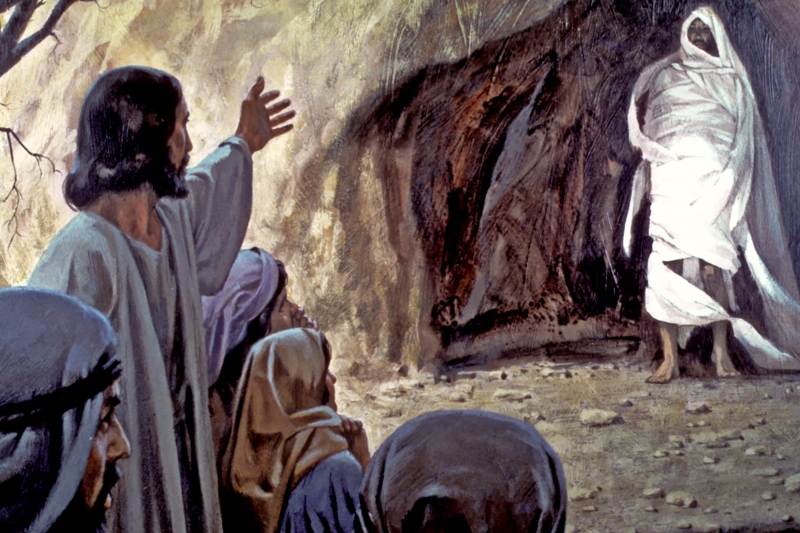
A Lazarus Apologetic

When most of us think of Christian Apologetics, we might think of a man standing before a crowd or an individual sharing the truths and defenses of the Christian faith.  We seldom look at a passage of Scripture and see the writer giving obvious evidence for the truth of a particular situation.  These apologetics in Scripture do exist, though, and one is in John chapter 11: the story of Jesus raising Lazarus from the dead.

First we have statements by John, Jesus, Martha and Mary – Lazarus’ sisters – that Lazarus was indeed dead:

Vs. 14: 14 So then [Jesus] told them plainly, “Lazarus is dead,

Vs. 21: 21 “Lord,” Martha said to Jesus, “if you had been here, my brother would not have died.”

 Vs. 32: 32 When Mary reached the place where Jesus was and saw him, she fell at his feet and said, “Lord, if you had been here, my brother would not have died.”

Vs. 44:  44 The dead man came out, his hands and feet wrapped with strips of linen, and a cloth around his face.

So, we can be sure Lazarus was dead.  Also, the people there saw him die and his sisters were eyewitnesses as well.

Could this be a trick?  Well, Jesus alone as the center figure in the drama at the home of Lazarus, Martha, and Mary had the idea Lazarus would rise from the dead.  He alone called for Lazarus using the power only God could provide, the reanimation of the dead.  Satan is not interested in raising people from the dead and does not have power to do so if he were.

Now Lazarus was alive.  The people who saw him die were there to see him alive.  He had been in the tomb for four days (vs 39).  This would eliminate the chance of a trick since four days without water would certainly result in one’s death from thirst.

Jesus was outside of town, not even nearby when Lazarus was put in the tomb (vs. 30), another proof of no tricks.  The sisters of Lazarus saw him both dead and alive and could testify to the facts.  Of course Jesus saw him alive as well.  Many who were there believed in Jesus because they saw Lazarus alive. 

Even those who were eyewitnesses but didn’t believe Jesus was the Son of God took the story to the chief priests and Pharisees (vs.47).  And even they didn’t doubt that Lazarus was now alive since they plotted to kill him as well as Jesus (vss 12:9-10).  The Pharisees couldn’t afford to have Lazarus, a living testimony to God’s power through His Son, walking around for all the world to see. They would lose their jobs (11:48).

Why is this important?

I think this is important for a couple of reasons.  First, Jesus had been accused of working the devil’s work and that He was not from God (Luke 11:14-15).  But raising someone from the dead is God’s work, not Satan’s.

Secondly, I think Jesus was still trying to completely convince His disciples He was God, and there was no limit to His power.  They needed to understand He could even raise Himself from the dead.

Like us, His disciples believed God could do some things, but they thought raising someone from the dead was too much to ask even though they had seen Him raise Jairus’ daughter (Luke 8:54) and the son of the widow at Nain (Luke 7:15).

You and I see God do something in our lives that we doubted He could or would do.  We’re limited creatures.  I remember a fairly famous pastor say once he had seen God heal many he had prayed for, but he didn’t have the faith to pray for a missing limb to be restored.  He believed God could do it, but didn’t have the faith to ask God to do it. He had never seen God do it.

Our understanding of God is so limited do to His vastness and our smallness.  I’m not sure we will ever overcome it this side of heaven.  Like the event with Lazarus, though, God has given us times in our lives when we have seen Him work, and those experiences increase our faith in praying for miraculous acts of God.  If we remember the times God has pulled our irons out of the fire, our faith grows so we’ll be more ready to believe next time. 

God proved His power at the raising of Lazarus.  After that event, the faith of Martha and Mary and certainly Lazarus was increased.  They had seen God act and began to see His limitless power.