Today is the 250th anniversary of the signing of the Declaration of Independence, so I thought it would be fitting to look at the role of Christianity, if any, in the founding of the United States.
There were 95 signers in total of the Declaration of Independence and the Constitution. 91 were Protestant, 3 were Roman Catholic, and one is uncertain – probably Ben Franklin, who was raised as a Protestant but did not live the life or proclaim a Christian belief later in life.
Some claim Jefferson was a deist. Jefferson himself said, “I am a sect by myself.” It is true, though, that Jefferson denied the Trinity, the bodily resurrection, and the deity of Christ: three major doctrines of the Christian faith. So, it is probable that Jefferson was not a Christian.
Prior to the Declaration of Independence, at least six of the colonies had official state-recognized denominations: Massachusets, Conneticut, New Hampshire, Maryland, Virginia, and South Carolina. North Carolina had no official denomination but required a man to be a Protestant in order to hold office.
After the Declaration was signed, ten of the 13 states required a person to be a Christian in order to hold office. By the Civil War, though, no state had an “official church,” but they still promoted moral education and Christian values informally in schools, politics, and public life.
This is all so different than what we see in 21st-century America, of course. The reason is the definition of “church” began to change in the 1940s when the Supreme Court applied the Fourteenth Amendment to states. The understanding of “Free Exercise” was broadened to define religion rather than denomination. Then, some of the military draft conscientious objections of the 1960s went before the Supreme Court, and “Free Exercise” was broadened even more to mean a “sincere and meaningful belief occupying a place parallel to belief in God.” This meant religion was no longer limited to traditional denominations or formal churches.
The Court, by the 1990s, defined “Religion” as “any sincerely held belief system about ultimate meaning,” and “Church” in law was defined as “any religious organization, not just Christian congregations.” These definitions now included Native American religious practices, Non-theistic belief systems, and small or nontraditional religious groups.
There have been some attempts at turning the direction of America back toward being a Christian nation, though. Promoting “In God We Trust” in schools and government buildings, expanding voluntary school prayer or Bible study programs in schools, and such.
In 2022, the Kennedy v. Bremerton School District decision by the Supreme Court allowed public school coaches to pray on the field under the banner of “historical practices and understandings.” That same year, in Carson v. Makin, states were allowed to fund religious schools in tuition assistance programs if secular schools also qualified.
Still in dispute and headed for the Supreme Court are cases involving The Ten Commandments in classrooms, Religious charter schools, and prayer in public institutions. Some things we can pray about.
Why Is This Important?
America’s historical laws and cultural moral standards ideally align well with those of the Bible. Some examples:
Justice and Fairness-
Lev. 19:15 (ESV) You shall do no injustice in court. You shall not be partial to the poor or defer to the great, but in righteousness shall you judge your neighbor.
Prov. 31:8-9 (ESV) Open your mouth for the mute, for the rights of all who are destitute. Open your mouth, judge righteously, defend the rights of the poor and needy.
The Moral and Criminal Law-
Ex. 20:13-16 (ESV) “You shall not murder. 14 “You shall not commit adultery. 15 “You shall not steal. 16 “You shall not bear false witness against your neighbor.
While we have lost many of the Christian standards our Founding Fathers gave us, there are still some Christian basics out there. Our culture values helping one another, taking the hot seat for values we believe in, and fighting for the freedom of the oppressed. On top of this, there is currently a movement to turn America back to God. Turning Point is active in this.
I heard someone say this morning that American was not formed against anything. It was formed for things: for liberty, freedom, rights. I like that. We argue so much with people against what they believe, we forget the positives God has given us that still reside here in America. We may have lost our footing a bit, but we are still the finest nation on earth.
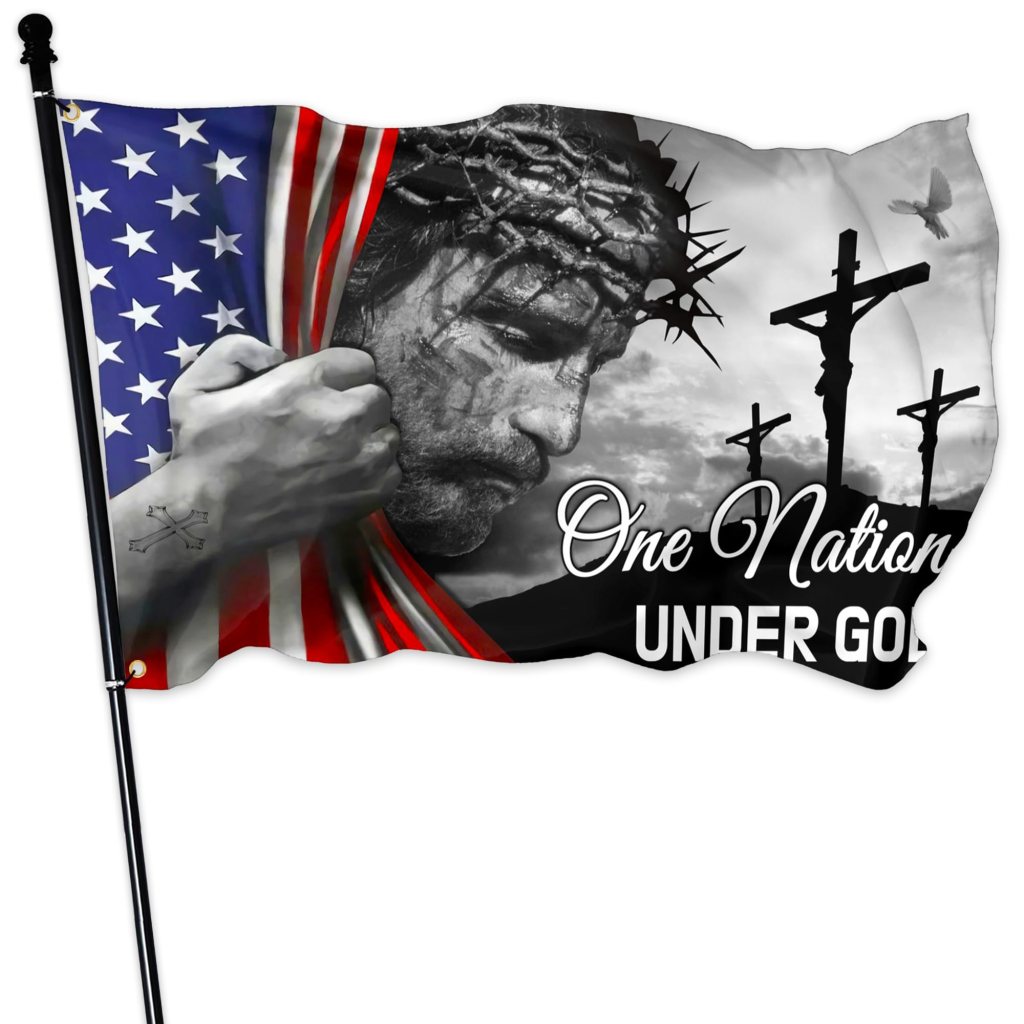
To turn society toward God, the people need to be pointed His way. This is done one individual at a time. We have lost a lot, but God is still the one in charge. His ability to change hearts is our best bet if we wish to move America forward to a more Biblical culture. God still has people here; He’s still working here; His love is still apparent here. Let’s rejoice that God has not given up on us, that this is still one nation under God.

