
How Omni is God?

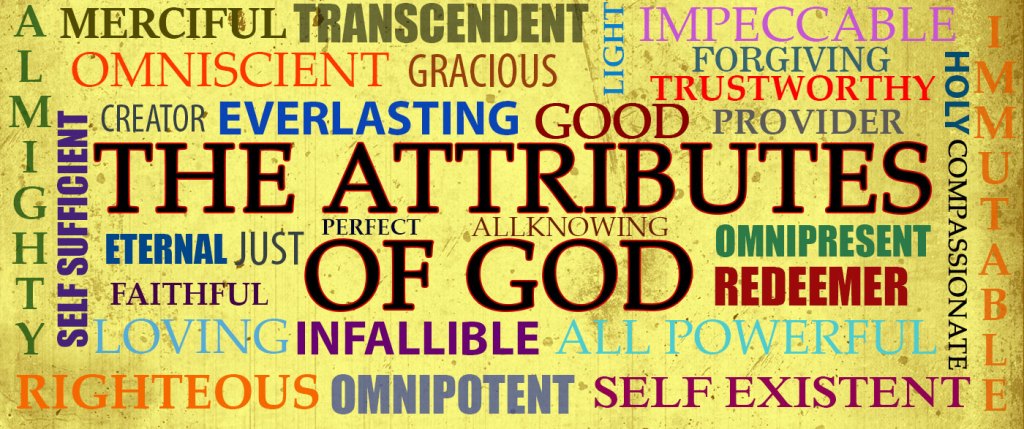
When we talk about God’s infinite nature, we usually talk about the three “omnis”: His omniscience (infinite knowledge), omnipotence (infinite power), and His omnipresence (infinite presence).  But other attributes of God are infinite as well: holiness, love, grace/mercy, and eternity, for instance.

Before we get into those, though, I’d like to look again at what infinity is.  There are two types of infinity related to duration: actual and potential infinity.  God is actually infinite.  That is, God has always existed from eternity past and will always exist to eternity future.  You and I are potentially infinite.  We had a beginning, but we will live forever.  There is no end to our existence. 

Where God cannot number His days, we can.  Though there will be no end to our existence, the number of days we exist, assuming time will always be measured in days, will always have a number.  There are about ten to the eightieth power electrons in the universe (ten octodecillion).  While that is a very large number, it is still an actual number that can be divided, added to, subtracted from, and multiplied. 

Infinity is larger than that.  Infinity is a number so large that it cannot change value when you add, multiply, divide, or subtract from it (except to divide or subtract infinity from itself).  It’s really so large, we can’t wrap our heads around it.  Let’s look at an old description of infinity just to add to the confusion:

Imagine a library with an infinite number of books.  In that library, there is an infinite number of red books and an infinite number of black books.  Each book has an infinite number of pages.  With this example, there is the same total number of books as there are red books.  There is the same number of pages in one book as there are pages in all the books combined, and the same total number of books.

It doesn’t make sense to our finite minds, but this is the concept of infinity.

Now, how infinite is God? God is infinite in His power (God doesn’t make logical contradictions such as square circles, but all His purposes are irresistible):

Luke 1:37 (ESV)  For with God nothing will be impossible.

                Job 42:2 (ESV)  “I know that You can do everything, And that no purpose of Yours can be withheld from You.”

God is infinite in His knowledge (all things actual, possible, past present and future):

                Psalm 147:5 (ESV)  Great is our Lord, and mighty in power; His understanding is infinite.

God is infinitely present (His being is not spread out but the entirety of His being is everywhere):

        Jer. 23:24 (ESV)  Can anyone hide himself in secret places, So I shall not see him?” says the Lord; “Do I not fill heaven and earth?” says the Lord.

God is infinitely Holy (absolute moral perfection and separation from sin)

Isa. 6:3 (ESV)  And one cried to another and said:  “Holy, holy, holy is the Lord of hosts; The whole earth is full of His glory!”

God’s love is infinite (immeasurable and eternal)

        Eph. 3:19 (ESV)  and to know the love of Christ that surpasses knowledge, that you may be filled with all the fullness of God.

God’s grace and mercy are infinite (it is eternal)

Psalm 136:1 (ESV)  Give thanks to the Lord, for he is good, for his steadfast love endures forever.

God’s duration is infinite (past, present, and future)

       Psalm 90:2 (ESV)  Before the mountains were brought forth, or ever you had formed the earth and the world, from everlasting to everlasting you are God.

Why is this important?

Our God is infinite beyond all human understanding, but don’t feel inadequate.  We’re not alone in our ignorance. No one understands God except He Himself:

                1 Cor. 2:11 (ESV)  So also no one comprehends the thoughts of God except the Spirit of God.

Hopefully, we see from this how truly great and grand the God we serve is.  There is none greater.  He is the one true God and the only God with whom we have to do.

The Woman Caught in Adultery

John 8:1-11 (NASB)  But Jesus went to the Mount of Olives. 2 And early in the morning He came again into the temple, and all the people were coming to Him; and He sat down and began to teach them. 3 And the scribes and the Pharisees *brought a woman caught in adultery, and having set her in the midst, 4 they *said to Him, “Teacher, this woman has been caught in adultery, in the very act. 5 “Now in the Law Moses commanded us to stone such women; what then do You say?” 6 And they were saying this, testing Him, in order that they might have grounds for accusing Him. But Jesus stooped down, and with His finger wrote on the ground. 7 But when they persisted in asking Him, He straightened up, and said to them, “He who is without sin among you, let him be the first to throw a stone at her.” 8 And again He stooped down, and wrote on the ground. 9 And when they heard it, they began to go out one by one, beginning with the older ones, and He was left alone, and the woman, where she was, in the midst. 10 And straightening up, Jesus said to her, “Woman, where are they? Did no one condemn you?” 11 And she said, “No one, Lord.” And Jesus said, “Neither do I condemn you; go your way. From now on sin no more.”

This story of the woman caught in adultery is an interesting passage of Scripture as are all passages of Scripture.  This one is disputed as to whether it is actually Scripture, though.  The story doesn’t appear in the earliest manuscripts of the New Testament but is possibly referred to by the Church Father, Papias (60 – 130 a.d.).  Since it doesn’t appear in a New Testament Manuscript until the fifth century, many scholars believe it was not included in the original text.  Greek Scholar, F. F. Bruce, doesn’t even include it in his commentary on the Gospel of John because of this belief.

Other scholars believe it appeared in the original autographs but was removed because the early church thought it treated adultery less severely than it should.  Adultery was apparently a problem in the early church perhaps due to the Roman and Greek culture of having a wife and a mistress.

A third camp believes this is a not Scripture but is a true historical event in which Jesus did address the adulterous woman and her Pharisee accusers.  They believe this because the story appears in early extrabiblical writings such as Papias (60-130 a.d.), Didascalia Apostolorum (c. 230 a.d.), Ambrose of Milan (c. 340-397 a.d.), and Augustine (354-439).  It also appears in the Latin Vulgate translated in the late fourth Century.  The earliest it appears in a New Testament manuscript is in one of our earliest full version of the New Testament, Codex Bezae (c. 400 a.d.) and Codex Washingtonianus dated about the same time and contains most of the four gospels.

The story doesn’t always appear in John chapter eight either.  Sometimes it appears in chapter 21 and even in Luke.  Again, this leads some to think either it was removed and copiests didn’t know where to reinsert the story, or it was a non-biblical but actual historical event which some copiests wanted to include in the gospel.

I’m going to take the view it is Scripture until proven otherwise.  Now let’s look a little at the text.  There are some fascinating points to make here.

In verses six and eight, Jesus writes in the dirt.  This is the only place in the New Testament where Jesus writes anything.  In Exodus 31:18, God (YHWH) uses His finger to write His Law in stone: (NASB)  And when He had finished speaking with him upon Mount Sinai, He gave Moses the two tablets of the testimony, tablets of stone, written by the finger of God.

Leviticus 20:10 says the Pharisees in our story should have brought the man who was committing adultery as well, and they were both to be stoned:  (NASB)  “If a man commits adultery with the wife of his neighbor, both the adulterer and the adulteress shall surely be put to death.”

According to Deut. 17:7, the witnesses to the offense were to be the first to cast the stones:

(ESV) The hand of the witnesses shall be first against him to put him to death, and afterward the hand of all the people. So you shall purge the evil from your midst.

So, legally, there was no one to pass judgment on the adulteress.  Her accusers had left. Remember she was still under the Law.  Jesus had not died and risen yet to bring on the New Testament Age.  And, there was to be no divine judgment either since Jesus did not condemn her.

On a lighter note, the last sentence in the passage, “From now on sin no more,” bothered me.  I asked Jesus several times in prayer why He would say that.  The woman was born with a sin nature just as you and I were.  She was going to sin again, maybe not commit adultery again, but she would sin. 

I sometimes think my questions are Jesus’ current main source of laughter.  He finally told me “Did you expect Me to say, ‘sin no more, and please cut back on the adultery?’”  I got the point. Absolute holiness is our goal, and we can only achieve that through God’s forgiveness.

Why is this important?

We receive criticism from all sides as Christians.  Many of these criticisms are directed at the reliability of Scripture.  Some will say we have included disputed passages in our Bibles, and we need to have an answer for them.  This is one.